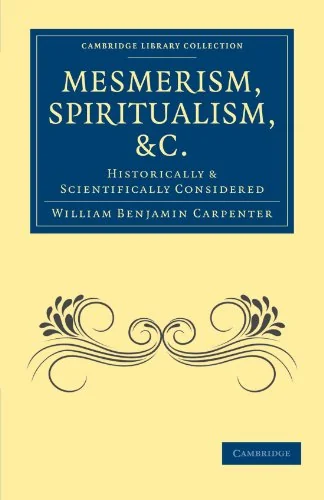
Mesmerism, Spiritualism, Etc.: Historically and Scientifically Considered
A medical professional's scientific analysis of nineteenth-century spiritualism and mesmerism.
This work presents the research of William Benjamin Carpenter, a London-based physician who studied the nervous system. He applied his medical expertise to evaluate questions surrounding the relationship between the mind, body, and spirit. The text is part of a broader collection on history and political science theory. It addresses the intersection of physiological study and spiritualist beliefs in Great Britain. The book does not provide instructions for ritual practice. It serves as a historical record of scientific inquiry into mystical topics. Readers interested in the evolution of medical thought regarding consciousness will find this volume relevant. It is not designed for those looking for esoteric instruction or modern magical theory.
This text originates from Great Britain and Europe during the period of William Benjamin Carpenter’s life (1813-1885). It reflects the scientific discourse of that era regarding physiology and the nervous system. The work is published by Cambridge University Press in January 2011, addressing historical and political science contexts.


📝 Description: Mesmerism, Spiritualism, Etc.: Historically and Scientifically Considered
💎 Expert review
📖 Why choose it
Why this book is worth reading
Readers fascinated by the intersection of science and spirituality will find immense value in this rigorous analysis. It offers a unique window into how distinguished physicians of the past attempted to rationalize the inexplicable through physiological lenses. If you are interested in the history of psychology, the skepticism surrounding Victorian spiritual phenomena, or the evolution of scientific thought regarding altered states of consciousness, this book provides essential context. It appeals to those who appreciate historical medical literature and wish to understand the intellectual climate that shaped modern approaches to the mind-body connection.
⭐ Reader reviews
Reader rating
Carpenter’s work is a vital resource for historians of science and esotericism, offering a meticulous dissection of Victorian spiritual phenomena through a skeptical, analytical lens. It successfully illuminates the physiological underpinnings of mesmerism for those seeking academic depth. However, it is strictly not suited for readers seeking supernatural validation or casual entertainment. Those expecting easy answers or mystical insights will likely find the tone too dry and clinical. Furthermore, generalists unfamiliar with 19th-century medical terminology may struggle with its dense, scholarly approach to unmasking the unseen.
❓ Frequently asked questions
📖 Who should read this
If you're fascinated by the historical intersection of science and the esoteric, or a seeker of rational explanations for the unexplained, this book is for you. It's a foundational text for understanding skepticism's role in spiritual inquiry.
🎯 Key themes and symbolism
Scientific Scrutiny
Carpenter champions the scientific method as the ultimate tool for understanding seemingly inexplicable phenomena. He methodically examines claims of spiritual communication and mesmerist trances, seeking empirical evidence and physiological explanations rather than accepting supernatural interpretations. His work exemplifies the era's growing commitment to rational inquiry over superstition.
Mind-Body Dynamics
A central focus is the profound interplay between our mental and physical states. Carpenter explores how psychological suggestion, nervous system responses, and altered consciousness can manifest in ways perceived as mystical or miraculous. He posits that many spiritual experiences originate within the subject's own physiological and psychological framework, rather than external forces.
Demystifying the Occult
This book acts as a critical deconstruction of popular occult practices of its time. Carpenter aims to strip away the mystique surrounding mesmerism and spiritualist séances, offering logical, often physiological, explanations for their effects. He challenges readers to consider the human element—belief, suggestion, and self-deception—as powerful forces behind perceived wonders.
📜 Historical context
📚 Glossary
- Mesmerism
- Spiritualism
- Physiology
📔 Questions to reflect on
- How do contemporary scientific understandings challenge or affirm your personal beliefs about unexplained phenomena or spiritual experiences?
- Reflect on a time you witnessed something you couldn't immediately explain. How did your personal biases or expectations influence your interpretation of the event?
- In what ways can a critical, scientific approach enhance rather than diminish the wonder or depth of human spiritual exploration?
📖 Read on the blog
📖 From the series “Cambridge Library Collection - Spiritualism and Esoteric Kno”
All books in the series →


🏛 Books from this publisher Cambridge University Press
All books from this publisher →
You might also like
See more →


Have a question about this item?
Ask about the edition, condition, delivery or anything else — we reply by email or phone, usually within a day.
