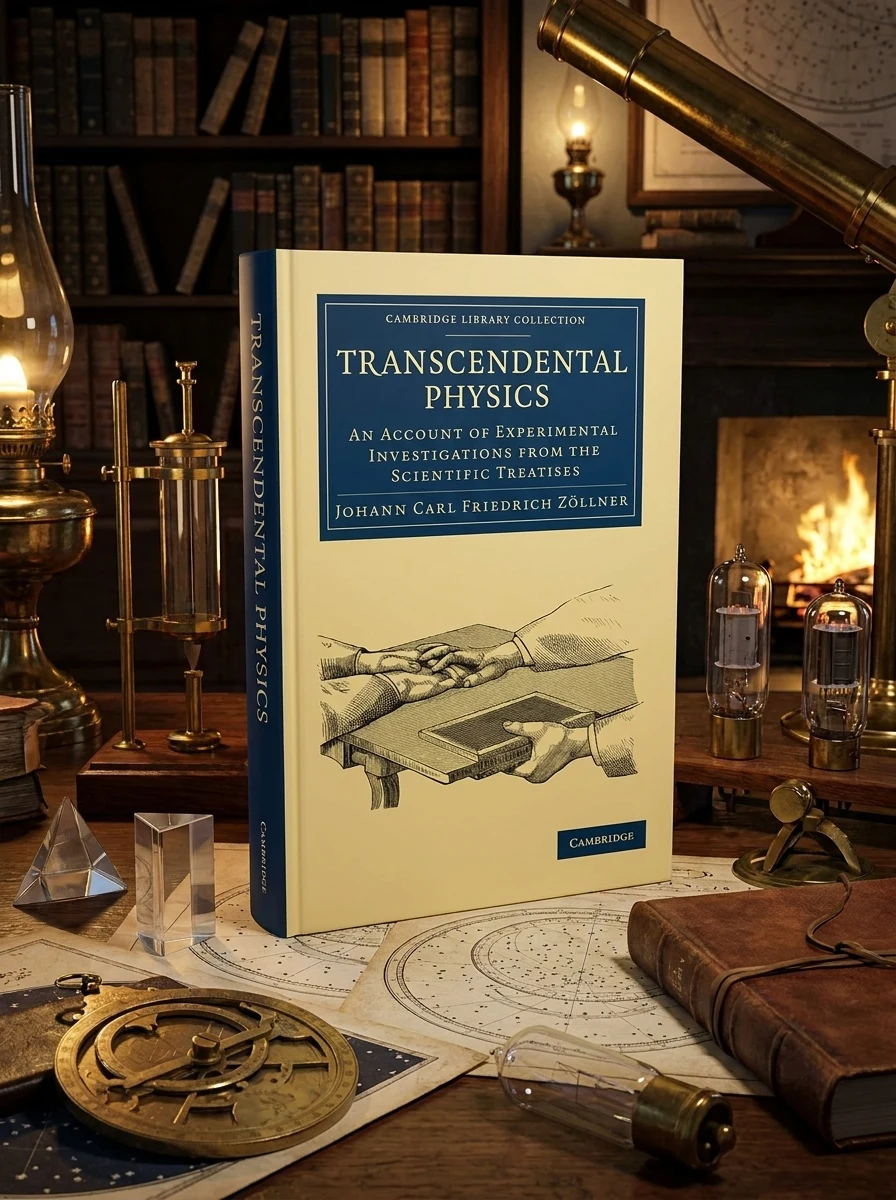

Transcendental Physics Zöllner, Johann Carl Friedrich
Step into the mind of Johann Zöllner, a brilliant astrophysicist who, despite his scientific renown, embarked on a controversial quest: to apply rigorous empirical methods to the enigmatic phenomena of spiritualism. This groundbreaking work meticulously documents his experiments and observations, seeking to bridge the chasm between the quantifiable physical realm and the purported manifestations of the spirit world. It's a fascinating look at a scientific intellect grappling with the inexplicable, pushing the very boundaries of what was considered knowable in his era.


📝 Description: Transcendental Physics Zöllner, Johann Carl Friedrich
💎 Expert review
📖 Why choose it
Why this book is worth reading
Readers interested in the history of science will find this book indispensable for understanding how a renowned astrophysicist attempted to quantify the spirit world. It offers a rare glimpse into a mind that refused to abandon empirical methods even when exploring the most elusive phenomena. Those fascinated by the tension between established scientific orthodoxy and spiritualist beliefs will appreciate Zöllner's courageous, albeit controversial, quest to bridge these chasms. This work is essential for anyone seeking to understand how the boundaries of knowledge were tested and expanded during a period of profound intellectual transition.
⭐ Reader reviews
Reader rating
This text is a compelling historical artifact for those interested in the sociology of science and the specific era's struggle with spiritualism. However, it is absolutely not suited for readers seeking modern physics explanations or straightforward paranormal validation. The rigorous empirical approach may feel dry to those expecting mystical revelations, while contemporary physicists might find the theoretical framework outdated. It serves best as a primary source document rather than a practical guide, appealing only to those who value historical context over current scientific consensus.
❓ Frequently asked questions
📖 Who should read this
If you're drawn to the compelling crossroads of science and the mystical, or curious about the historical attempts to rationalize the paranormal through a scientific lens, this work offers an unparalleled perspective. It's perfect for those who appreciate intellectual daring and profound philosophical inquiry.
🎯 Key themes and symbolism
Scientific Spiritualism
Zöllner's work stands as a unique attempt to subject alleged spiritualist occurrences to strict scientific scrutiny. He approached mediums and their purported abilities not with blind faith, but with instruments and a physicist's analytical mind, aiming to quantify and understand what others dismissed as trickery or delusion. It's a testament to his bold, if controversial, intellectual curiosity.
The Nature of Reality
This book provocatively challenges conventional understandings of physical reality. Zöllner hypothesizes that spiritual phenomena might operate through higher dimensions or forces not yet recognized by mainstream physics. He invites readers to consider a universe far more complex and interconnected than typically conceived, where the mind might interact with matter in profound, unacknowledged ways.
Empirical vs. Esoteric
At its heart, Zöllner's 'Transcendental Physics' explores the tension between empirical observation and esoteric claims. He meticulously details his experiments, attempting to bring the precision of the laboratory to the séance room. This creates a compelling dialogue about the limits of scientific inquiry and whether certain phenomena, by their very nature, resist conventional measurement, or if our tools merely need refinement.
📜 Historical context
📚 Glossary
- Transcendental Physics
- Spiritualism
- Astrophysics
📔 Questions to reflect on
- How does Zöllner's established scientific background influence both the strengths and potential limitations of his approach to spiritual phenomena?
- Consider the societal and scientific implications if Zöllner's 'transcendental physics' were widely accepted as a legitimate field of study today.
- Where do you personally draw the line between rigorous scientific inquiry and what might be considered pseudoscientific belief, and how does Zöllner's work challenge that line?