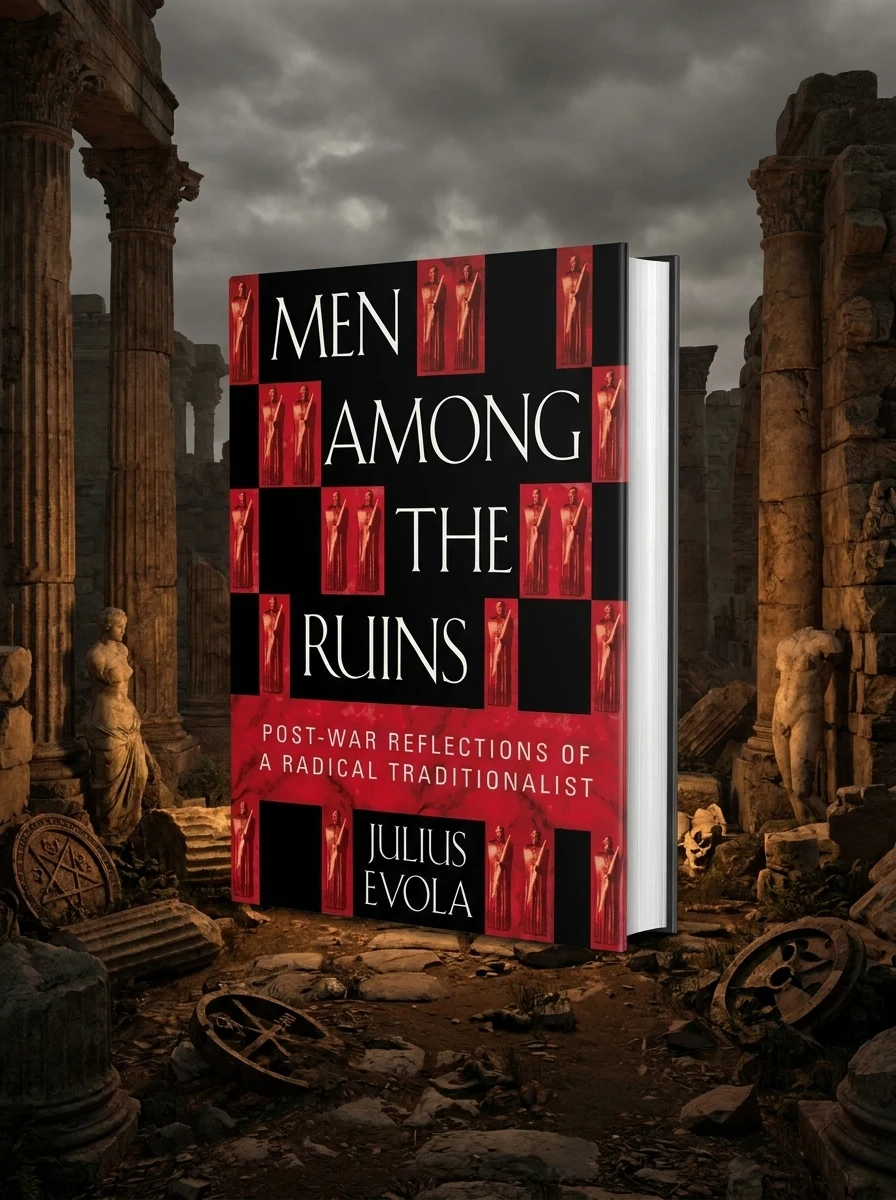
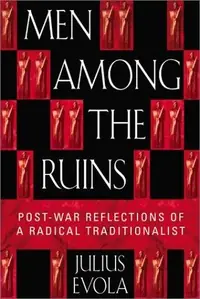
Men Among the Ruins: Postwar Reflections of a Radical Traditionalist
Evola, Julius

This edition can be ordered. No arrival date is confirmed.
Uncover the hidden spiritual war eroding modern civilization and reclaim ancient wisdom.
Julius Evola’s profound work meticulously dissects the perceived decline of contemporary society, interpreting its crises not merely as political or economic failures but as manifestations of a deeper, ongoing spiritual conflict. Drawing parallels with the Hindu concept of the Kali Yuga, Evola posits that a 'secret occult war' actively undermines traditional values and spiritual integrity, rendering humanity passive and vulnerable. This book challenges the pervasive materialism and the illusion of continuous progress, offering a radical traditionalist perspective on the fundamental forces shaping our turbulent modern age. It's an urgent call to recognize the true nature of the forces at play.
This work anchors itself firmly within the radical traditionalist movement, specifically drawing upon Hindu cosmological concepts like the Kali Yuga to frame modern societal decline as part of a deeper spiritual conflict.


📝 Description: Men Among the Ruins: Postwar Reflections of a Radical Traditionalist
💎 Expert review
📖 Why choose it
Why this book is worth reading
Readers seeking to understand the esoteric underpinnings of contemporary cultural decay will find this text indispensable. It appeals to those disillusioned by materialism who desire a rigorous, albeit radical, framework for interpreting modern crises as symptoms of spiritual erosion. The book offers a compelling narrative of hidden forces at work, providing intellectual tools to reclaim ancient wisdom against the tide of passive vulnerability. For the dedicated student of occult philosophy, it serves as a vital map through the ruins of modernity, urging active recognition of the spiritual war that defines our turbulent age.
⭐ Reader reviews
Reader rating
Evola presents a dense, uncompromising analysis that demands significant intellectual effort from its audience. While intellectually stimulating for those aligned with traditionalist thought, this book is decidedly not suited for casual readers or those seeking optimistic, progressive narratives about human advancement. It rejects the illusion of continuous progress in favor of a stark, often grim, view of civilizational decline. Readers expecting light, accessible prose or hopeful solutions will likely find the tone oppressive and the arguments polarizing. It is strictly for those already committed to the radical traditionalist perspective.
❓ Frequently asked questions
📖 Who should read this
If you question the foundations of contemporary society, seek explanations beyond conventional narratives for global crises, or are drawn to esoteric interpretations of history and spirituality, this profound work offers a challenging perspective. It's for those willing to confront radical anti-modern thought.
🎯 Key themes and symbolism
The Age of Decline
Evola argues that humanity currently resides in a period of pervasive spiritual and social decay, akin to the Hindu Kali Yuga or the Germanic Ragnarok. This theme explores how modern institutions and prevalent ideologies contribute to a widespread decadence, rather than fostering genuine advancement or well-being, presenting a stark counter-narrative to the idea of inevitable progress.
Occult War on Values
Central to Evola's thesis is the concept of a hidden, spiritual struggle against traditional and sacred principles. He posits that the crises of modern life are not random but are orchestrated elements of a larger, unseen conflict designed to eradicate spiritual foundations and transform individuals into compliant, materialistic beings. This offers an esoteric explanation for societal ills.
Radical Traditionalism Advocated
The book champions a return to perennial spiritual truths and an aristocratic, hierarchical worldview as an antidote to modern chaos. Evola contrasts these immutable, transcendent principles with the fleeting, materialistic, and egalitarian ideals of contemporary society. It's a powerful argument for a philosophy rooted in ancient wisdom, standing against the currents of modernity.
💬 Quotes from the book
“The notion of continuous progress is a narcotic illusion, blinding humanity to its accelerating descent into spiritual void.”
“True power lies not in material accumulation, but in the unwavering adherence to principles that transcend temporal decay.”
📜 Historical context
📚 Glossary
- Kali Yuga
- Traditionalism
- Occult War
📔 Questions to reflect on
- How do I perceive 'progress' in my own life and society, and how might Evola's critique challenge or confirm this view?
- Where do I observe evidence of a 'spiritual decline' or an 'occult war' against traditional values in contemporary culture, if at all?
- What traditional values or principles, if any, do I believe are essential for human flourishing today, and how might they be upheld in a modern context?
✍️ More books by this author Evola, Julius
All books by this author →

🏛 Books from this publisher Inner Traditions International
All books from this publisher →



You might also like
See more →