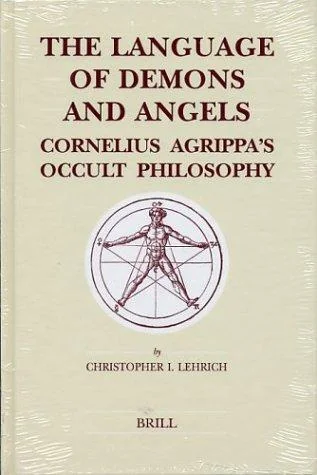
The Language of Demons and Angels - Ingram Academic Lehrich, Christopher I
✍️ Lehrich, Christopher IThis groundbreaking study delves into the esoteric systems and forgotten lexicons used to engage with celestial and chthonic powers. It explores how ancient and medieval thinkers conceived of divine and demonic communication, not merely as abstract concepts, but as tangible forces shaping spiritual and physical realities. With a unique focus on how these "languages" manifest in sacred architecture and ritual design, the book offers a scholarly yet accessible journey through the historical intersections of mysticism, philosophy, and the built environment, revealing profound insights into humanity's enduring quest to understand the unseen.


📝 Description: The Language of Demons and Angels - Ingram Academic Lehrich, Christopher I
📑 What's inside
- Acknowledgements Abbreviations List of Illustrations 1. Introduction 2. Logos and nature 3. Sign, Sigil, Text 4. The Language of Demons and Angels 5. Conclusion Appendix I. Latin Quotations,
- De occulta philosophia Appendix II
- De vanitate on Alchemy Bibliography Index
💎 Expert review
📖 Why choose it
Why this book is worth reading
Scholars and serious practitioners of the occult will find this text indispensable for its rigorous exploration of how divine and demonic languages functioned as tangible forces. Readers interested in the historical mechanics of mysticism, particularly those curious about how spiritual concepts were embedded in physical spaces like sacred architecture, will gain profound insights. It is ideal for those seeking to understand the intellectual frameworks that shaped humanity's quest to engage with the unseen, offering a scholarly yet accessible path through complex esoteric systems without sacrificing depth or academic integrity.
⭐ Reader reviews
Reader rating
Lehrich delivers a groundbreaking study that meticulously unpacks the forgotten lexicons of celestial and infernal communication. The book’s strength lies in its unique focus on how these linguistic systems manifested in ritual design and built environments, providing a fresh perspective on historical mysticism. However, readers seeking quick, practical spellcasting guides or light entertainment will find this dry and overly academic. It is strictly for those willing to engage with dense philosophical arguments and historical analysis. The work demands patience and a strong interest in the theoretical underpinnings of esoteric traditions rather than immediate mystical application.
❓ Frequently asked questions
📖 Who should read this
For seekers of forgotten lore, students of medieval history, or anyone fascinated by the intersection of spirituality, philosophy, and architectural symbolism. If you're drawn to the intricate systems humans devised to commune with the unknown, this scholarly exploration awaits your discerning eye.
🎯 Key themes and symbolism
Celestial & Chthonic Tongues
Explores the varied interpretations and practical applications of "language" when communicating with non-human entities, from divine hymns to infernal incantations, charting historical efforts to decipher and utilize these powerful symbolic systems across different traditions and epochs.
Medieval Esoteric Traditions
Examines how philosophical and mystical currents of the European Middle Ages shaped understandings of angels and demons. It delves into the theological debates, magical practices, and esoteric texts that sought to categorize and interact with these beings, highlighting their cultural impact.
Architecture of the Unseen
Uniquely investigates the interplay between spiritual beliefs and the physical world, showing how concepts of angelic and demonic influence were embedded in architectural design, sacred spaces, and ritualistic environments, reflecting humanity's attempts to bridge earthly and spiritual realms.
📜 Historical context
📚 Glossary
- Angelology
- Demonology
- Esoteric
📔 Questions to reflect on
- How might our modern understanding of communication, often focused on verbal or digital forms, limit our perception of non-human or spiritual 'languages'?
- Consider a sacred space you know (a temple, church, ancient ruin). How do its architectural elements or design choices reflect a hidden 'language' or attempt to connect with unseen forces?
- If angels and demons possess distinct 'languages,' what might these reveal about their nature or purpose, beyond simple binary notions of good and evil?