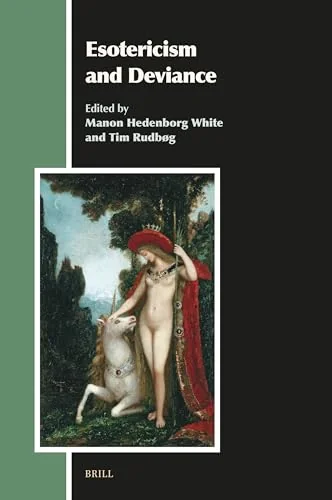
Esotericism and Deviance - Ingram Academic Hedenborg White, Manon
This groundbreaking volume meticulously examines the intricate relationship between esoteric traditions and the concept of deviance across millennia. From ancient mystery cults to contemporary spiritual movements, it investigates how society has historically perceived and labeled alternative spiritual paths as transgressive. The work offers both profound theoretical frameworks and richly detailed empirical studies, providing an unprecedented academic lens on how "othered" spiritual practices have shaped, and been shaped by, normative cultural boundaries.


📝 Description: Esotericism and Deviance - Ingram Academic Hedenborg White, Manon
💎 Expert review
📖 Why choose it
Why this book is worth reading
Scholars and serious practitioners will find this text invaluable for understanding how spiritual paths are constructed as 'other' by dominant cultures. It offers a rare theoretical depth, connecting ancient mystery cults to modern movements through the lens of deviance. Readers interested in the sociology of religion, the politics of knowledge, or the historical marginalization of occult practices will gain a robust framework for analyzing these dynamics. It is essential for those seeking to move beyond superficial descriptions of esotericism into its complex social ramifications.
⭐ Reader reviews
Reader rating
While intellectually rigorous and groundbreaking, this work is strictly academic and may alienate casual readers or those seeking practical ritual guidance. It does not suit those looking for accessible introductions to magic or history without dense theoretical jargon. However, for researchers examining the intersection of normativity and transgression in spiritual contexts, it provides an indispensable empirical and theoretical foundation that few other texts match.
❓ Frequently asked questions
📖 Who should read this
If you're fascinated by the social dynamics of belief, the historical persecution of mystics, or the philosophical boundaries of accepted spirituality, this book will illuminate overlooked facets of occult history. It's essential for anyone pondering the societal impact of alternative spiritual paths.
🎯 Key themes and symbolism
History of Esoteric Deviance
This book traces the shifting definitions of deviance applied to esoteric practices from ancient times through modern eras. It reveals how perceptions of the "other" in spirituality have evolved, highlighting the continuous tension between established norms and alternative mystical pursuits.
Conceptualizing Esoteric Transgression
The authors introduce robust theoretical models to understand how esotericism is categorized as deviant. They explore the sociological, philosophical, and religious underpinnings of these classifications, offering new perspectives on the mechanisms by which certain spiritual paths become marginalized or demonized.
Case Studies in Othered Spirituality
Through a series of compelling empirical examples, the work illustrates how specific esoteric groups and individuals have been labeled and treated as deviant. These practical applications of the theoretical framework provide concrete insights into the lived experiences of those pursuing non-mainstream spiritual paths.
📜 Historical context
📚 Glossary
- Esotericism
- Deviance
- Late Modernity
📔 Questions to reflect on
- How have your own perceptions of "deviant" spiritual practices been shaped by societal norms or media representations?
- Can you identify historical or contemporary examples where esoteric knowledge was deliberately suppressed or demonized, and what were the consequences?
- In what ways might labeling something as "deviant" inadvertently empower or strengthen its adherents, rather than diminish them?