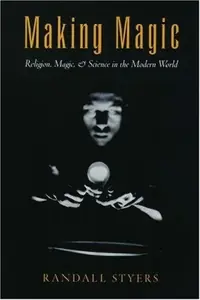
Making Magic: Religion, Magic, and Science in the Modern World Styers, Randall
Stock reported in the catalog; fulfillment is confirmed with your request.
Unmasking magic's hidden role in shaping modern identity and academic thought.
Randall Styers delves into how the concept of "magic" has been continually employed by academic disciplines like religious studies and social sciences, despite its persistently vague definition. He contends that this enduring, yet ill-defined, notion isn't a failure, but rather a deliberate and functional mechanism. Styers reveals that "magic" serves as a crucial conceptual counterpoint, enabling Western society to articulate and reinforce its self-perceived modern norms of rationality, piety, and social order by contrasting them with this constructed "other."
This work sits at the intersection of religious studies and social theory, examining how Western modernity constructs its identity through the conceptual rejection of 'magic.' It challenges essentialist views by treating magic as a functional category rather than a historical reality.


📝 Description: Making Magic: Religion, Magic, and Science in the Modern World Styers, Randall
💎 Expert review
📖 Why choose it
Why this book is worth reading
Readers interested in the philosophical underpinnings of modern thought will find this book indispensable for understanding how 'magic' functions as a critical counterpoint to Western rationality. It is ideal for scholars in religious studies who wish to deconstruct the vague but powerful definitions used by academia to reinforce norms of piety and social order. By revealing magic as a deliberate mechanism rather than a failed definition, Styers offers a profound lens through which to view modern identity formation, appealing to those who enjoy rigorous intellectual exploration of how societies define themselves against constructed 'others.'
⭐ Reader reviews
Reader rating
Styers presents a dense, theoretical argument that may frustrate readers seeking practical magical instruction or historical narratives. This is not a guide for practitioners but a critical analysis of academic discourse. Those expecting a straightforward history of occult practices will find little here, as the focus remains strictly on the sociological utility of the term. However, for those willing to engage with complex meta-theoretical discussions about how Western society polices the boundary between reason and superstition, this text offers a sharp, unmasking perspective on the very foundations of modern cultural identity.
❓ Frequently asked questions
📖 Who should read this
If you're a critical thinker interested in the sociology of knowledge, the history of academic disciplines, or how cultural concepts shape our understanding of modernity and self, this book offers profound insights. It's for those who question the underlying assumptions of how we categorize belief and practice.
🎯 Key themes and symbolism
Magic as Academic Tool
Styers demonstrates that rather than being an intrinsic phenomenon, "magic" functions as a conceptual device within academia. It helps scholars demarcate the boundaries between what they classify as legitimate religion and rational science, often positioning magic as a primitive or non-modern counterpart to these established categories, thus facilitating disciplinary self-definition.
Constructing Modern Identity
The book argues that the persistent scholarly engagement with "magic" is deeply intertwined with the Western endeavor to establish and maintain specific ideals of modernity. By framing magic as irrational or deviant, society reinforces its preferred norms of instrumental rationality, industriousness, conventional gender roles, and controlled desire, solidifying a particular modern self-image.
The Power of Alterity
Styers highlights how the concept of magic acts as a powerful signifier of "otherness." It is deployed to designate forms of deviance or difference against which dominant Western notions of appropriate religious practice, scientific thought, and social relations are clearly distinguished. This process of "othering" reinforces what is considered normal and acceptable within modern frameworks.
💬 Quotes from the book
“The persistent scholarly engagement with 'magic,' despite its stubbornly amorphous nature, reveals less about an inherent, universal phenomenon and more about the discursive needs of the disciplines themselves.”
“By consistently positioning 'magic' as the antithesis of modern scientific rigor and appropriate religious piety, Western thought has effectively forged a conceptual mirror, reflecting its own desired self-image.”
📜 Historical context
📚 Glossary
- Alterity
- Instrumental Rationality
- Amorphous
📔 Questions to reflect on
- Consider a time when you encountered something labeled "magic." How did that label shape your understanding or perception of it, and what might it have been contrasted against?
- How do modern societies continue to define 'rationality' and 'deviance,' and what 'others' are invoked in this process today?
- Reflect on the academic fields you are familiar with. Can you identify any concepts that, like 'magic,' are used more as boundary markers or conceptual tools than as clear, stable phenomena?
🏛 Books from this publisher Oxford University Press
All books from this publisher →
 81
81

You might also like
See more →