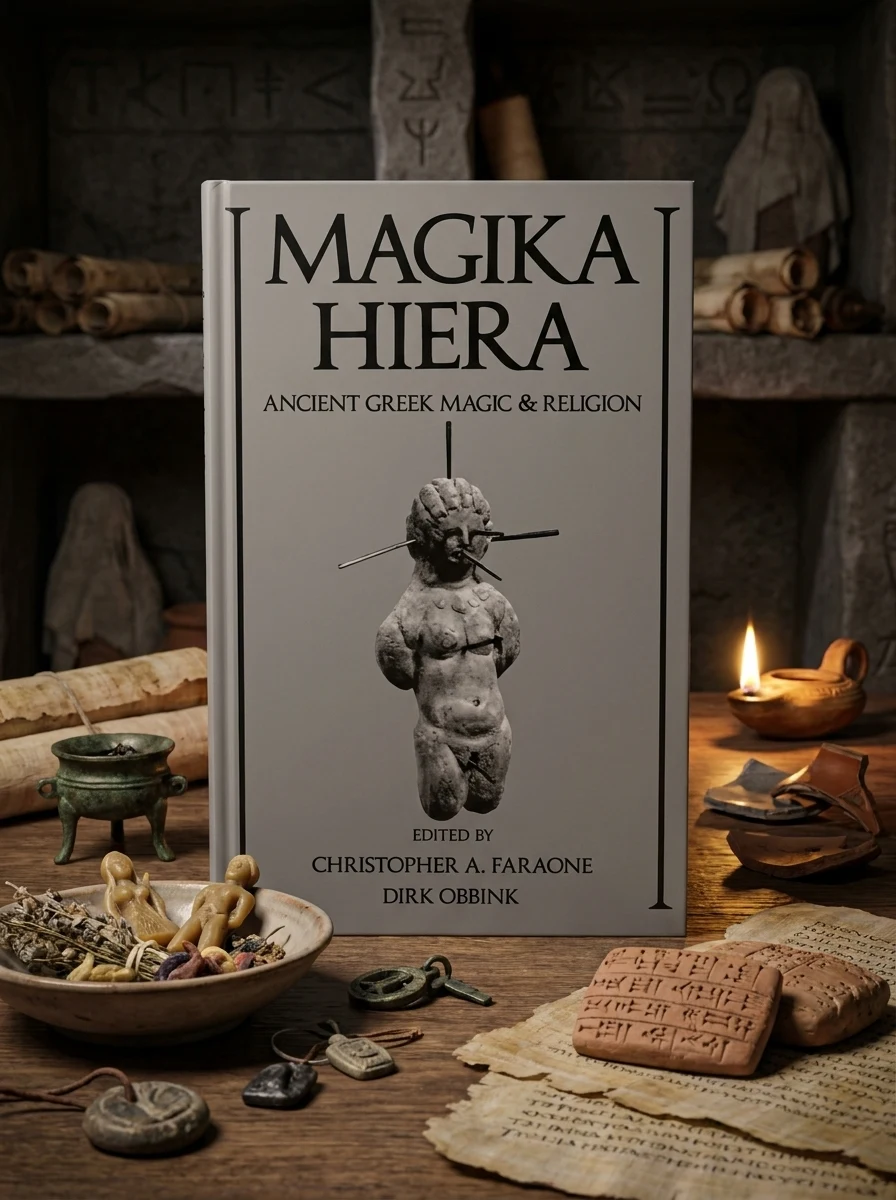
Magika Hiera: Ancient Greek Magic and Religion
✍️ Obbink Faraone, Christopher a Faraone, Dirk ObbinkA scholarly collection challenging the separation of magic and religion in ancient Greece.
This volume addresses a significant gap in classical studies by integrating magical practices into the study of Greek religion. The editors, Christopher A. Faraone and Dirk Obbink, compile ten distinct pieces that utilize epigraphical and archaeological data to reveal the complexity of ancient spiritual life. The work demonstrates that magical rituals were not peripheral but central to religious expression in Greece. By focusing on primary materials, the authors provide a nuanced view of how ancient people understood their interactions with the divine and the supernatural.
The book examines ancient Greece during the classical period, focusing on religious practices and magical rituals. It utilizes archaeological and epigraphical sources to understand how these elements functioned within the broader context of Greek spirituality and societal norms.


Praise for this book
“To assemble these 10 pieces on various aspects of ancient magic was an excellent idea....To do justice to the wealth of material presented and the intriguing new ideas which emerge one would have to write another book.”
“This excellent and thought-provoking book will be indispensable to all who study Gre k religion. It draws on a wealth of illuminating primary material.”
📝 Description: Magika Hiera: Ancient Greek Magic and Religion
💎 Expert review
📖 Why choose it
Why this book is worth reading
This book is essential for scholars and serious practitioners who feel that modern occultism often lacks historical depth or relies on anachronistic distinctions between magic and religion. By dismantling the rigid academic barriers that have long separated these fields, Faraone and Obbink offer a richly textured view of ancient Hellenic spirituality where ritual action and divine devotion were inseparable. Readers seeking to understand the authentic roots of ceremonial practice will find this collection invaluable, as it provides the archaeological and epigraphic evidence needed to reconstruct a more integrated spiritual framework. It invites you to look beyond superficial classifications and engage with the complex, nuanced reality of how ancient Greeks actually experienced their gods and manipulated the unseen forces around them.
⭐ Reader reviews
Reader rating
While intellectually robust, this collection is not for casual readers or those seeking practical spell-casting instructions. The text demands a strong background in classical studies, as it relies heavily on dense epigraphic analysis and archaeological interpretation rather than accessible narrative. It may frustrate practitioners looking for immediate esoteric application, as its primary goal is academic correction rather than occult instruction. However, for those willing to engage with rigorous scholarship, it offers a necessary corrective to modern misconceptions about ancient spirituality.
❓ Frequently asked questions
📖 Who should read this
If you're a serious student of ancient Greece, a scholar of religious history, or simply fascinated by the esoteric traditions of antiquity, this book will profoundly reshape your understanding. Prepare for a rigorous, yet illuminating, journey into the true spiritual landscape of the Hellenic world.
🎯 Key themes and symbolism
Blurred Sacred Boundaries
This collection meticulously deconstructs the artificial academic divide between religious worship and magical rites in ancient Greece. It demonstrates how ancient practitioners often viewed these practices as fluid and interchangeable, challenging modern categorizations that have distorted our understanding of their spiritual world and its complex dynamics.
Reclaiming Esoteric Practice
By re-evaluating long-overlooked or dismissed evidence, the contributors bring "magical" aspects of Greek spirituality back into the scholarly discourse. They highlight how spells, curses, amulets, and various forms of divination were not peripheral superstitions but often integral components of daily religious and social life.
Evidentiary Reconstruction
The book grounds its revolutionary arguments in a rich array of primary source materials. Drawing on archaeological discoveries, detailed epigraphic records (inscriptions), and newly interpreted textual fragments, it offers a robust, evidence-based perspective on the integrated nature of ancient Greek magic and religion, moving beyond speculative theories.
📜 Historical context
📚 Glossary
- Epigraphy
- Dichotomy
- Magika Hiera
📔 Questions to reflect on
- How do modern definitions of 'magic' and 'religion' influence our understanding of historical spiritual practices, and what biases might this introduce?
- Reflect on a contemporary spiritual or religious practice. Can you identify elements within it that, through a different historical or cultural lens, might be labeled as 'magical'?
- Consider the implications of viewing ancient Greek magic and religion as an integrated system. How might this change our perception of their worldview, ethics, and daily lives?
📖 Read on the blog
🏛 Books from this publisher Oxford University Press
All books from this publisher →




You might also like
See more →
Have a question about this item?
Ask about the edition, condition, delivery or anything else — we reply by email or phone, usually within a day.
