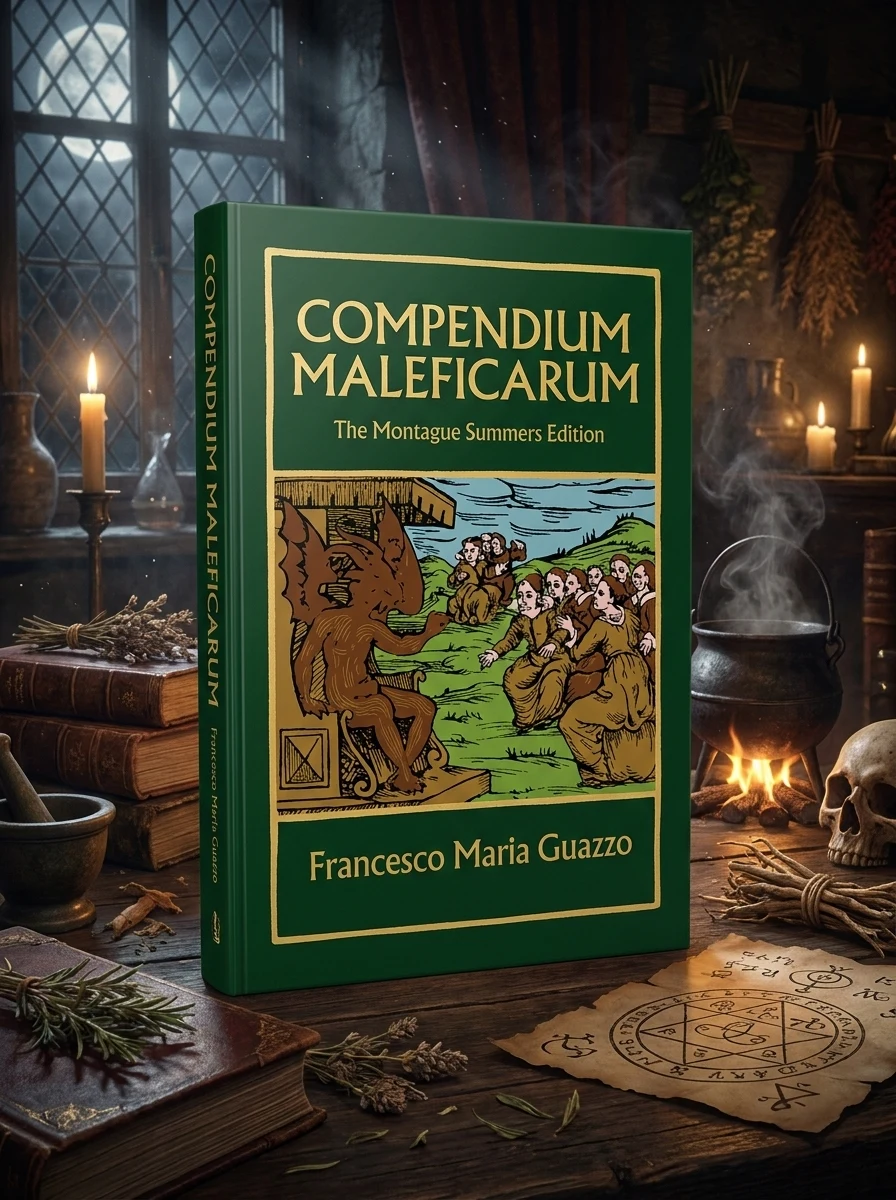
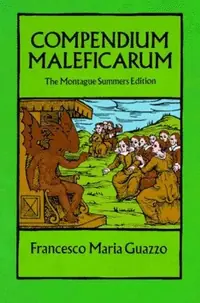
Compendium Maleficarum: The Montague Summers Edition Guazzo, Francesco Maria
Stock reported in the catalog; fulfillment is confirmed with your request.
A terrifying 1608 manual of witchcraft, revitalized by Montague Summers’ scholarly annotations.
This volume resurrects Francesco Maria Guazzo’s seminal 1608 treatise on the mechanics of sorcery, offering a raw window into the anxieties of the early seventeenth century. Guazzo, an Ambrosian monk, meticulously catalogs the perceived spread of demonic influence across all strata of society. Reproduced from a scarce 1929 printing, this edition is significantly enhanced by the erudite editorial notes of the renowned occultist Montague Summers. Together, they provide a comprehensive examination of witchcraft’s profession, detailing the satanic pacts and spiritual dangers that defined the era’s religious consciousness.
This text stands as a seminal artifact of early seventeenth-century religious consciousness, documenting the pervasive anxieties regarding demonic influence during that era. It bridges the gap between historical theological treatises and modern occult scholarship through its specific editorial lineage.


📝 Description: Compendium Maleficarum: The Montague Summers Edition Guazzo, Francesco Maria
💎 Expert review
📖 Why choose it
Why this book is worth reading
Scholars of historical witchcraft and enthusiasts of esoteric literature will find immense value in this volume, which offers a raw, unfiltered window into the mechanics of sorcery as perceived by an Ambrosian monk. The inclusion of Montague Summers’ erudite annotations elevates the text from a mere historical curiosity to a comprehensive examination of satanic pacts and spiritual dangers. By revitalizing Guazzo’s 1608 treatise, this edition provides essential context for understanding the religious anxieties that defined the period. It is particularly rewarding for those interested in the intersection of theology, fear, and the occult, offering a rare glimpse into how demonic influence was cataloged across all societal strata at the time.
⭐ Reader reviews
Reader rating
As someone who reads a lot in this field, I can be picky. The language takes some getting used to, but it becomes part of the charm. The symbolism is layered and generous to patient readers.
Needed this for my research. A text you study rather than simply read. Every rereading turns up something I missed. A keeper.
First purchase from this shop. It rewards patience more than any book I've bought this year. Still worth having on the shelf.
I keep coming back to this one. It connects ideas I'd only seen treated separately elsewhere. Every rereading turns up something I missed. One of my better finds this year.
Came across this title in a footnote and had to track it down. A text you study rather than simply read. Some chapters demand a slow, careful read, and that's exactly the point. My only quibble is the cover feels thinner than expected.
Exactly what I was looking for. The historical context alone makes it worth the price. The ideas are old but land with surprising force today. My only regret is not ordering it sooner.
This edition serves as a vital resource for serious students of occult history and early modern religious studies. However, it is not suited for casual readers seeking entertainment or those uncomfortable with dense theological arguments and archaic conceptualizations of evil. The text requires patience to navigate Guazzo’s meticulous cataloging of demonic influence alongside Summers’ scholarly commentary. Readers looking for a straightforward narrative or modern Wiccan practice guides will likely find the material dry and overly academic. It demands an appreciation for historical context and scholarly annotation, making it best suited for those willing to engage with the serious, anxious worldview of the early seventeenth century.
❓ Frequently asked questions
📖 Who should read this
Devotees of historical occultism, researchers of the witch-hunt era, and those fascinated by the theological intersection of medieval demonology and Renaissance society.
🎯 Key themes and symbolism
Demonic Pacts
Early Modern Witch Trials
Spiritual Warfare
💬 Quotes from the book
“Witchcraft and sorcery had 'spread in all directions,' leaving 'no country, town, village, or district' free.”
“Guarding against such seductions and manipulations by living piously.”
📜 Historical context
📚 Glossary
- Compendium
- Ambrosian
- Counter-Reformation
📔 Questions to reflect on
- How does the language of 'spread' and 'infection' in the text reflect contemporary fears of disease and moral decay?
- In what ways does the author’s clerical identity shape his perception of the witch as a spiritual adversary rather than a criminal?
- How might the 1929 publication context influence Montague Summers’ editorial choices compared to Guazzo’s original 1608 intent?
📖 From the series “Dover Occult”
All books in the series →
 90
90
🏛 Books from this publisher Dover Publications
All books from this publisher →


You might also like
See more →
 86
86
 82
82