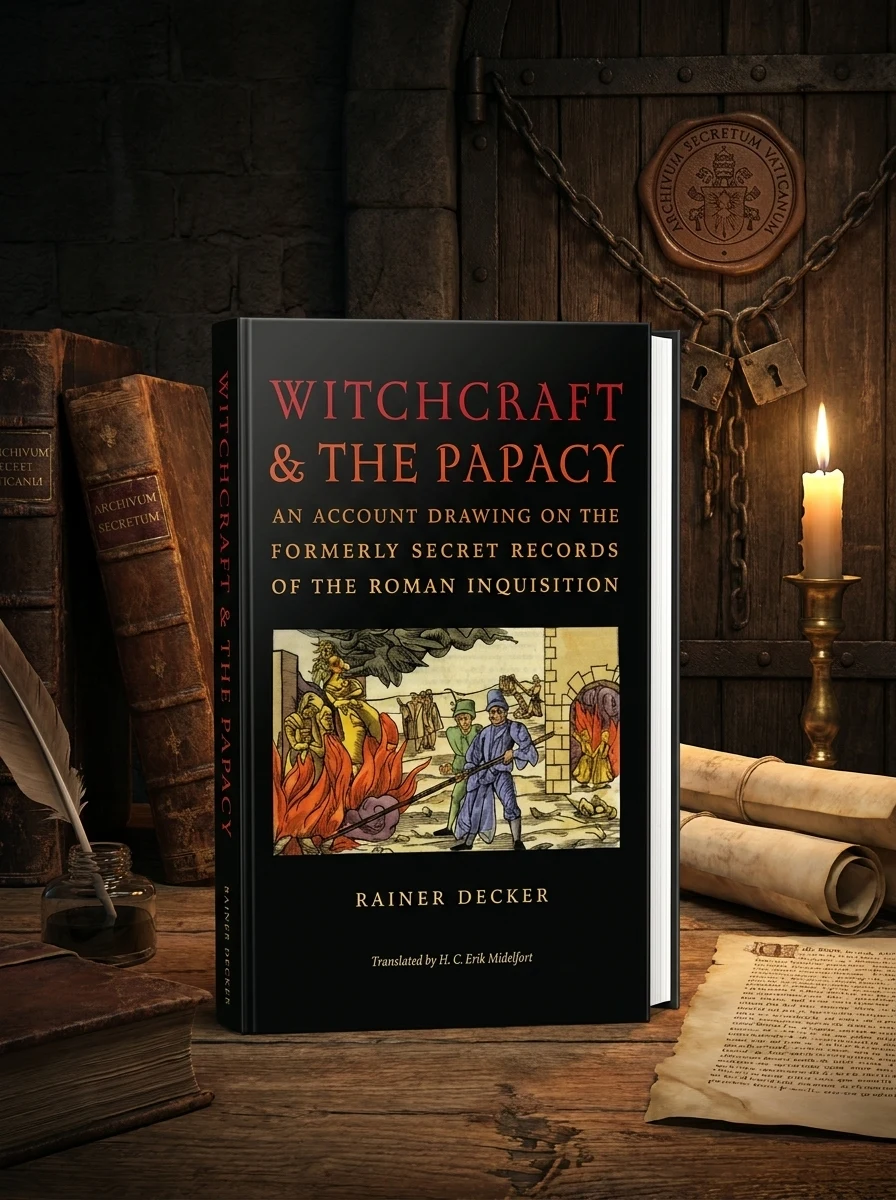
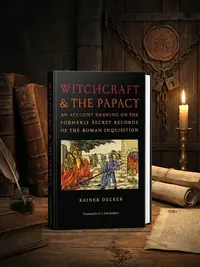
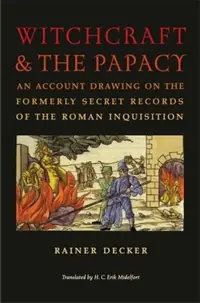
Witchcraft & the Papacy: An Account Drawing on the Formerly Secret Records of the Roman Inquisition Decker, Rainer
Stock reported in the catalog; fulfillment is confirmed with your request.
Unearth the Vatican's surprising role in witchcraft trials, challenging centuries of misconception.
Rainer Decker's groundbreaking research began with a surprising discovery: the Papacy acted as a skeptical force in a 17th-century German witch trial. His quest led him to the previously inaccessible Roman Inquisition archives. This volume, originally Die Päpste und die Hexen, reveals the Vatican's true stance on witchcraft prosecutions from the medieval era through the 18th century. Decker meticulously demonstrates how, contrary to popular belief, the post-medieval Papacy often exercised restraint, questioning accusations during Europe's most fervent witch-hunting periods. This work profoundly redefines our understanding of ecclesiastical involvement.
This work sits at the intersection of ecclesiastical history and the social study of witchcraft, challenging the prevailing narrative of uniform papal hostility toward alleged witches in early modern Europe. It contributes significantly to the revisionist scholarship that examines the complex relationship between religious authority and judicial processes during the witch-hunting era.


📝 Description: Witchcraft & the Papacy: An Account Drawing on the Formerly Secret Records of the Roman Inquisition Decker, Rainer
💎 Expert review
📖 Why choose it
Why this book is worth reading
Scholars, historians of religion, and readers interested in the nuanced dynamics of power during the early modern period will find this volume indispensable. Decker’s meticulous examination of previously inaccessible Roman Inquisition archives offers a revelatory counter-narrative to popular misconceptions about papal involvement in witch hunts. Readers seeking to understand how ecclesiastical authorities actually functioned behind the scenes, often exercising restraint rather than incitement, will gain a profound appreciation for the historical complexity of these trials. This book is essential for anyone willing to look past simplified myths to grasp the true stance of the Vatican during Europe's most fervent witch-hunting periods.
⭐ Reader reviews
Reader rating
Decker’s research provides a crucial corrective to long-held beliefs about the Papacy’s role in European witch trials, grounded in rigorous archival evidence. However, this text is not suited for casual readers seeking a dramatic narrative or simple condemnation of religious institutions. It requires patience and an interest in dense historical analysis rather than accessible storytelling. Those expecting a sensational exposé of papal villainy will be disappointed by the nuanced depiction of institutional skepticism and restraint. It is best appreciated by academic audiences or dedicated enthusiasts of ecclesiastical history who value primary source examination over dramatic flair, making it a specialized but vital contribution to the field.
❓ Frequently asked questions
📖 Who should read this
For anyone captivated by the history of magic, heresy, or seeking to challenge conventional narratives, this book is essential. It offers a sophisticated, archive-driven re-evaluation of the Church's complex relationship with witchcraft, perfect for scholars and dedicated enthusiasts.
🎯 Key themes and symbolism
Papal Skepticism & Restraint
This book challenges the popular narrative of an all-persecuting Church, illustrating instances where the Roman and Spanish Inquisitions, particularly the Papacy itself, actively questioned witch trial evidence. It reveals how these institutions often pushed back against local fervor, acting as a brake on the widespread hysteria that gripped parts of Europe.
Secret Archives Unveiled
Drawing upon unprecedented access to the formerly sealed records of the Roman Inquisition, Decker provides a fresh, evidence-based perspective. These long-hidden documents offer an intimate look into the internal deliberations and policies of the Vatican regarding magic and heresy, providing crucial insights unavailable until now.
Revisiting Witchcraft Narratives
The work fundamentally reconfigures our understanding of the Church's role in the European witch hunts. It distinguishes between the foundational theological groundwork laid in the medieval period and the later, more nuanced, and often mitigating actions of the post-medieval Papacy, correcting widespread historical misinterpretations.
💬 Quotes from the book
“My initial findings in a German trial suggested a Papacy surprisingly inclined towards skepticism, a notion entirely at odds with prevailing historical assumptions.”
“While the medieval Church undeniably laid some theological groundwork, the post-medieval Roman Inquisition frequently acted as a critical filter, often dismissing fantastical accusations of diabolical pacts.”
📜 Historical context
📚 Glossary
- Roman Inquisition
- Papacy
- Witch Hunts
📔 Questions to reflect on
- How does understanding the Papacy's nuanced role challenge your prior assumptions about the European witch hunts?
- Consider the power of inaccessible archives. What other historical narratives might be radically altered by newly revealed documents?
- In what ways do modern institutions or media perpetuate oversimplified historical narratives, similar to the traditional view of the Church and witchcraft?
📖 From the series “Studies in Early Modern German History”
All books in the series →
🏛 Books from this publisher University of Virginia Press
All books from this publisher →
You might also like
See more →



 91
91