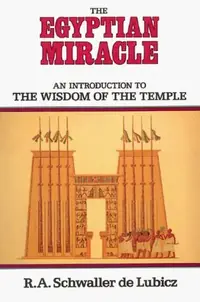
The Egyptian Miracle: An Introduction to the Wisdom of the Temple (Us)
Schwaller De Lubicz, R AThis edition can be ordered. No arrival date is confirmed.
Decipher the living geometry of Egyptian temples as a sacred science of consciousness.
Schwaller de Lubicz presents the Luxor Temple not as a monument to dead pharaohs, but as a cosmic instrument designed to manifest divine wisdom. He argues that every proportion, text, and architectural detail serves a precise metaphysical function, encoding a 'superhuman science' of spiritual evolution. By interpreting these elements as a unified whole, the book reveals how ancient builders utilized sacred geometry to align human consciousness with universal laws, offering a tangible path to esoteric understanding through the study of their sacred space.
This work sits firmly within the esoteric Egyptian revival tradition, reinterpreting ancient temple architecture through the lens of modern sacred geometry and metaphysical science. It bridges the gap between historical archaeology and spiritual alchemy by presenting the Luxor Temple as a living instrument of consciousness rather than a mere historical relic.


📝 Description: The Egyptian Miracle: An Introduction to the Wisdom of the Temple (Us)
💎 Expert review
📖 Why choose it
Why this book is worth reading
Readers deeply interested in the intersection of architecture, mysticism, and human evolution will find this book transformative. It offers a unique pathway to esoteric understanding by decoding the Luxor Temple as a cosmic instrument designed for spiritual awakening. Those seeking to move beyond superficial historical accounts and engage with the 'superhuman science' encoded in sacred proportions will appreciate its rigorous yet profound approach. The text provides a tangible framework for aligning consciousness with universal laws, making it essential for anyone wishing to explore how ancient builders utilized geometric precision to facilitate divine wisdom and metaphysical transformation.
⭐ Reader reviews
Reader rating
Arrived faster than expected and well packaged. The material is presented clearly and the structure makes it easy to revisit key passages. My only regret is not ordering it sooner.
My third book from this store and this one might be the best. You can tell why this work has endured. The typesetting is comfortable for study, with good margins for notes. Some archaic spellings slow things down. Happy enough with the purchase.
Exactly what I was looking for. It's become a regular reference in my practice. I'd have loved an index, but that's on the original text. Still worth having on the shelf.
Honestly wasn't sure what to expect, but I'm impressed. It pairs well with more modern commentaries on the same tradition. A keeper.
Not my usual area but wanted to branch out. The typesetting is comfortable for study, with good margins for notes. Some sections stopped me cold in the best way. It assumes more background than a beginner might have. Good, with the caveats above.
Was skeptical at first. The material is presented clearly and the structure makes it easy to revisit key passages. Challenging in places, but never needlessly obscure. Would buy from this store again.
This volume is a dense, intellectual exploration that demands patience and an open mind toward non-literal interpretation. It will not suit readers seeking straightforward historical narratives or empirical archaeological evidence, as the author prioritizes metaphysical function over factual chronology. Those uncomfortable with abstract geometric symbolism or the idea of 'dead' monuments being reanimated as spiritual tools may find the text inaccessible. However, for those willing to suspend conventional skepticism and engage with the temple as a unified whole of sacred science, it offers a compelling, albeit complex, vision of ancient wisdom as a living, functional system for consciousness expansion.
❓ Frequently asked questions
📖 Who should read this
Seekers of Hermetic philosophy, architects of the soul, and those fascinated by the intersection of mathematics, mysticism, and ancient Egyptian spirituality who crave deeper meaning behind stone structures.
🎯 Key themes and symbolism
Sacred Architecture
Egyptian Esotericism
Symbolic Geometry
💬 Quotes from the book
“The temple is the visible body of the invisible god.”
“Every column, every pillar, every wall is a syllable in the great word of creation.”
📜 Historical context
📚 Glossary
- Ma'at
- Sacred Geometry
- Temple as Machine
📔 Questions to reflect on
- How does the physical space around you influence your internal state of mind?
- What ancient symbols or geometric patterns do you find naturally calming or inspiring?
- In what ways can you view your daily rituals as a 'temple' for personal transformation?
✍️ More books by this author Schwaller De Lubicz, R A
All books by this author →
 82
82
 89
89
🏛 Books from this publisher Inner Traditions International
All books from this publisher →



You might also like
See more →