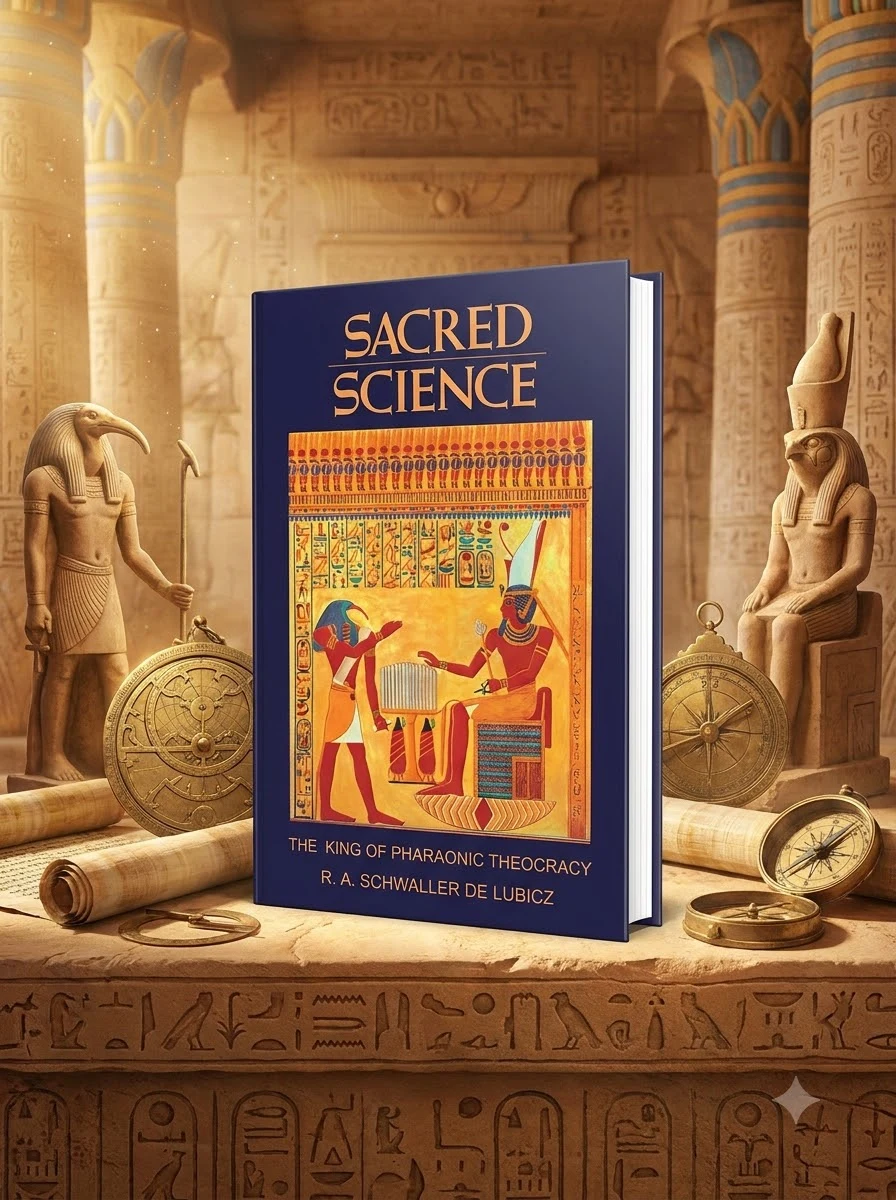
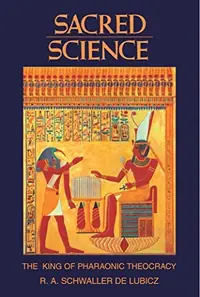
Sacred Science: The King of Pharaonic Theocracy (Original)
Schwaller De Lubicz, R AStock reported in the catalog; fulfillment is confirmed with your request.
Unearth the forgotten source of Western civilization's deepest esoteric wisdom.
R. A. Schwaller de Lubicz presents a revolutionary reinterpretation of ancient Egypt, arguing it was not merely a primitive civilization but the foundational wellspring of Western philosophy, spirituality, and scientific understanding. This profound work challenges conventional historical narratives, asserting that a "sacred science" guided Pharaonic society, integrating spiritual insight with empirical knowledge. De Lubicz's meticulous scholarship unveils how this sophisticated, holistic worldview offers keys to rediscovering profound truths lost to modernity, positioning Egypt as the true cradle of our intellectual and spiritual heritage.
This work stands as a pivotal text in the intersection of esoteric philosophy and alternative Egyptology, challenging conventional academic narratives through the lens of Hermetic tradition. It positions ancient Pharaonic society not as a primitive antecedent but as the sophisticated spiritual foundation for Western intellectual heritage.


📝 Description: Sacred Science: The King of Pharaonic Theocracy (Original)
💎 Expert review
📖 Why choose it
Why this book is worth reading
This book is essential for seekers who feel that standard historical accounts leave a spiritual void in their understanding of Western civilization's roots. If you are drawn to the idea that ancient wisdom holds keys to modern consciousness, Schwaller de Lubicz offers a rigorous, albeit dense, pathway to re-evaluate Egypt's role. You will gain from this text if you crave a holistic worldview that integrates empirical knowledge with deep spiritual insight. It is for those willing to dismantle conventional history to uncover the sacred science that supposedly guided Pharaonic society. The reward is a profound shift in perspective, positioning Egypt as the true cradle of our intellectual and spiritual heritage rather than a mere historical footnote. It invites you to rediscover truths lost to modernity through meticulous scholarship that bridges the gap between philosophy and spirituality.
⭐ Reader reviews
Reader rating
Schwaller de Lubicz presents a revolutionary reinterpretation that demands patience and an open mind, offering a dense tapestry of esoteric argumentation rather than accessible storytelling. This book is not for readers seeking straightforward historical facts or light leisure reading; it requires engagement with complex philosophical frameworks. It suits those interested in ceremonial magic and the hidden foundations of Western thought but may frustrate those preferring conventional academic rigor or linear narratives. The value lies in its bold assertion that a sacred science underpinned Pharaonic culture, challenging us to view Egypt as the wellspring of our deepest wisdom. While intellectually stimulating, it is a demanding read that rewards perseverance with a transformative perspective on spiritual heritage.
❓ Frequently asked questions
📖 Who should read this
If you're a seeker of forgotten knowledge, an enthusiast of esoteric history, or someone who questions conventional narratives about civilization's origins, this book is essential. Prepare to have your understanding of ancient Egypt and the roots of Western thought profoundly transformed.
🎯 Key themes and symbolism
Ancient Egyptian Wisdom
This book delves into the complex intellectual and spiritual legacy of Pharaonic Egypt, moving beyond archaeological artifacts to reveal a sophisticated system of thought. It explores how ancient Egyptians perceived the cosmos, divinity, and humanity's place within a grand, interconnected order, offering insights into their profound understanding of life's mysteries.
Sacred Science Revealed
Schwaller de Lubicz introduces the concept of a "sacred science," a unified field of knowledge where spiritual principles and scientific inquiry were inextricably linked. This wasn't merely superstition, but a profound understanding of natural laws and cosmic harmony, expressed through architecture, art, and ritual, bridging the material and the transcendent.
Reclaiming Western Origins
Challenging the traditional view that Greece birthed Western thought, the author meticulously demonstrates Egypt's primacy as the foundational source. He traces the deep philosophical, theological, and scientific roots of Western civilization back to the Nile Valley, urging a re-evaluation of our intellectual lineage and a recognition of its esoteric foundations.
💬 Quotes from the book
“The pyramids are not merely tombs for kings, but colossal textbooks in stone, their proportions and alignments speaking a forgotten language of cosmic law and sacred geometry.”
“To understand Egypt is to understand that the 'spiritual' and the 'material' were never truly separate; they were two facets of a single, divine reality, expressed through every aspect of life.”
📜 Historical context
📚 Glossary
- Pharaonic Theocracy
- Sacred Science
- Symbolist Interpretation
📔 Questions to reflect on
- Consider how our modern understanding of "science" differs from the "sacred science" proposed by Schwaller de Lubicz. What might be gained or lost by integrating spiritual perspectives into scientific inquiry?
- If ancient Egypt truly is the cradle of Western thought, how might this change your perception of history, philosophy, and our cultural heritage? What implications does this have for contemporary society?
- Reflect on a time when you experienced a profound connection between the spiritual and the material. How does this personal experience resonate with the idea of a unified sacred science?
✍️ More books by this author Schwaller De Lubicz, R A
All books by this author →
 82
82
 89
89
🏛 Books from this publisher Inner Traditions International
All books from this publisher →



You might also like
See more →