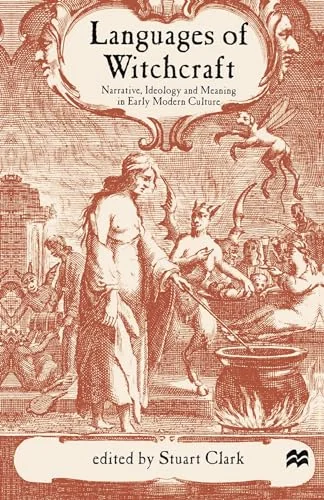
Languages of Witchcraft: Narrative, Ideology and Meaning in Early Modern Culture (2000)
An academic essay collection examining how early modern Europeans conceptualized and experienced witchcraft.
This paperback volume gathers specialized essays to analyze the cultural and ideological framework of early modern European witchcraft. Professor Stuart Clark compiles research focused on how historical worldviews permitted belief in the occult. Published by Red Globe Press, the work addresses topics across social history, religion, and cult studies. It offers theoretical analysis rather than practical instruction, serving readers focused on historical reality.
This work focuses specifically on early modern Europe, exploring how the region's historical culture, religious perspectives, and social structure made belief in witchcraft possible during that specific historical period.


Praise for this book
“The volume's true value lies in the application of a theoretical approach that takes seriously the worldviews of early modern Europeans.”
📝 Description: Languages of Witchcraft: Narrative, Ideology and Meaning in Early Modern Culture (2000)
💎 Expert review
📖 Why choose it
Why this book is worth reading
Scholars and serious enthusiasts of esoteric history will find this volume indispensable for its rigorous deconstruction of how societal narratives manufactured the reality of witchcraft. It moves past simple demonological tropes to reveal the complex tapestry of cultural meaning that made these accusations tangible and terrifying. Readers seeking to understand the profound impact of belief systems on human lives and legal structures will gain a rich, multidimensional perspective on Early Modern society. This book is essential for anyone wishing to grasp how ideology shaped historical events beyond mere superstition.
⭐ Reader reviews
Reader rating
Clark offers a dense, academic examination that rewards patience with deep insights into cultural construction. However, it is explicitly not suited for casual readers seeking narrative thrill or practical magical instruction. Those expecting a straightforward chronicle of trials may find the theoretical framework dry and abstract. The text demands intellectual engagement with ideology rather than emotional connection to individual victims. It serves best as a scholarly reference for understanding the 'why' behind the hysteria, rather than the 'who' or 'how' of specific cases.
❓ Frequently asked questions
📖 Who should read this
If you're fascinated by the historical power of belief, the construction of reality through culture, or the intricate social dynamics of Early Modern Europe, this book is essential. It offers a profound, academic exploration for those eager to understand witchcraft beyond superficial narratives.
🎯 Key themes and symbolism
Cultural Reality of Witchcraft
This book posits that witchcraft's existence was less about objective truth and more about societal perception. It investigates how varying cultural frameworks and worldviews in Early Modern Europe created the conditions for witchcraft to be understood as a very real and present danger, exploring the social and psychological underpinnings of such widespread belief systems.
Narrative's Shaping Power
The collection rigorously analyzes the role of stories, accusations, and testimonies in defining and propagating the concept of witchcraft. It demonstrates how these narratives — whether legal, theological, or popular — did not merely reflect beliefs, but actively constructed and reinforced the ideological landscape that made witchcraft comprehensible and actionable within its cultural context.
Early Modern European Context
Focusing specifically on Early Modern Europe, the essays dissect the unique historical, religious, and social conditions that fostered the intense period of witchcraft accusations and trials. Readers gain insight into the specific intellectual currents, anxieties, and power structures that characterized this era and contributed to its distinct interpretations of magic and malevolence.
📜 Historical context
📚 Glossary
- Early Modern Europe
- Ideology
- Cultural Construction
📔 Questions to reflect on
- How do contemporary cultural narratives influence what we consider 'real' or 'possible' today, echoing the dynamics of Early Modern witchcraft beliefs?
- Reflect on a historical or modern belief system that, much like witchcraft, seems incomprehensible from an external perspective but was deeply logical within its own cultural context.
- Consider how the 'language' used to describe a phenomenon (e.g., 'mental illness' vs. 'demonic possession') fundamentally shapes societal responses and individual experiences.