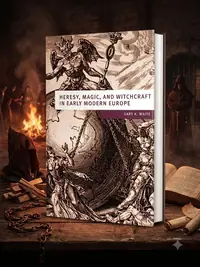

Heresy, Magic and Witchcraft in Early Modern Europe (2003) Waite, Gary K
Waite, Gary KThis edition can be ordered. No arrival date is confirmed.
Religious terror birthed the witch hunts; Waite exposes this dark, pivotal alchemy of faith and fear.
Gary K. Waite masterfully dissects the terrifying intersection of Reformation politics and witchcraft hysteria. He demonstrates how sixteenth-century religious upheaval transformed abstract doctrinal disputes into concrete fears of Satanic conspiracy. By persecuting perceived heretics, church authorities sought to solidify their crumbling orthodoxy, turning social anxiety into judicial slaughter. Only when societies began to accept religious pluralism did these panics finally subside, revealing the hunt as a tool for political control rather than spiritual defense.
This volume sits firmly within the historiography of early modern Europe, specifically examining the turbulent intersection of Reformation politics and witchcraft hysteria in the sixteenth century. It contributes to the scholarly understanding of how religious upheaval transformed doctrinal disputes into concrete fears of Satanic conspiracy.


📝 Description: Heresy, Magic and Witchcraft in Early Modern Europe (2003) Waite, Gary K
💎 Expert review
📖 Why choose it
Why this book is worth reading
Readers fascinated by the sociological mechanics of religious terror will find this text indispensable. Gary K. Waite offers a rigorous dissection of how church authorities utilized judicial slaughter to solidify crumbling orthodoxy during times of social anxiety. If you are interested in the political utility of hysteria and how abstract theological debates manifested as concrete Satanic conspiracies, this book provides critical insight. It reveals the witch hunts not as spiritual defense mechanisms, but as tools for political control that only subsided with the acceptance of religious pluralism. It is essential for those seeking to understand the dark alchemy of faith and fear in early modern society.
⭐ Reader reviews
Reader rating
Needed this for my research. It's become a regular reference in my practice. I'd have loved an index, but that's on the original text. Solid, if not essential.
Long-time student of the esoteric here. I appreciated how the argument builds steadily from first principles. Great value for what you get.
Waite delivers a masterful analysis of the pivotal alchemy between faith and fear, exposing how religious terror birthed the witch hunts through political necessity rather than spiritual conviction. The work is dense with historical argumentation, making it unsuitable for casual readers seeking narrative thrill or simple moralizing tales of good versus evil. It may frustrate those preferring light, accessible prose over rigorous academic dissection of Reformation politics. However, for scholars and serious enthusiasts, it offers a candid, compelling look at how social anxiety was turned into judicial slaughter to maintain power.
❓ Frequently asked questions
📖 Who should read this
Scholars of European history, theologians, and occultists interested in how political instability and doctrinal conflict directly fueled supernatural persecutions and the construction of the 'witch' archetype.
🎯 Key themes and symbolism
Reformation Politics
Judicial Terror
Religious Pluralism
💬 Quotes from the book
“Fear of the Devil and his followers inspired horrific incidents of judicially-approved terror.”
“It was only when the authorities came to terms with pluralism that there was a corresponding decline in witch panics.”
📜 Historical context
📚 Glossary
- Diabolical Conspiracy
- Orthodoxy
- Judicial Terror
📔 Questions to reflect on
- How do modern political fears mirror the 'conspiracy' narratives of the early modern period?
- In what ways do authorities today use 'othering' to consolidate power, similar to the witch hunts?
- How does the decline of absolute doctrinal certainty change societal approaches to dissent?
✍️ More books by this author Waite, Gary K
All books by this author →
🏛 Books from this publisher Red Globe Press
All books from this publisher →
You might also like
See more →

 91
91