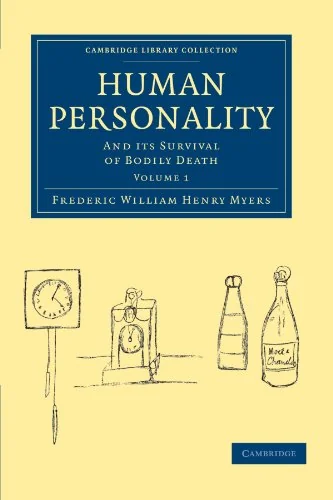
Human Personality - Volume 1
✍️ Myers, Frederic William HenryA Victorian classical scholar investigates psychic phenomena and spiritualism in this 752-page Cambridge publication.
This paperback edition from Cambridge University Press covers the intersection of historical research and spiritualist inquiry. Frederic William Henry Myers left his position as a Classics teacher at Trinity College, Cambridge, in 1869 to dedicate his work to psychic phenomena. Myers applies scholar-level academic techniques to supernatural occurrences, offering detailed analysis of mid-career cases. The text provides primary material for readers interested in the nineteenth-century origins of research into human personality, spiritualism, and political history.
This text emerges from nineteenth-century academia at Trinity College, Cambridge. It captures the moment in 1869 when classical scholar Frederic William Henry Myers turned away from traditional teaching to research psychic phenomena and spiritualism.


📝 Description: Human Personality - Volume 1
💎 Expert review
📖 Why choose it
Why this book is worth reading
This book is essential for the intellectually curious historian of ideas, the serious student of parapsychology’s origins, and any reader fascinated by the Victorian era's unique intersection of faith and empiricism. Myers offers a compelling framework for understanding consciousness beyond the physical body, appealing to those who appreciate rigorous academic inquiry applied to spiritual questions. It provides a rare glimpse into how respected scholars of the time attempted to validate psychic experiences without abandoning scientific integrity. If you seek to understand the roots of modern occult thought through a lens of classical scholarship and systematic investigation, this text is an indispensable resource for grasping the depth and seriousness of early spiritualist endeavors.
⭐ Reader reviews
Reader rating
Myers’ work is a dense, scholarly exploration that demands patience and a strong background in Victorian intellectual history. It is not suitable for casual readers seeking accessible spirituality or quick paranormal thrills; the prose is academic, and the subject matter requires focused attention to appreciate its nuances. Those expecting easy answers or supernatural entertainment will find little here. However, for those willing to engage with the systematic dismantling of superstition through rigorous analysis, it offers profound insights into the historical development of consciousness studies. It is a challenging but rewarding read for the dedicated scholar.
❓ Frequently asked questions
📖 Who should read this
If you're drawn to the intersection of science and spirituality, curious about parapsychology's origins, or fascinated by Victorian intellectual daring, this book is essential. Dive into the mind of a scholar who challenged materialist dogma, seeking empirical evidence for the non-physical aspects of human existence.
🎯 Key themes and symbolism
Classical Scholarship's Pivot
Myers, initially steeped in the intellectual traditions of ancient Greece and Rome at Trinity College, Cambridge, brought a unique academic discipline to unconventional subjects. His journey reflects a profound intellectual shift, demonstrating how a rigorous classical mind could embrace and analyze phenomena outside conventional scientific understanding, thereby legitimizing their study.
Systematic Psychic Investigation
This work represents Myers's dedicated efforts to apply scientific methodology to psychic experiences. He sought to move beyond anecdotal accounts, striving for a systematic collection and analysis of phenomena like telepathy, precognition, and post-mortem survival. His aim was to establish a credible framework for understanding these occurrences, laying groundwork for future parapsychological research.
Mind-Body-Spirit Connection
Myers's research inherently explores the intricate relationship between the material body, the conscious mind, and the enduring human spirit. His investigations into spiritualism and consciousness aimed to prove the existence of aspects of being that transcend physical death, offering a holistic perspective on human existence that integrates empirical observation with profound spiritual implications.
📜 Historical context
📚 Glossary
- Psychic Phenomena
- Spiritualism
- Classical Scholar
📔 Questions to reflect on
- How might a modern scientific approach differ from Myers's in investigating consciousness or psychic phenomena, and what lessons from his work remain relevant?
- Consider a time you experienced something seemingly unexplainable. How might Myers's framework encourage a different way of interpreting that event?
- In what ways do contemporary society's views on "mind, body, spirit" align with or diverge from the questions Myers was exploring at the turn of the 20th century?
📖 Read on the blog
📖 From the series “Human Personality 2 Volume Set”
All books in the series →


✍️ More books by this author Myers, Frederic William Henry
All books by this author →🏛 Books from this publisher Cambridge University Press
All books from this publisher →
You might also like
See more →

Have a question about this item?
Ask about the edition, condition, delivery or anything else — we reply by email or phone, usually within a day.
