
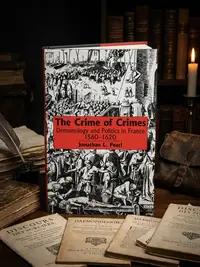


The Crime of Crimes: Demonology and Politics in France, 1560-1620
Stock reported in the catalog; fulfillment is confirmed with your request.
Uncover the terrifying intersection of demonic terror and state power in early modern France.
Jonathan L. Pearl dismantles the myth that witchcraft was merely a folk superstition by revealing it as a central political instrument in France between 1560 and 1620. This scholarly work explores how pamphlets and legal texts were weaponized to define the 'crime of crimes,' transforming spiritual anxiety into a tool for social control. You will witness how the state and the church collaborated to construct a narrative of absolute evil, justifying unprecedented violence under the guise of divine justice and political stability during a era of profound religious turmoil.
This scholarly work situates itself within the historiography of early modern European religious turmoil, specifically examining the intersection of demonology and state power in France during the late sixteenth and early seventeenth centuries.


📝 Description: The Crime of Crimes: Demonology and Politics in France, 1560-1620
💎 Expert review
📖 Why choose it
Why this book is worth reading
Readers fascinated by the mechanics of historical power structures and the weaponization of fear will find this text indispensable. It offers a rigorous dismantling of the misconception that witchcraft trials were merely folk superstitions, revealing them instead as sophisticated political instruments used to enforce social control. If you are interested in how state and church authorities collaborated to construct narratives of absolute evil during an era of profound religious instability, this book provides crucial insight. It is ideal for those who wish to understand how spiritual anxiety was transformed into a tool for justifying unprecedented violence under the guise of divine justice and political stability.
⭐ Reader reviews
Reader rating
I keep coming back to this one. The print is clean and easy on the eyes for long sessions. Already eyeing my next order.
Jonathan L. Pearl delivers a dense, academic analysis that may alienate casual readers seeking narrative drama or accessible storytelling. This book demands patience and a strong interest in archival research, legal texts, and pamphlet culture rather than atmospheric ghost stories. It is not suitable for those looking for lighthearted occult lore or practical Wiccan guidance; it is strictly a scholarly examination of political manipulation. While intellectually robust for historians of early modern France, general readers preferring engaging prose over rigorous historical dissection might find the focus on state power and legal definitions dry and overly technical.
❓ Frequently asked questions
📖 Who should read this
Readers interested in the history of religious violence, the sociology of fear, and the intersection of law and theology. Ideal for scholars of early modern Europe and those exploring how narratives of evil are constructed to serve political ends.
🎯 Key themes and symbolism
Demonic Politics
Pearl illustrates how witchcraft accusations were not random outbreaks of hysteria but calculated political maneuvers. He shows how authorities used the threat of demonic conspiracy to consolidate power, suppress dissent, and enforce religious conformity, making the hunt for witches a primary function of the state rather than a peripheral social phenomenon.
Literary Propaganda
The author analyzes the flood of pamphlets and tracts that circulated during this period, arguing they were deliberate instruments of terror. These texts did not just record events; they actively shaped public perception, creating a unified cultural understanding of witchcraft as an existential threat that demanded immediate and ruthless eradication by all levels of society.
Spiritual Warfare
The book delves into the theological underpinnings of the persecution, showing how Christian living was redefined through the lens of active spiritual combat. Believers were taught that everyday life was a battlefield against Satan, and that participating in the prosecution of witches was a sacred duty essential for the salvation of the soul and the community.
💬 Quotes from the book
“Witchcraft was not a fringe belief but a central pillar of early modern political ideology.”
“The printed word became the sword that cut through the veil of doubt.”
📜 Historical context
📚 Glossary
- Crime of Crimes
- Tracts
- Witchcraft Phenomenon
📔 Questions to reflect on
- How do contemporary narratives of 'evil' serve similar political functions to those described in the text?
- In what ways does language shape our perception of threat and justice?
- How might the intersection of fear and authority manifest in your own community today?
You might also like
See more →

 91
91

 91
91