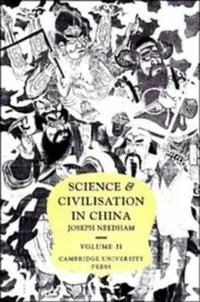
Science and Civilisation in China: Volume 2, History of Scientific Thought Needham, Joseph
 84
84
 Editorial score
How we rate
Editorial score
How we rate
Stock reported in the catalog; fulfillment is confirmed with your request.
Unearth the mystical roots of ancient China's scientific mind.
Delve into the profound intellectual journey of China's scientific thought, from its nascent stages in antiquity. This seminal volume meticulously unveils how the structured Confucian worldview intertwined with the fluid, organic naturalism championed by Taoist philosophy, shaping a unique understanding of the cosmos and its workings. It offers an unparalleled exploration into the foundational principles that guided ancient Chinese innovation and inquiry, revealing a rich tapestry of wisdom often overlooked by Western perspectives and challenging conventional historical narratives.
This volume belongs to the scholarly tradition of comparative history of science, specifically examining the intellectual evolution within ancient China. It sits at the intersection of Confucian structured worldviews and Taoist organic naturalism.


📝 Description: Science and Civilisation in China: Volume 2, History of Scientific Thought Needham, Joseph
💎 Expert review
📖 Why choose it
Why this book is worth reading
Readers fascinated by the mystical roots of ancient China's scientific mind will find this volume indispensable. It offers a profound intellectual journey into how Confucian structure intertwined with Taoist fluidity to shape a unique cosmic understanding. Those seeking to challenge conventional Western historical narratives and uncover overlooked wisdom in ancient Chinese innovation will gain immense value here. The book serves as an unparalleled exploration of foundational principles that guided inquiry, appealing to anyone interested in the rich tapestry of esoteric thought and its impact on scientific development.
⭐ Reader reviews
Reader rating
This seminal work meticulously unveils the structured Confucian worldview’s interplay with Taoist naturalism, offering a unique lens on ancient Chinese scientific thought. However, it is not suited for readers seeking light, anecdotal storytelling or quick historical summaries. The dense analysis of intellectual journeys and foundational principles demands patience and a serious academic interest. Those looking for straightforward, easy-to-digest narratives about the past may find the depth overwhelming. It is best reserved for scholars and dedicated enthusiasts willing to engage with complex philosophical underpinnings rather than casual readers seeking entertainment or simple facts.
❓ Frequently asked questions
📖 Who should read this
For the discerning scholar, the curious seeker of hidden knowledge, or anyone drawn to the profound intersection of philosophy, history, and scientific discovery. If you yearn to understand how Eastern thought shaped the very fabric of knowledge, this journey awaits.
🎯 Key themes and symbolism
Ancient Scientific Evolution
This work meticulously traces the development of scientific inquiry and understanding across millennia in China. It explores how observations, empirical methods, and theoretical frameworks evolved, providing a continuous narrative that highlights the indigenous genius behind numerous breakthroughs and their philosophical underpinnings, distinct from Western paradigms.
Confucian & Taoist Influence
Discover how the ethical framework of Confucianism and the mystical, naturalistic insights of Taoism profoundly shaped scientific thought. The book illustrates how these philosophies weren't detached from empirical investigation but provided the very lenses through which the natural world was observed, interpreted, and categorized.
Organic Naturalism Unveiled
Explore the concept of organic naturalism, a cornerstone of ancient Chinese scientific philosophy. This perspective viewed the universe as a self-organizing, interconnected organism rather than a machine. The volume details how this holistic approach informed everything from medicine to astronomy, fostering a unique relationship with nature.
💬 Quotes from the book
“The true alchemy of China lay not in transmuting base metals, but in a profound, organic understanding of nature's incessant transformations, where observation and philosophy were inseparable.”
“To dissect the universe without acknowledging its living pulse, as understood by the sages, was to miss the very essence of its operation.”
📜 Historical context
📚 Glossary
- Confucian milieu
- Organic naturalism
- Taoist
📔 Questions to reflect on
- How might a worldview rooted in "organic naturalism" alter modern scientific research or our understanding of ecological systems?
- Reflect on the ways philosophical traditions (like Confucianism or Taoism) in your own culture might subtly influence or limit scientific inquiry today.
- Consider how Western scientific history might appear if re-examined through a lens that prioritizes interconnectedness and cyclical patterns over linear progress and discrete causality.
🏛 Books from this publisher Cambridge University Press
All books from this publisher →

 75
75

You might also like
See more →