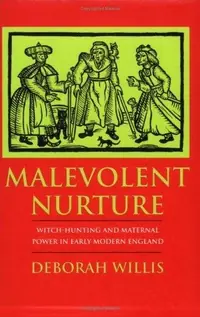
Malevolent Nurture
 79
79
 Editorial score
How we rate
Editorial score
How we rate
Stock reported in the catalog; fulfillment is confirmed with your request.
Uncover the unsettling truth: women were often both witch and accuser in early modern Europe.
Deborah Willis boldly re-examines the early modern witch trials, moving beyond the conventional focus on male persecutors. She delves into the often-overlooked role of women as accusers, exploring the intricate survival strategies and quests for empowerment that shaped their actions within a patriarchal society. Drawing on feminist, new historicist, and psychoanalytic frameworks, Willis scrutinizes primary documents like legal records and pamphlets. Her insightful analysis reveals how both the accused and the accuser were engaged in a complex negotiation of female identity, particularly concerning societal expectations around nurturing behavior.
This work sits firmly within the intersection of early modern European history and feminist historiography, challenging traditional narratives of the witch trials by centering female agency rather than male persecution.


📝 Description: Malevolent Nurture
💎 Expert review
📖 Why choose it
Why this book is worth reading
Readers deeply interested in the complexities of gender dynamics during the early modern period will find this text indispensable. It offers a profound re-examination of the witch trials, shifting the lens from male persecutors to the intricate survival strategies and quests for empowerment undertaken by women as accusers. Those fascinated by how patriarchal societies shaped female identity, particularly regarding nurturing roles, will gain significant insight into these historical negotiations. This book is essential for anyone seeking to understand the nuanced power structures of the past through a feminist and psychoanalytic lens, revealing the unsettling yet compelling truth of women's dual roles in this dark chapter of history.
⭐ Reader reviews
Reader rating
Deborah Willis provides a rigorous academic analysis that may feel dense to casual readers. While intellectually stimulating, it is not suited for those seeking a sensationalized recounting of witchcraft folklore or a straightforward historical narrative without theoretical depth. The reliance on feminist and new historicist frameworks requires patience and an appreciation for complex sociological argumentation. It is best appreciated by scholars and dedicated students of gender history who value nuanced primary source scrutiny over accessible storytelling. Readers looking for light entertainment or simple moral judgments on the trials will likely find this work too abstract and academically demanding for their tastes.
❓ Frequently asked questions
📖 Who should read this
If you're fascinated by the history of witchcraft, gender studies, or the psychology of power dynamics, this book offers a profound reinterpretation. It’s perfect for readers seeking to understand the complex roles women played during a tumultuous historical period, challenging established narratives with fresh insights.
🎯 Key themes and symbolism
Female Accusers' Agency
This work uniquely spotlights the significant, yet often ignored, participation of women as accusers in witchcraft trials. Willis explores the motivations behind these accusations, framing them not merely as internal malice but as complex responses to societal pressures and precarious positions within a male-dominated world, challenging simplistic narratives of victimhood.
Witchcraft Perceptions Diverge
Willis meticulously contrasts how the figure of the witch was envisioned by different societal strata. She demonstrates that while elite authorities, like King James, saw witches as betrayers of God, village communities often imagined them as malevolent mothers. This distinction is crucial for understanding the varied social anxieties and cultural narratives surrounding witchcraft.
Patriarchy and Survival
The book positions the witch and her accuser within a broader patriarchal context, arguing that their interactions were often a struggle for survival and a nuanced form of empowerment. It explores how definitions of female identity, particularly those valuing nurturing, created an uneasy dynamic that both constrained women and offered avenues for agency.
💬 Quotes from the book
“The female accuser, often overlooked, represents a critical lens through which to understand the complex power dynamics within patriarchal communities.”
“While elite discourse demonized the witch as Satan's pawn, local communities more frequently envisioned a malevolent mother, revealing a profound divergence in perception.”
📜 Historical context
📚 Glossary
- Malevolent Nurture
- Early Modern Period
- Patriarchal Culture
📔 Questions to reflect on
- Consider how societal expectations for women, particularly regarding 'nurturing,' might have created a fertile ground for accusations of its opposite – malevolence – in any historical or contemporary context.
- Reflect on a time when you observed or experienced differing interpretations of a person or event based on varying social statuses or perspectives. How did these differing views impact the outcome?
- If women were both accusers and accused, what does this tell us about the nature of power and survival within oppressive systems, and how might individuals navigate such constraints today?
🏛 Books from this publisher Cornell University Press
All books from this publisher → 90
90
 84
84

 75
75

You might also like
See more →