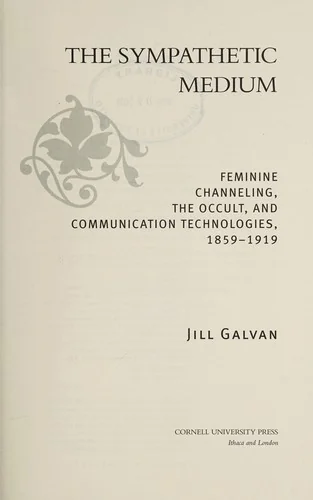
The Sympathetic Medium
Jill Galvan’s "The Sympathetic Medium" delves into the intriguing phenomenon of female mediums in Victorian Britain and America. This compelling study explores the surprising parallels between emerging communication technologies like the telegraph and telephone, and the era’s fascination with spiritualist practices such as automatic writing and séances. Galvan argues that women frequently assumed, or were assigned, these roles in both technological communication (like switchboard operators) and spiritual communication, due to cultural perceptions that linked feminine empathy and sensitivity to the act of transmitting messages across distances, whether physical or spiritual.


📝 Description: The Sympathetic Medium
📑 What's inside
- Acknowledgments
- Introduction: Tuning in to the Female Medium
- 1. Sympathy and the Spiriting of Information In the Cage
- 2. Securing the Line: Automatism and Cross-Cultural Encounters in Late Victorian Gothic Fiction
- 3. Du Maurier's Media: The Phonographic Unconscious on the Cusp of the Future
- 4. Telltale Typing, Hysterical Channeling: The Medium as Detective Device
- 5. Literary Transmission and Male Mediation
- Epilogue
- Bibliography
- Index
💎 Expert review
📖 Why choose it
Why this book is worth reading
Readers fascinated by the hidden connections between gender roles and technological advancement will find this book profoundly illuminating. It offers a unique perspective on how Victorian women navigated their agency through both spiritual mediums and switchboard operators. If you are interested in the cultural construction of empathy, sensitivity, and communication, this text provides essential context. It is particularly valuable for those who wish to understand how mystical beliefs influenced industrial progress. The book reveals how feminine traits were commodified for transmitting messages across vast distances. By exploring these parallels, it helps modern readers appreciate the historical roots of our current digital age. It is a must-read for scholars and enthusiasts of Victorian culture, gender studies, and the history of media technology who seek to uncover the nuanced ways women shaped both spiritual and mechanical landscapes.
⭐ Reader reviews
Reader rating
Jill Galvan presents a rigorous academic analysis that may not appeal to casual readers seeking light historical fiction or straightforward spiritual guides. The text demands patience due to its dense theoretical framework and focus on cultural critique rather than narrative storytelling. It is best suited for academics, historians, and those with a specific interest in Victorian gender studies or the sociology of technology. Readers looking for practical advice on mediumship or entertaining biographical anecdotes will likely find this work too dry and abstract. However, for those willing to engage with complex arguments about the synergy between telegraphy and spiritualism, it offers a compelling, well-researched exploration of how feminine sensitivity was perceived as a conduit for both scientific and supernatural communication.
❓ Frequently asked questions
📖 Who should read this
If you're captivated by the intersection of science and spirituality, fascinated by Victorian social history, or intrigued by the evolving roles of women, this book offers a profound and illuminating perspective. It's essential reading for understanding the cultural currents that shaped an age.
🎯 Key themes and symbolism
Technology & Transcendence
Explore the fascinating connections drawn by Victorians between burgeoning communication technologies—like the telegraph and telephone—and spiritualist practices. Galvan reveals how both were perceived as means to bridge vast distances, whether geographical or metaphysical, creating a shared cultural landscape where wires and spirits intertwined.
The Feminine Conduit
Discover why women predominantly occupied the roles of mediums, both in séance parlors and at the new technological interfaces of the era. This book examines the societal and cultural beliefs that positioned women as ideal transmitters, emphasizing their perceived sensitivity and capacity for sympathetic reception, making them crucial to both worldly and otherworldly communication.
Fictional Echoes
Analyze how prominent Victorian authors like Henry James, George Eliot, and Arthur Conan Doyle engaged with the figure of the female medium in their works. Galvan dissects these literary portrayals, illustrating how fiction mirrored, shaped, and interrogated the era's evolving understanding of female agency, communication, and the supernatural.
📜 Historical context
📚 Glossary
- Automatic Writing
- Séances
- Mediumship
📔 Questions to reflect on
- How might today's digital communication technologies be seen as echoing or replacing the spiritualist practices of the Victorian era?
- Reflect on historical perceptions of women's "sensitivity" or "intuition." How have these traits been leveraged or constrained in different societal roles, particularly those involving communication?
- Consider a piece of fiction you know that features a character who communicates across boundaries (spiritual, technological, or psychological). How does their role compare to the female mediums described in this book?