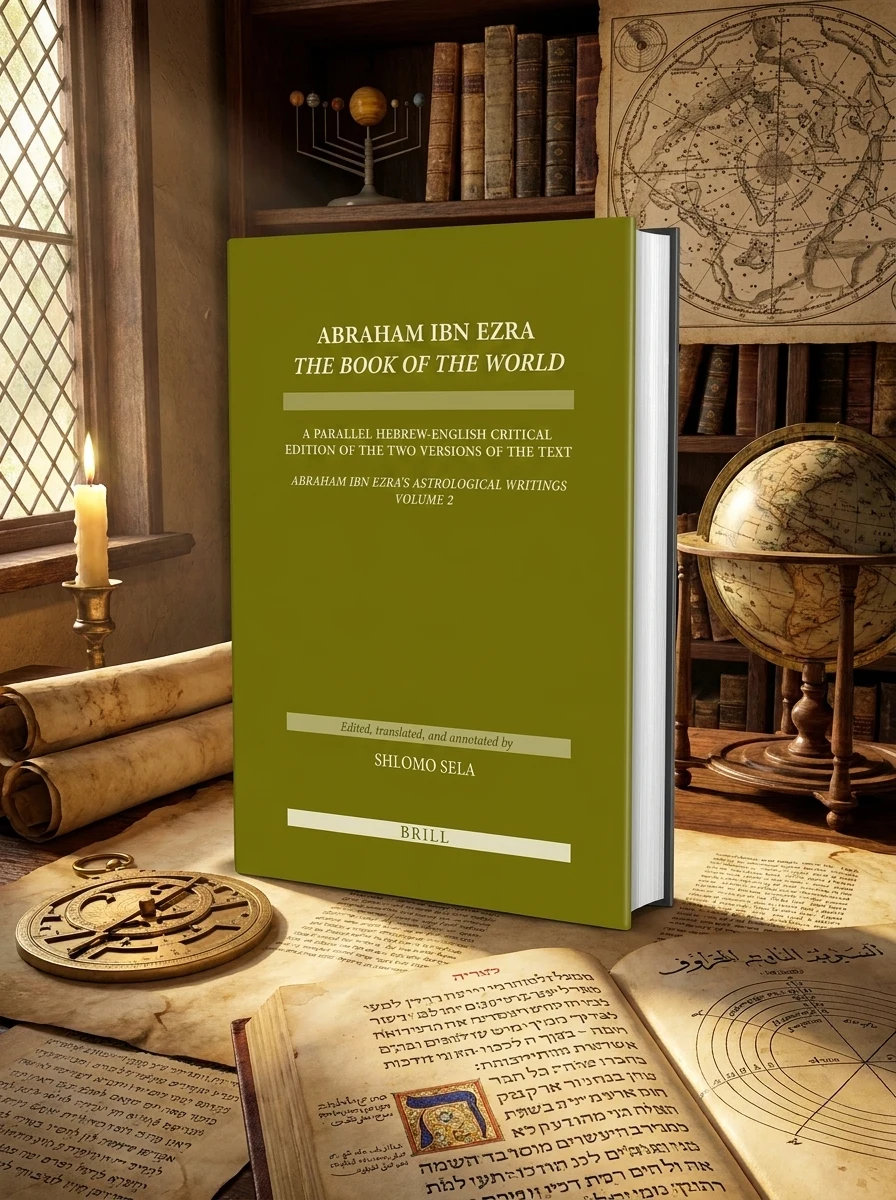
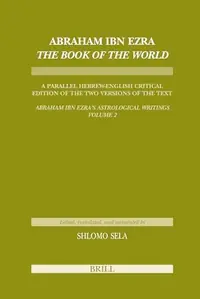
Abraham Ibn Ezra the Book of the World: A Parallel Hebrew English Critical Edition of the Two Versions of the Text. Abraham Ibn Era's Astrological Wri - Ingram Academic Sela, Shlom
Sela, Shlomo 79
79
 Editorial score
How we rate
Editorial score
How we rate
Stock reported in the catalog; fulfillment is confirmed with your request.
Unearth the celestial secrets of medieval Jewish astrology with Abraham Ibn Ezra's profound insights.
This groundbreaking volume presents the definitive critical edition of Abraham Ibn Ezra's "Book of the World," offering a parallel Hebrew-English text alongside meticulous commentary. It delves into the pioneering integration of historical and meteorological astrology within medieval Jewish thought, drawing extensively from Greek, Hindu, Persian, and Arabic traditions. Readers will also find the first critical edition and translation of Māshāʾallāh's "Book on Eclipses," a foundational text in mundane astrology, traditionally attributed in Hebrew to Ibn Ezra, further enriched by Ibn Ezra’s own brief reflections on the subject. It's an unparalleled resource for understanding a unique chapter in intellectual history.
This work sits at the intersection of medieval Jewish intellectual history and the transmission of Hellenistic and Near Eastern astrological traditions into the Latin West. It reflects the scholarly efforts to preserve and critically edit foundational esoteric texts from the Islamic Golden Age.


📝 Description: Abraham Ibn Ezra the Book of the World: A Parallel Hebrew English Critical Edition of the Two Versions of the Text. Abraham Ibn Era's Astrological Wri - Ingram Academic Sela, Shlom
💎 Expert review
📖 Why choose it
Why this book is worth reading
This volume is an indispensable resource for scholars and serious students of the history of science and esotericism who seek to understand the complex web of medieval Jewish thought. Readers will gain access to the definitive critical edition of Abraham Ibn Ezra's 'Book of the World,' allowing them to trace the precise integration of Greek, Hindu, Persian, and Arabic influences into Jewish astrology. Furthermore, the inclusion of Māshāʾallāh's 'Book on Eclipses' provides a rare glimpse into mundane astrology’s foundational texts. It is ideal for those fascinated by the transmission of knowledge across cultures and the specific historical context of meteorological and historical astrology in the medieval period.
⭐ Reader reviews
Reader rating
This academic publication offers rigorous philological work, presenting parallel Hebrew and English texts with meticulous commentary. However, it is strictly a scholarly tool rather than a guide for practical astrological application. It does not suit casual readers seeking accessible introductions to horary or natal astrology, nor those looking for modern interpretations of celestial influence. The text’s density and focus on critical edition mechanics may alienate anyone without a background in Semitic languages or medieval intellectual history. It is best reserved for researchers and historians rather than general occult enthusiasts.
❓ Frequently asked questions
📖 Who should read this
If you're a scholar of medieval science, Jewish studies, or the history of astrology, this critical edition is indispensable. Readers fascinated by the cross-cultural transmission of knowledge and the practical application of ancient celestial wisdom will find profound insights within these pages.
🎯 Key themes and symbolism
Medieval Astrological Synthesis
Explore how Ibn Ezra masterfully wove together diverse astrological theories and techniques from various ancient civilizations. This book showcases his unique ability to synthesize Greek, Hindu, Persian, and Arabic knowledge into a cohesive framework, marking a significant intellectual achievement within medieval Jewish science and beyond. It highlights the cross-cultural exchange of scientific ideas.
Historical & Mundane Astrology
Delve into the specific branches of astrology focused on predicting large-scale events, such as historical shifts, political fortunes, and meteorological phenomena. Ibn Ezra's work, along with Māshāʾallāh's treatise on eclipses, demonstrates how celestial observations were applied to understand and forecast earthly affairs, offering a fascinating glimpse into pre-modern predictive systems.
Pioneering Jewish Science
Discover the unique position of "The Book of the World" as the first Hebrew treatise of its kind to systematically address historical and meteorological astrology. This volume illuminates how Ibn Ezra's contributions pushed the boundaries of medieval Jewish scholarship, integrating advanced scientific disciplines into a theological and philosophical context, distinguishing his work from contemporaries.
💬 Quotes from the book
“For in the dance of the planets and the precise timing of their conjunctions, one may discern the very temper of the heavens and the earthly affairs they govern.”
“The wisdom gathered from the Greeks, the Hindus, and the Arabs, when distilled through diligent observation, yields a comprehensive tapestry of cosmic influence.”
📜 Historical context
📚 Glossary
- Mundane Astrology
- Historical Astrology
- Critical Edition
📔 Questions to reflect on
- Reflect on how medieval scholars like Ibn Ezra integrated scientific inquiry with religious or philosophical frameworks. What parallels or divergences do you see with modern thought?
- Consider the concept of 'historical astrology.' How might understanding past attempts to predict world events through celestial means inform our perspective on history or human attempts at forecasting?
- Ibn Ezra drew from Greek, Hindu, Persian, and Arabic sources. What does this tell us about the global exchange of knowledge in the medieval period, and how might that compare to today?
✍️ More books by this author Sela, Shlomo
All books by this author →
🏛 Books from this publisher Brill
All books from this publisher →
You might also like
See more →
 91
91
![The Instant Astrologer [With CD]](/img/the-instant-astrologer-with-cd-scene.webp) 91
91