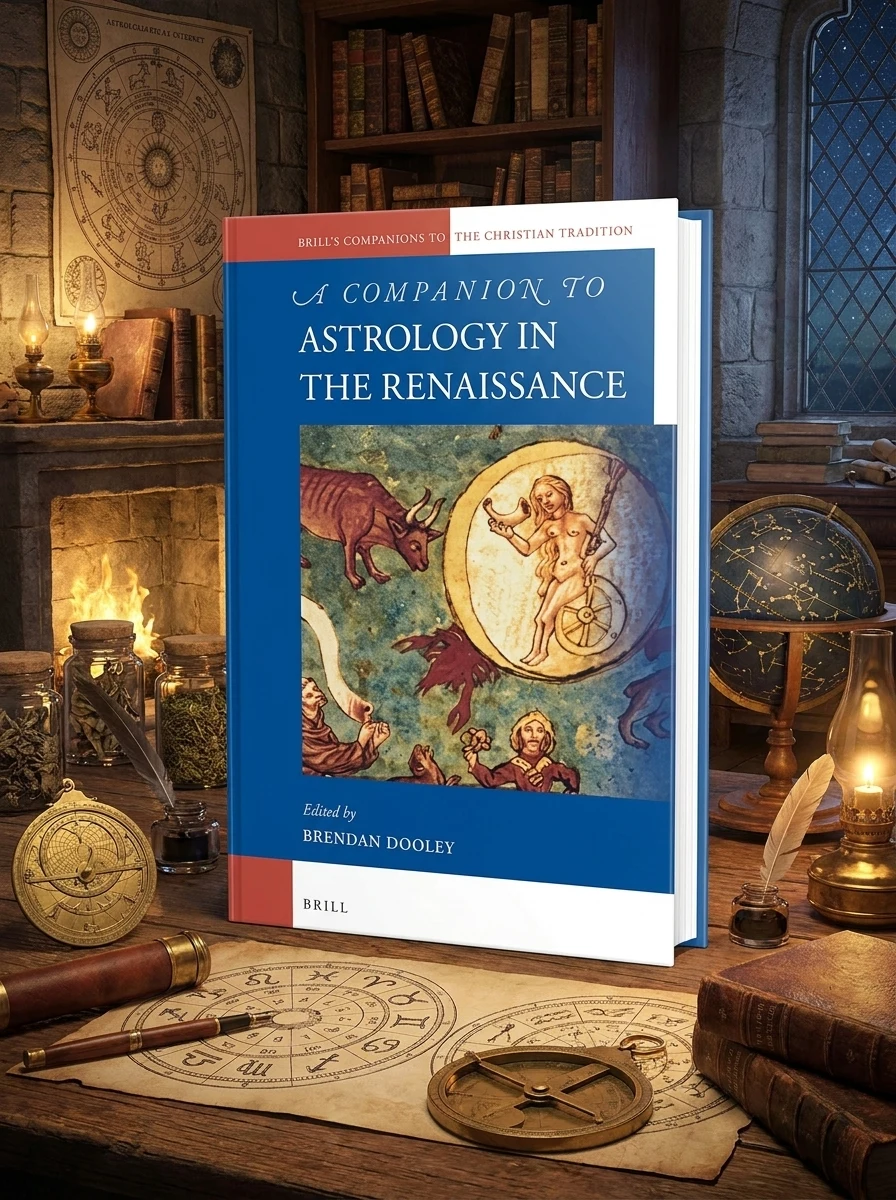
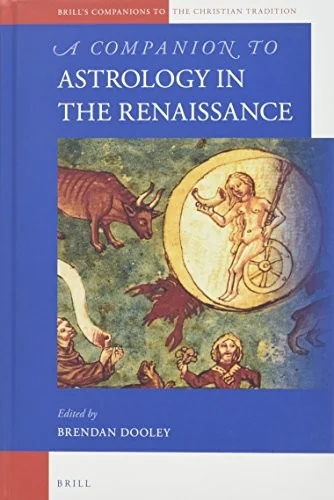
A Companion to Astrology in the Renaissance - Ingram Academic
✍️ Dooley, BrendanA scholarly collection analyzing astrology's role in Renaissance society, science, and art.
This volume presents a multidisciplinary approach to understanding astrology as it flourished in early modern Europe. Contributors analyze specific domains including law, medicine, literature, and political strategy. The text moves beyond general history to examine how astrological imagery functioned visually and intellectually. It connects ancient traditions with Renaissance innovations through detailed chapter studies. The work highlights the complex relationship between theological doctrine and scientific inquiry during this era.
The book focuses on European history during the Renaissance, a period when astrology reached its cultural peak. It examines the discipline within the context of early modern Italy and the Latin West, addressing its intersection with law, philosophy, and social structures in Europe.


📝 Description: A Companion to Astrology in the Renaissance - Ingram Academic
📑 What's inside
- List of Figures
- Note on Contributors
- Preface
- Introduction
- Brendan Dooley
- 1.The Culture of Astrology from Ancient to Renaissance
- Wolfgang Hübner
- 2.Representation of the Skies and the Astrological Chart
- Giuseppe Bezza
- 3.The Return to Ptolemy
- Ornella Faracovi
- 4.The Theological Debate
- Graziella Federici Vescovini
- 5.Astrology and Society
- William Eamon
- 6.Astrology and Politics
- Steven Vanden Broecke
- 7.Astrology and Science
- Brendan Dooley
- 8.The New Astral Medicine
- Hiro Hirai
- 9.Astrology and Literature
- Eileen Reeves
- 10.Picturing the Stars: Astrological Imagery in the Latin West, 1100-1550
- Dieter Blume
- 11.Reading the Peruvian Skies
- Claudia Brosseder
- Conclusion
- Index
- List of Figures
- 1.1 The four humours and elements adapted to the four triplicities of the zodiac
- 1.2Zodiacal man from the Flores Albumasaris, Erhard Radolt 1488
- 1.3The symmetry of the seven planets
- 1.4Francesco di Giorgio: Atlas, Braunschweig, Kupferkabinett
- 1.5Joseph Justus Scaliger's horoscope
- 1.6Capital of the doge's palace in Venice: Mercury with Virgin (Virgo) and Twins (Gemini)
- 1.7Planisphere of the Aldina from 1499
- 1.8The Tychonic system
- 2.1Making a Geniture
- 2.2Graphic representation of a geniture
- 2.3 Geniture of Girolamo Cardano
- 5.1The great conjunction in Pisces, portending a second deluge. Leonhard Reynmann, Practica vber die grossen und manigfeltigen Coniunction der Planeten (Nuremberg, 1524)
- 5.2Frontispiece to John Melton, Astrologaster (1620)
- 5.3Girolamo Cardano's Horoscope of Andreas Vesalius (Courtesy of the Clendening History of Medicine Library, University of Kansas Medical Center)
- 7.1Kepler's Polyhedric Model
- 7.2Robert Fludd's Monochord
- 7.3Robert Fludd: Microcosm and Macrocosm
- 10.1Raphael, Dome of the Chigi Chapel in Rome, S. Maria del Popolo
- 10.2Ferrara Palazzo Schifanoia, Sala dei Mesi, March with Aries
- 10.3Ferrara Palazzo Schifanoia, Sala dei Mesi, April with Taurus
- 10.4Ferrara Palazzo Schifanoia, Sala dei Mesi, Detail, First Decan of Aries
- 10.5Ferrara Palazzo Schifanoia, Sala dei Mesi, Detail ot the upper Register with Vulcan
- 10.6Paris, bibl. Nat. Ms. lat. 7330, Fol. 42v, Saturn in his houses
- 10.7Paris, bibl. Nat. Ms. lat. 7330, Fol. 43r, Saturn in his Anti-Houses
- 10.8Paris, bibl. Nat. Ms. lat. 7330, Fol. 43v, Saturn in his exaltation
- 10.9Paris, bibl. Nat. Ms. lat. 7330, Fol. 44r. Saturn in his deiectio
- 10.10Paris, bibl. Nat. Ms. lat. 7330, Fol. 54v, Venus in his exaltatio
- 10.11Paris, bibl. Nat. Ms. lat. 7330, Fol. 56r, Mercury in his houses
- 10.12Madrid, Bibl. Nac. Cod. 19, fol.55r, Jupiter on the eagle
- 10.13Madrid, Bibl. Nac. Cod. 19, fol. 68r, The five planets
Showing the first 60 entries.
💎 Expert review
📖 Why choose it
Why this book is worth reading
This book is essential for scholars and serious enthusiasts who wish to understand astrology not as a fringe practice, but as a central pillar of Renaissance thought. Readers will gain a profound appreciation for how this 'singular centaur' of religion and science shaped the cultural landscape of Europe at its apogee. Dooley’s meticulous scholarship reveals the intricate links between celestial influences and societal structures, offering clarity to those perplexed by the era's intellectual history. It is ideal for anyone seeking to unravel the cosmic tapestry woven by Renaissance minds, providing a rigorous yet accessible entry into a time when science and spirit were deeply intertwined in the pursuit of understanding the universe.
⭐ Reader reviews
Reader rating
Dooley provides a compelling scholarly defense of Renaissance astrology as a legitimate intellectual discipline rather than simple superstition. The text is dense with academic rigor, making it an invaluable resource for historians of science and esoteric studies. However, readers seeking practical horoscope advice or lightweight mystical musings will find little here; this is a serious historical analysis, not a devotional guide. It does not suit those looking for quick answers or modern astrological interpretations. Instead, it rewards the patient reader with a deep dive into how celestial mechanics influenced medicine, governance, and philosophy. The work stands as a testament to the complexity of early modern thought, requiring significant attention from its audience.
❓ Frequently asked questions
📖 Who should read this
If you're fascinated by the history of ideas, the complex interplay of belief systems, or how ancient practices shaped modern thought, this scholarly companion offers profound insights into a pivotal era. It's ideal for serious students of intellectual and cultural history.
🎯 Key themes and symbolism
Astrology's Renaissance Zenith
This volume illuminates how astrology reached its peak prominence during the European Renaissance, permeating every level of society. It was not an fringe belief but a respected area of study, influencing royal decisions, medical diagnoses, and everyday life, reflecting a worldview deeply connected to celestial mechanics.
Science and Spirit Unification
The book meticulously examines the unique position of Renaissance astrology as a bridge between nascent scientific inquiry and established spiritual or religious frameworks. It explores how intellectual figures grappled with the apparent paradox of planetary influences, seeking rational explanations within a divinely ordered cosmos.
Cultural and Intellectual Impact
Discover the profound impact astrology had on the intellectual currents and cultural expressions of the Renaissance. From shaping philosophical discourse to influencing artistic depictions and legal practices, this study reveals how astrological tenets were woven into the very fabric of thought and daily existence.
📜 Historical context
📚 Glossary
- Centaur
- Apogee
- Renaissance
📔 Questions to reflect on
- How might our modern understanding of 'science' be different if astrology had remained a mainstream academic discipline?
- Consider how the integration of spiritual and scientific thought in the Renaissance contrasts with contemporary societal divisions.
- If astrology is a 'centaur' of religion and science, what other 'centaurs' exist in today's cultural landscape, blending disparate fields?
📖 Read on the blog
✍️ More books by this author Dooley, Brendan
All books by this author →


🏛 Books from this publisher Brill
All books from this publisher →


You might also like
See more →
Have a question about this item?
Ask about the edition, condition, delivery or anything else — we reply by email or phone, usually within a day.
