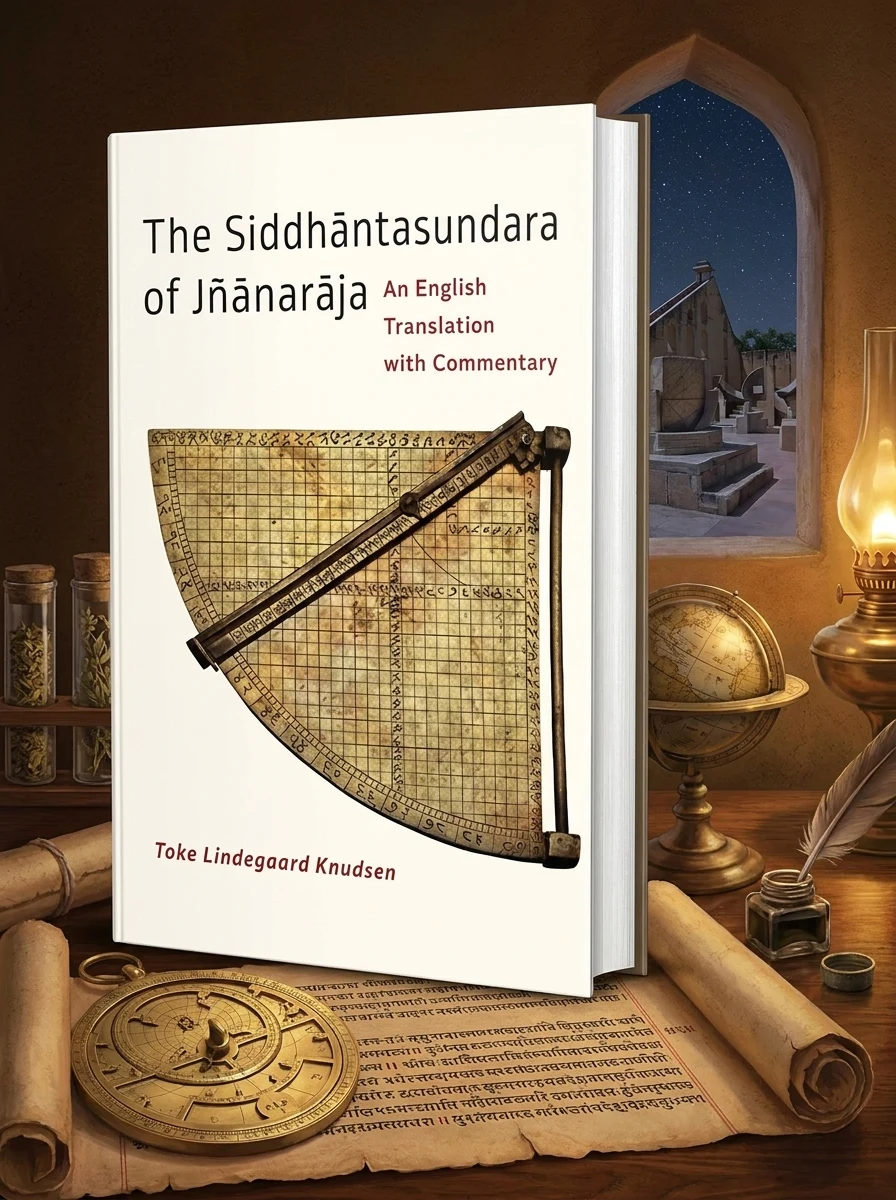

The Siddhāntasundara of Jñānarāja: An English Translation with Commentary
Stock reported in the catalog; fulfillment is confirmed with your request.
Unearth cosmic secrets from 16th-century India through a master astronomer's words.
This groundbreaking English rendition unveils Jñānarāja's monumental *Siddhāntasundara*, a cornerstone of classical Indian astronomy from around 1500 C.E. Expertly translated by Toke Lindegaard Knudsen, this volume introduces readers to the rich heritage of Hindu celestial science and the life of its brilliant author. Beyond mere calculations for planetary movements and eclipses, Jñānarāja's treatise delves into profound philosophical inquiries, seeking harmony between ancient astronomical models and sacred Hindu cosmologies. It offers a unique window into the intellectual crossroads of early modern India, presenting a comprehensive system of cosmic understanding.
This work bridges the intellectual crossroads of early modern India around 1500 C.E., presenting a comprehensive system of cosmic understanding rooted in classical Hindu celestial science and sacred cosmologies.


📝 Description: The Siddhāntasundara of Jñānarāja: An English Translation with Commentary
💎 Expert review
📖 Why choose it
Why this book is worth reading
Scholars of ancient science and enthusiasts of cross-cultural intellectual history will find immense value in this volume. It offers a rare window into the sophisticated astronomical models and philosophical inquiries that defined early modern India. By translating Jñānarāja’s monumental treatise, Knudsen allows readers to explore the harmony between planetary calculations and sacred Hindu cosmologies. This book is essential for those seeking to understand the rich heritage of celestial science beyond Western traditions, providing a deep appreciation for how ancient minds mapped the cosmos while engaging with profound metaphysical questions about the universe's structure.
⭐ Reader reviews
Reader rating
Knudsen delivers a groundbreaking English rendition of a cornerstone text in classical Indian astronomy. The translation is meticulous, unveiling Jñānarāja’s work as both a technical manual for eclipses and a philosophical inquiry into cosmic harmony. However, this book does not suit casual readers seeking straightforward planetary horoscopes or those uninterested in dense academic commentary. It is rigorously scholarly, aimed at those who appreciate the nuance of historical scientific texts and the intellectual crossroads of 16th-century India. Readers expecting light entertainment or simple astrological advice will likely find this volume too specialized and intellectually demanding for their needs.
❓ Frequently asked questions
📖 Who should read this
If you are drawn to the intellectual tapestry of early modern India, the intricate dance of ancient astronomy, or the philosophical quest to unite science with spiritual cosmology, this translation is an essential addition to your library. Delve into a master's mind.
🎯 Key themes and symbolism
Cosmic Systems of India
Jñānarāja's text offers an exhaustive blueprint of traditional Indian astronomical thought. It meticulously details the mechanisms for calculating celestial phenomena like planetary positions and predicting eclipses, providing a foundational understanding of how ancient scholars mapped the heavens. This comprehensive system unveils the intricate mathematical and observational techniques of the era.
Bridging Sacred and Celestial
A core aspect of *Siddhāntasundara* is its ambitious attempt to reconcile the practical astronomical models of its time with the profound cosmological narratives embedded in sacred Hindu scriptures. Jñānarāja navigates this complex intersection, exploring how scientific understanding can coexist with spiritual doctrines, particularly regarding universal structures and divine order.
Philosophical Cosmic Explorations
Beyond equations, Jñānarāja engages in deep philosophical discourse concerning the universe's fundamental nature. He probes concepts like the "direction of down" and the existence of "adhesive antipodeans," challenging prevailing notions and offering intricate arguments. This intellectual rigor showcases a mind wrestling with cosmic paradoxes and seeking coherent explanations for reality.
💬 Quotes from the book
“Just as a lotus unfurls its petals towards the sun, so too does our understanding expand when we harmonize the observed movements of celestial bodies with the profound wisdom of our sacred texts.”
“Consider the antipodes, where those upon the earth's opposite face perceive the sky above them, a testament to the sphere's grand design, challenging our limited terrestrial perspective.”
📜 Historical context
📚 Glossary
- Siddhāntasundara
- Jñānarāja
- Antipodeans
📔 Questions to reflect on
- How might ancient astronomical understanding, devoid of modern instruments, still offer profound insights into our place in the cosmos?
- In what ways do you see the ongoing tension or harmony between scientific discovery and spiritual belief in contemporary thought?
- Reflect on Jñānarāja's philosophical inquiries into concepts like "down" or "antipodeans." How do such questions broaden your own understanding of reality?
🏛 Books from this publisher Johns Hopkins University Press
All books from this publisher →




You might also like
See more →
![The Instant Astrologer [With CD]](/img/the-instant-astrologer-with-cd-scene.webp)
 91
91

 91
91

 91
91
 91
91