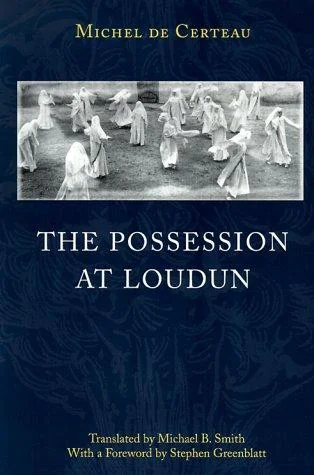
The Possession of Loudun
A Jesuit historian analyzes the 1634 demonic possession of Ursuline nuns in provincial Loudun, France.
This volume examines the 1634 trial and burning of Father Urbain Grandier through primary French documents and historical analysis. De Certeau traces the origins of the alleged demonic possession of Ursuline nuns, the political maneuvers of Laubardemont, the judicial inquiries, and the medical examinations of the period. He tracks how public hysteria reflected a culture caught between collapsing religious authority and emerging scientific thought, following the story through Grandier's execution to its spiritual and literary aftermath.
Set in provincial Loudun during seventeenth-century France, this account sits at the intersection of declining centralized religious authority and the rise of scientific reason. It records a society experiencing violent anxiety during a period of traumatic cultural transformation.


📝 Description: The Possession of Loudun
📑 What's inside
- List of Illustrations
- Foreword by Stephen Greenblatt
- Translator's Acknowledgments
- History Is Never Sure
- 1. How a Possession is Born
- 2. The Magic Circle
- 3. The Discourse of Possession
- 4. The Accused: Urbain Grandier
- 5. Politics in Loudun: Laubardemont
- 6. Beginning the Judicial Inquiry
- 7. The Theater of the Possessed
- 8. The Medical Eye
- 9. A Teratology of Truth
- I. The Imagination
- II. The Liar
- 10. The Judgment of the Sorcerer
- 11. The Execution: Legend and History
- 12. After Death, Literature
- 13. The Time of Spirituality: Father Surin
- 14. The Triumph of Jeanne des Anges
- Figures of the Other
- Primary Sources and Bibliography
- Notes
- Index
💎 Expert review
📖 Why choose it
Why this book is worth reading
Readers fascinated by the complex interplay between faith, power, and terror will find profound value in this meticulous inquiry. It offers a unique lens through which to view a society grappling with shifting spiritual foundations and the dawn of scientific thought. By dissecting the dramatic core of the Loudun episode, the book reveals how purported sorcery served as a mirror for deep-seated cultural fears. Those interested in the historical roots of occultism and the psychological landscape of the 17th century will gain insight into how these elements collided to shape public perception and institutional authority.
⭐ Reader reviews
Reader rating
This text provides a masterful dissection of an infamous episode, interweaving primary accounts with insightful analysis to expose societal anxieties. However, it is not suited for readers seeking straightforward supernatural thrillers or simple moral judgments. Those expecting easy answers or sensationalist plots may find the rigorous historical inquiry dry and dense. It demands patience and an appreciation for academic depth rather than narrative convenience. The work is best approached by those willing to engage with complex cultural transitions and the intellectual frameworks that defined a pivotal era in European history.
❓ Frequently asked questions
📖 Who should read this
For those captivated by the interplay of history, religion, and psychology, this book offers a penetrating look into a society on the cusp of change. If you seek to understand how collective belief systems shape dramatic events and power dynamics unfold in the shadow of the sacred, this is essential.
🎯 Key themes and symbolism
The Possession Phenomenon
De Certeau delves into the purported demonic possession of the Ursuline nuns, not just as a sensational event but as a mirror reflecting the collective psyche. He explores the societal interpretations of such phenomena, questioning their origins and functions within a deeply religious yet increasingly skeptical era, dissecting how these events unfolded publicly.
Societal Transformation & Anxiety
This work brilliantly unpacks the deep-seated fears and anxieties gripping 17th-century France. De Certeau argues that the Loudun affair was a symptom and catalyst for a society in "traumatic flux," caught between old certainties and an uncertain future. It explores how a populace navigated profound cultural shifts.
Authority, Faith, and Reason
The book examines the clash between entrenched religious authority and the nascent stirrings of scientific rationalism. De Certeau portrays a society grappling with whom or what to believe as traditional spiritual power waned. Loudun becomes a crucible where the struggle between faith, superstition, and emerging enlightenment played out dramatically.
📜 Historical context
📚 Glossary
- Ursuline nuns
- Urbain Grandier
- Sorcery
📔 Questions to reflect on
- How do contemporary anxieties or shifts in societal paradigms manifest in collective fears or moral panics today?
- Reflect on a time when an established authority (religious, political, scientific) was challenged. What were the consequences, and how were new truths negotiated?
- Consider the power of narrative and interpretation: How does the way a dramatic event is told (historically, artistically, religiously) shape its meaning and impact over time?
📖 Read on the blog
🏛 Books from this publisher University of Chicago Press
All books from this publisher →








You might also like
See more →





Have a question about this item?
Ask about the edition, condition, delivery or anything else — we reply by email or phone, usually within a day.
