

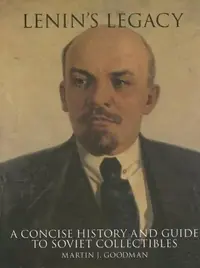
Lenin's Legacy: A Concise History and Guide to Soviet Collectibles Goodman, Martin J
This edition can be ordered. No arrival date is confirmed.
Uncover the hidden iconography of the USSR through over nine hundred vibrant photographs of rare Soviet artifacts.
This volume serves as both a visual archive and a historical primer for the Soviet era. Goodman curates nearly two thousand objects, ranging from military medals to space program badges, offering readers a tangible connection to the past. The text decodes the complex symbolism embedded in these items, explaining their political and cultural significance. With detailed captions and pricing guides, it stands as an essential reference for understanding the visual language of the Kremlin and the everyday material culture of the Soviet citizen.
This work bridges the gap between political history and material culture studies by examining the visual language of the Soviet Union through its tangible artifacts. It situates itself within the tradition of collecting guides that decode the symbolic iconography of specific historical regimes.


📝 Description: Lenin's Legacy: A Concise History and Guide to Soviet Collectibles Goodman, Martin J
💎 Expert review
📖 Why choose it
Why this book is worth reading
Readers fascinated by the intersection of politics and daily life will find immense value in this comprehensive visual archive. By presenting over nine hundred vibrant photographs alongside detailed captions, the book offers a tangible connection to the Soviet past that text-only histories often lack. It is particularly beneficial for collectors seeking to understand the complex symbolism embedded in military medals, space program badges, and other rare artifacts. The inclusion of pricing guides further aids those looking to navigate the market for these items. Ultimately, it serves as an essential reference for decoding the visual language of the Kremlin and the everyday material culture of Soviet citizens, making the abstract history of the USSR concrete and accessible through its objects.
⭐ Reader reviews
Reader rating
While this volume excels as a visual primer and cataloging tool for enthusiasts of Soviet collectibles, it may disappoint readers seeking deep theoretical analysis or dense political critique. The focus on artifacts and pricing guides makes it less suitable for academic historians looking for primary source interpretations or nuanced geopolitical arguments. It is strictly a guide to the physical remnants of the era rather than an intellectual deconstruction of its ideology. Consequently, those expecting a narrative history or philosophical treatise on communism will likely find the content too superficial. However, for the specific audience of collectors and visual learners, it remains a highly practical and informative resource that successfully bridges the gap between hobbyist interest and historical awareness.
❓ Frequently asked questions
📖 Who should read this
This volume is crafted for serious collectors of Soviet memorabilia and historians seeking visual documentation. It also appeals to anyone fascinated by the intersection of political power, propaganda, and material culture in the twentieth century.
🎯 Key themes and symbolism
Decoding Soviet Iconography
The book meticulously analyzes the visual symbols of the regime, explaining how pins, flags, and statues communicated power and ideology to the masses.
Material Culture of the State
Goodman explores the physical artifacts of the USSR, from Aeroflot memorabilia to party congress awards, revealing the tangible extent of state influence.
Historical Contextualization
Each item is placed within its specific historical moment, linking personal collectibles to broader narratives of Soviet political history and military expansion.
💬 Quotes from the book
“The symbolism of the Soviet Union was largely hidden from the West until now.”
“This is the first book to show such a wide variety of artifacts from the Soviet Union.”
📜 Historical context
📚 Glossary
- Badges and Pins
- Aeroflot Memorabilia
- Soviet Space Program
📔 Questions to reflect on
- How did the visual language of the Soviet state influence daily life and personal identity?
- In what ways do collectibles preserve historical memory more effectively than written records?
- How does the commodification of political artifacts change our understanding of the original ideology?
🏛 Books from this publisher Schiffer Publishing
All books from this publisher →
 89
89




You might also like
See more → 91
91
 91
91

 91
91
 91
91
 91
91