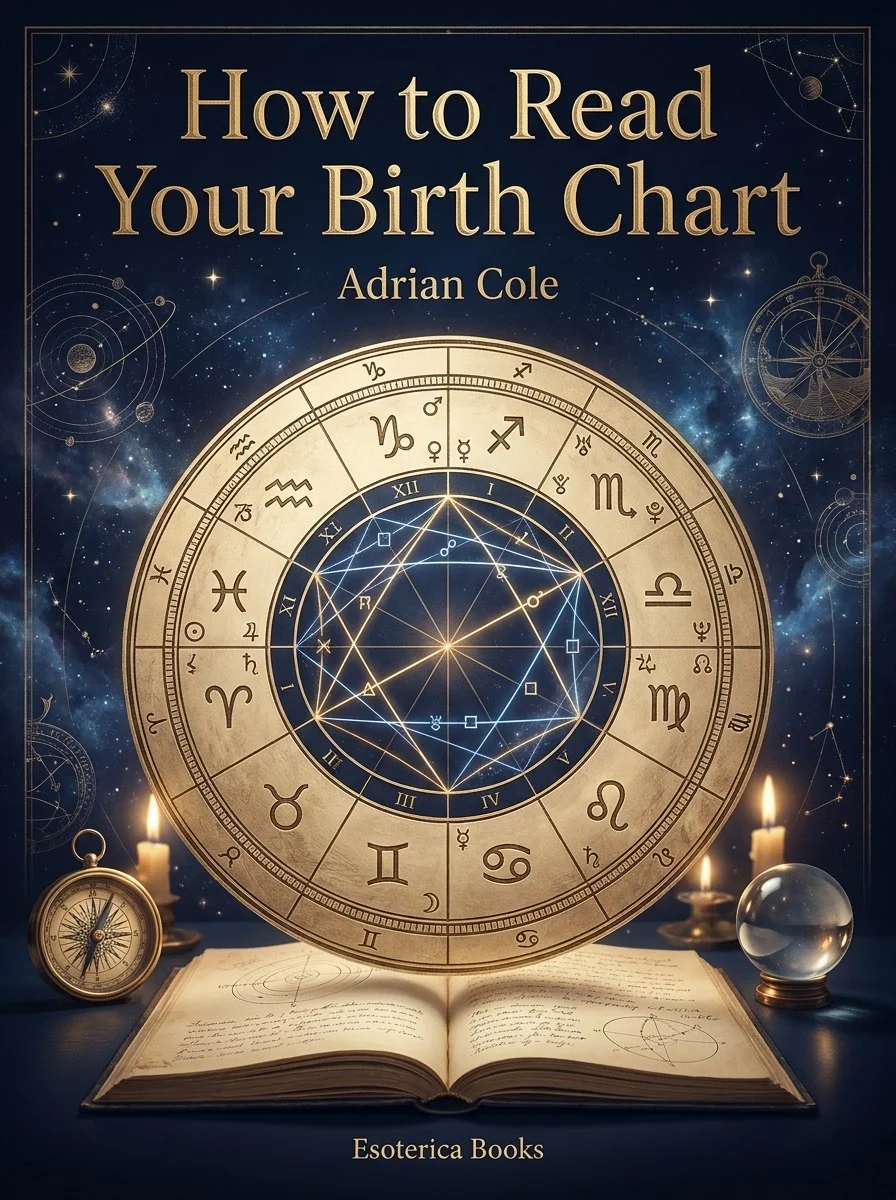

How to Read Your Birth Chart
Contents
- Your Chart Is Already Telling a Story
Start with your own online-generated birth chart and discover three essential placements: Sun, Moon, and Rising sign. Follow a simple first-reading exercise that turns these familiar symbols into an initial interpretation, giving you an immediate sense of how a natal chart works. - Find Your Way Around the Wheel
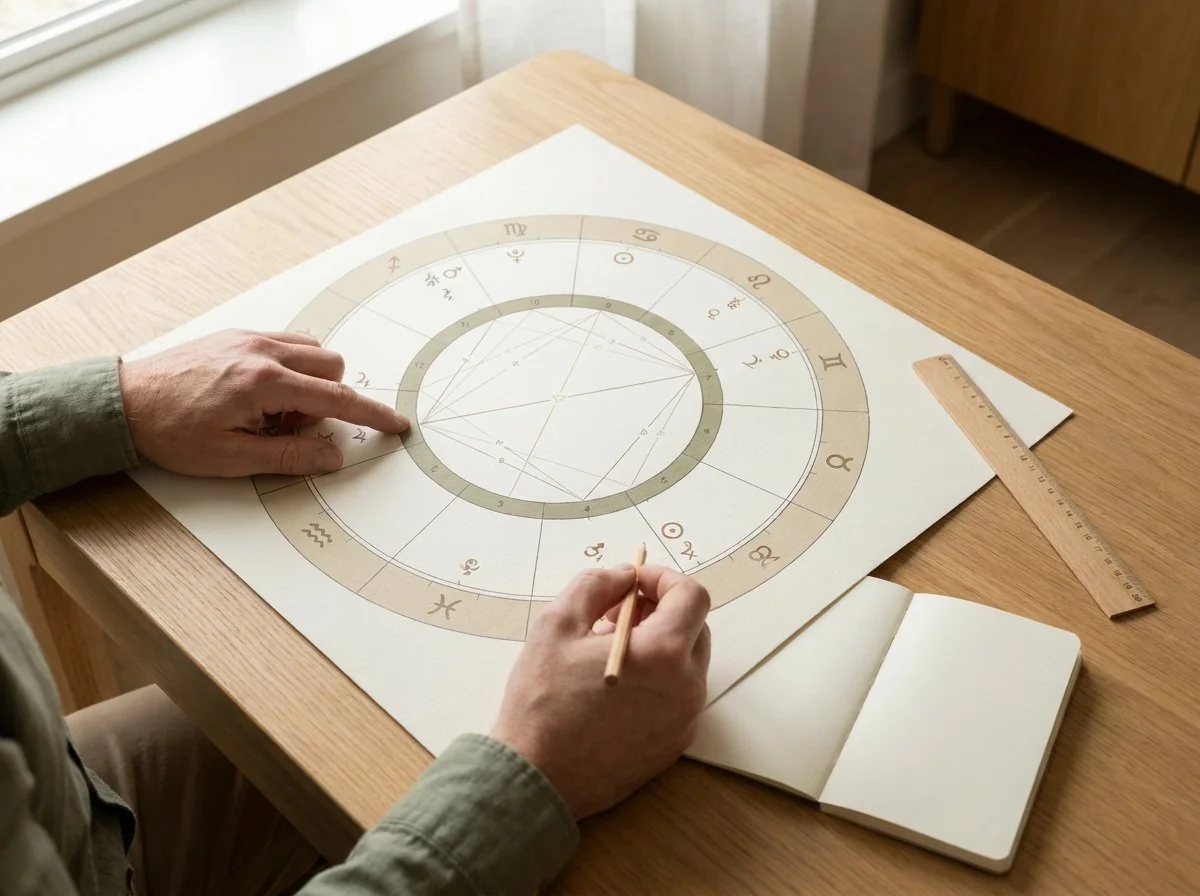
Learn to navigate the circular chart, identify its twelve sections, locate planetary symbols, and understand the lines connecting different placements. A fully explained sample wheel shows how to read the chart without getting lost in its visual details. - Meet the Planets and Their Personalities
Explore the Sun, Moon, Mercury, Venus, Mars, Jupiter, Saturn, Uranus, Neptune, and Pluto as symbolic characters in an astrological interpretation. Learn the distinct questions each planet raises and practice identifying their roles in a sample birth chart. - The Zodiac Signs Give Every Planet a Voice
Discover how the twelve zodiac signs describe different styles of expression and modify planetary symbolism. Work through contrasting examples, such as Venus in Aries and Venus in Taurus, to see why the same planet can produce very different astrological interpretations. - Twelve Houses, Twelve Areas of Experience
Understand what the twelve houses represent, how house numbers are arranged, and why a planet's house placement matters. A practical walkthrough explains how to identify the first, seventh, tenth, and other houses and connect them with the subjects of a chart. - Put the First Three Pieces Together
Combine planet, sign, and house into one interpretable placement using a repeatable sentence-building exercise. Several worked examples demonstrate how to move beyond isolated definitions and create a nuanced interpretation of an actual chart position. - Read the Lines That Connect Everything
Explore conjunctions, oppositions, squares, trines, and sextiles, learning how aspects describe symbolic relationships between planets. Follow annotated examples to understand major aspect patterns without treating challenging or harmonious configurations as fixed predictions. - Love, Connection, and the Seventh House
Use Venus, Mars, the Moon, the seventh house, and relevant aspects to explore relationship preferences and interpersonal themes. Learn to interpret your own chart thoughtfully and introduce synastry as a comparison of two charts rather than a verdict about compatibility or another person's feelings. - Work, Purpose, and Your Public Self
Explore the tenth and sixth houses, Midheaven, Saturn, and other relevant placements to consider vocational interests, working styles, and ambitions. A worked example demonstrates how to combine several indicators without claiming that astrology determines a particular profession or guarantees career success. - When the Chart Starts Repeating Itself
Move beyond individual placements to recognize clusters, planetary emphasis, recurring elements, chart rulers, and other interpretive patterns. Apply the M.A.P.S. Method to a more complex sample chart and learn to distinguish meaningful repetition from overinterpretation. - Different Traditions, Different Maps
Discover the distinction between Western tropical astrology and Vedic astrology, including their different frameworks and interpretive conventions. Learn why numerology and astronomy are separate subjects, how birth information affects chart calculations, and why different online chart generators may display different results. - Become the Reader of Your Own Chart
Bring all four M.A.P.S. stages together in a complete birth chart reading, from identifying the dominant placements to interpreting houses, aspects, relationships, and recurring themes. Finish with a reusable reading template, a self-checking process, and guidance for approaching increasingly complex charts with curiosity and interpretive humility.
How to Read Your Birth Chart by Adrian Cole is a practical introduction to Western natal astrology that teaches readers to interpret a complete birth chart rather than rely on Sun sign descriptions. Using the M.A.P.S. Method—Mark, Assign, Pair, Synthesize—the book explains how planets, zodiac signs, houses, and aspects work together. Step-by-step exercises and worked examples guide readers from identifying their Sun, Moon, and Rising sign to exploring relationship themes, career interests, and recurring chart patterns. The emphasis is on thoughtful interpretation, independent learning, and understanding astrology as a symbolic tradition.


📝 Description: How to Read Your Birth Chart
📖 Why choose it
Why this book is worth reading
Knowing your Sun sign is a starting point, not a complete birth chart reading. This book addresses the gap between recognizing familiar astrological symbols and understanding how they interact. Its particular strength is the M.A.P.S. framework, which gives readers a repeatable process for connecting planetary placements, houses, and aspects. Rather than encouraging dependence on generic interpretations, it works toward independent reading skills and a more nuanced understanding of astrological symbolism.
⭐ Reader reviews
Reader rating
The strongest feature of this guide is its practical organization. The M.A.P.S. Method provides a clear sequence for moving from chart identification to interpretation, while the progression from the Sun, Moon, and Ascendant to planetary aspects and complete readings makes the subject approachable. The chapter plan also handles common beginner misunderstandings, particularly the distinction between signs and houses and the temptation to interpret placements in isolation. Its treatment of relationship and career symbolism is appropriately restrained. One limitation: experienced astrologers looking for advanced techniques, detailed house-system comparisons, or specialist predictive methods will find the approach introductory rather than comprehensive. For beginners, that restraint is a reasonable editorial choice.
❓ Frequently asked questions
📖 Who should read this
This book is for astrology beginners who want to understand their own birth chart and for curious readers who know their Sun sign but want to explore the wider natal chart. It also suits self-directed learners who prefer a repeatable method and worked examples to abstract astrological descriptions.
🎯 Key themes and symbolism
Natal Chart Interpretation
Planets Signs Houses
Planetary Aspects
Relationship and Career Themes
📜 Historical context
📚 Glossary
- Natal Chart
- Ascendant (ASC)
- Planetary Placement
- Aspect
- Midheaven (MC)
- Synastry
📔 Questions to reflect on
- Which parts of your birth chart do you recognize most easily, and which symbols or placements would you like to understand more deeply?
- When you connect a planet, its zodiac sign, and its house, what new interpretive possibilities emerge that were not apparent when you considered each element separately?
- How can you distinguish an interpretation supported by several recurring chart themes from an assumption based on one isolated placement?
📖 Read on the blog
✍️ More books by this author Adrian Cole


🏛 Books from this publisher Esoterica Books

You might also like
See more →

Have a question about this item?
Ask about the edition, condition, delivery or anything else — we reply by email or phone, usually within a day.
