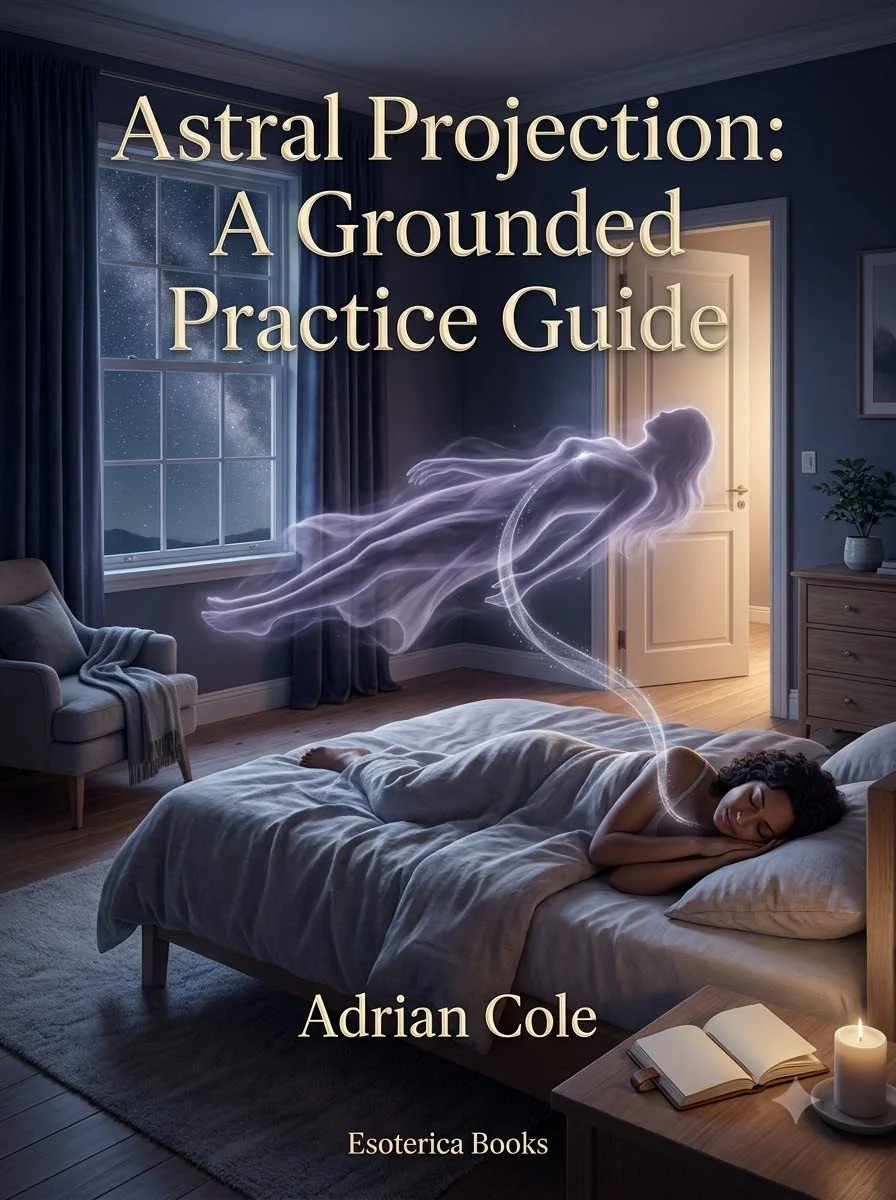


Astral Projection: A Grounded Practice Guide
Contents
- Your First Journey Begins Before You Close Your Eyes
Start with a simple, approachable first-session exercise that combines intention setting, comfortable positioning, relaxation, and gentle visualization. Follow the complete S.T.E.A.D.Y. sequence in miniature, record your observations, and discover how to approach the experience without pressuring yourself to leave your body. - Find Your Ground Before You Explore
Establish the essential foundations of a balanced practice: preparing your surroundings, choosing an appropriate time, setting boundaries, and learning simple grounding exercises. Understand common concerns about unusual sensations, how to stop a session, and why a calm, deliberate ending belongs in every practice. - The Quiet Threshold Between Waking and Dreaming
Explore the transition between wakefulness and sleep, including the hypnagogic imagery and unusual sensations that practitioners sometimes associate with out-of-body experiences. Learn to observe these moments without mistaking imagination, dream imagery, or bodily sensations for proof of a literal departure. - The Rope, the Float, and the Open Door
Work through several traditional visualization approaches, including the rope method, floating imagery, rolling-out imagery, and imagined movement. Each exercise includes preparation, step-by-step instructions, ways to adapt the imagery, and guidance on ending the session when concentration fades. - When a Dream Becomes a Place You Can Explore
Discover lucid dreaming as a complementary practice in which the dreamer becomes aware of dreaming while a dream is underway. Explore dream recognition, reality-checking as a reflective habit, dream intentions, and the differences between lucid dreaming experiences and traditional astral projection interpretations. - Learn to Recognize the Moment You Are Dreaming
Build a practical lucid dreaming routine through dream recall, daytime awareness exercises, intention setting, and the MILD approach. Explore how to do lucid dreaming without turning bedtime into a demanding task, and understand how dream awareness can complement astral projection exploration. - Keep a Record of What Happens at Night
Create a useful practice log that captures preparation, techniques attempted, sleep and dream observations, remembered imagery, and reflections after each session. Learn how a dream journal for lucid dreaming can reveal recurring personal patterns without turning subjective experiences into assumed facts. - Make Sense of Sensations Without Losing Perspective
Examine commonly reported experiences such as floating, vibration-like sensations, vivid imagery, altered perceptions of space, and a sense of movement. Consider possible sleep-related and imaginative explanations alongside spiritual interpretations, while learning to distinguish personal meaning from claims that cannot be established through experience alone. - Choose Your Tools Without Chasing Shortcuts
Explore optional aids such as written intentions, guided visualization, sound environments, and binaural audio as elements of a personal practice rather than necessary requirements. Consider the role of lucid dreaming masks and other sleep-related accessories critically, and learn when simplicity is the better choice. - Know When to Pause, Return, and Begin Again
Develop a practical approach to interrupted sessions, unwanted imagery, difficulty relaxing, and experiences that feel overwhelming or confusing. Learn a consistent closing routine, room-orientation exercise, and grounding sequence, along with sensible boundaries for deciding when to stop experimenting and return to ordinary sleep habits. - Build a Practice That Reflects Your Own Experience
Move beyond copying individual techniques and use the S.T.E.A.D.Y. Method to design a flexible personal routine. Compare visualization approaches, review practice-log entries, identify realistic intentions, and learn how to distinguish meaningful personal interpretations from expectations imposed by other people's accounts. - An Open Mind, a Steady Practice, and Your Own Path
Bring the complete method together in an adaptable long-term practice that balances astral projection traditions, lucid dreaming exploration, grounding, and reflective journaling. Consider different spiritual interpretations respectfully, develop your own criteria for evaluating experiences, and learn to remain curious without needing to reach a predetermined conclusion about what happened.
Curious about astral projection but unsure what to believe or how to begin? Adrian Cole introduces a structured approach to traditional out-of-body experience practices, combining bedtime relaxation, the rope method, floating visualization, and lucid dreaming exercises. At the center is the six-stage S.T.E.A.D.Y. Method: Settle, Tune, Envision, Anchor, Document, and Yield. Across twelve chapters, readers learn to prepare for sessions, recognize the transition into sleep, record unusual experiences, and distinguish personal spiritual interpretations from claims that cannot be verified.


📝 Description: Astral Projection: A Grounded Practice Guide
📖 Why choose it
Why this book is worth reading
Astral projection information can become confusing when traditional explanations, personal accounts, and claims of literal separation are mixed together. This book offers a more orderly starting point. Its six-stage framework connects preparation, visualization, grounding, and journaling into one adaptable routine. The inclusion of lucid dreaming is particularly useful for readers who want to understand overlapping experiences without treating the two practices as identical. Its most appealing quality is also its restraint: curiosity is encouraged, but certainty is never demanded.
⭐ Reader reviews
Reader rating
The strongest feature of Cole's guide is its organization. The S.T.E.A.D.Y. Method gives beginners a recognizable sequence, while the twelve chapters cover the practical territory expected from an introductory guide: relaxation, hypnagogia, rope and floating visualizations, lucid dreaming, journaling, and session management. The distinction between subjective experience and literal out-of-body travel is handled particularly carefully. The discussion of unusual sensations also leaves room for different interpretations without endorsing unsupported conclusions. One limitation is the introductory level: experienced practitioners looking for advanced techniques, detailed comparisons of historical traditions, or extensive philosophical discussion may find the treatment too basic. For beginners, however, the accessible structure is a clear strength.
❓ Frequently asked questions
📖 Who should read this
A good fit for beginners interested in astral projection, traditional out-of-body experience practices, and the connection between lucid dreaming and sleep awareness. Readers who prefer practical exercises, clear terminology, and a balanced discussion of spiritual interpretations will find the approach especially approachable.
🎯 Key themes and symbolism
Astral Projection Traditions
Lucid Dreaming
Visualization Techniques
Grounded Self-Observation
📜 Historical context
📚 Glossary
- Astral Projection
- Out-of-Body Experience (OBE)
- Hypnagogia
- Rope Method
- Lucid Dreaming
- S.T.E.A.D.Y. Method
📔 Questions to reflect on
- What draws me to astral projection, and what do I personally hope to understand through exploring this tradition?
- When I experience vivid imagery, unusual bodily sensations, or dream awareness, how can I distinguish what I directly observed from what I assume it means?
- Which elements of the S.T.E.A.D.Y. Method help me approach nighttime exploration with curiosity, realistic expectations, and a sense of personal boundaries?
📖 Read on the blog
✍️ More books by this author Adrian Cole




🏛 Books from this publisher Esoterica Books


You might also like
See more →








Have a question about this item?
Ask about the edition, condition, delivery or anything else — we reply by email or phone, usually within a day.
