Astral Projection
Astral projection is the deliberate experience of leaving the physical body and travelling in a subtle "astral body". Esoteric traditions describe it as a spiritual practice; researchers call the experience an out-of-body experience (OBE) and study it as a state of consciousness.
Where the word comes from
"Astral" comes from the Latin astrum and Greek astron, "star". In Neoplatonic and Renaissance thought the soul was clothed in a subtle vehicle made of starry or celestial substance as it descended through the planetary spheres. Nineteenth-century Theosophists spoke of an "astral body" and an "astral plane", and the phrase "astral projection" became standard in English occult writing in the early twentieth century.
In depth
Accounts of the soul leaving the body are very old: shamanic journeys, the "flights" of ancient mystics, and medieval visions all have something of this shape. The modern practice, with techniques meant to induce the experience at will, took form in Theosophy and the magical orders of the late nineteenth century.
The astral body and the astral plane
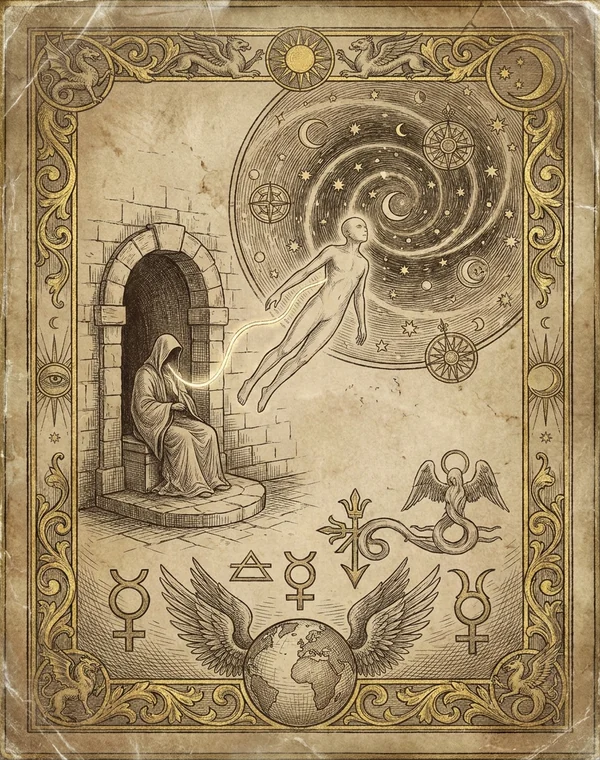
Theosophists such as Helena Blavatsky, C. W. Leadbeater and Annie Besant described the human being as layered: a physical body, an etheric double, an astral body of emotion and desire, and higher mental and spiritual bodies. The astral body could separate from the physical in sleep or trance and move in the astral plane, a world of thought-forms and subtle beings. Many later accounts include a "silver cord" connecting the two bodies, a detail often traced to Ecclesiastes 12:6.
In the Hermetic Order of the Golden Dawn, related techniques were taught as "skrying in the spirit vision" and "rising on the planes": the practitioner visualised a symbol, such as a tarot card or tattwa, imagined passing through it, and explored the scene that opened, testing what appeared by divine names and signs.
The classic manuals
Two books shaped popular practice. The Projection of the Astral Body (1929), by Sylvan Muldoon with the psychical researcher Hereward Carrington, gave detailed first-person accounts and methods, such as going to sleep with intense thirst or desire. Oliver Fox, the pen name of Hugh Callaway, described learning projection through lucid dreaming, noticing a "dream of knowledge" and then stepping out of it. In 1971 the American broadcasting executive Robert Monroe published Journeys Out of the Body, describing years of spontaneous and deliberate experiences; the Monroe Institute he founded developed audio techniques (Hemi-Sync) aimed at inducing them.
Common techniques
Most methods share a few elements: deep physical relaxation while the mind stays alert, often in the drowsy state at the edge of sleep; visualisation of a second body, a rope to climb or a point outside the body; and attention to vibrations, sounds or a sense of floating that many people report just before separation. Others approach projection from lucid dreaming, which many writers regard as a closely related or overlapping state.
What research says
Out-of-body experiences have been studied scientifically since the twentieth century. Surveys suggest a meaningful minority of people report at least one in their lives, often during sleep paralysis, near sleep, in near-death situations or under anaesthesia. Charles Tart reported laboratory studies of a gifted subject in 1968. In 2002 the neurologist Olaf Blanke and colleagues reported inducing out-of-body sensations by electrically stimulating the temporoparietal junction of a patient's brain, which suggests the experience is linked to how the brain integrates body position and perception. Controlled tests of whether projectors can see verifiable information at a distance have not produced reliable positive results.
How different paths see it
Where it appears
The Projection of the Astral Body (Sylvan Muldoon and Hereward Carrington, 1929). The classic early manual.
Journeys Out of the Body (Robert Monroe, 1971). A modern first-person account that founded the Monroe Institute.
Golden Dawn papers on skrying and rising on the planes (published by Israel Regardie, 1937 to 1940). The magical order's method.
Ecclesiastes 12:6. The "silver cord", later read as the link between astral and physical bodies.
What it means today
Astral projection is one of the few esoteric practices that a large number of people have experienced spontaneously, often to their surprise. That is part of its appeal: it feels like proof, from the inside, that consciousness is more than the body.
A balanced reader can hold two things at once. The experiences are real as experiences, and the neuroscience of how they happen is fascinating. Whether they show the soul travelling is a separate question that the evidence does not settle.
For practice, Muldoon and Carrington and Monroe are the classics, and modern lucid dreaming manuals offer the most reliable entry. For theory, compare the Theosophical account with current research on out-of-body experiences.