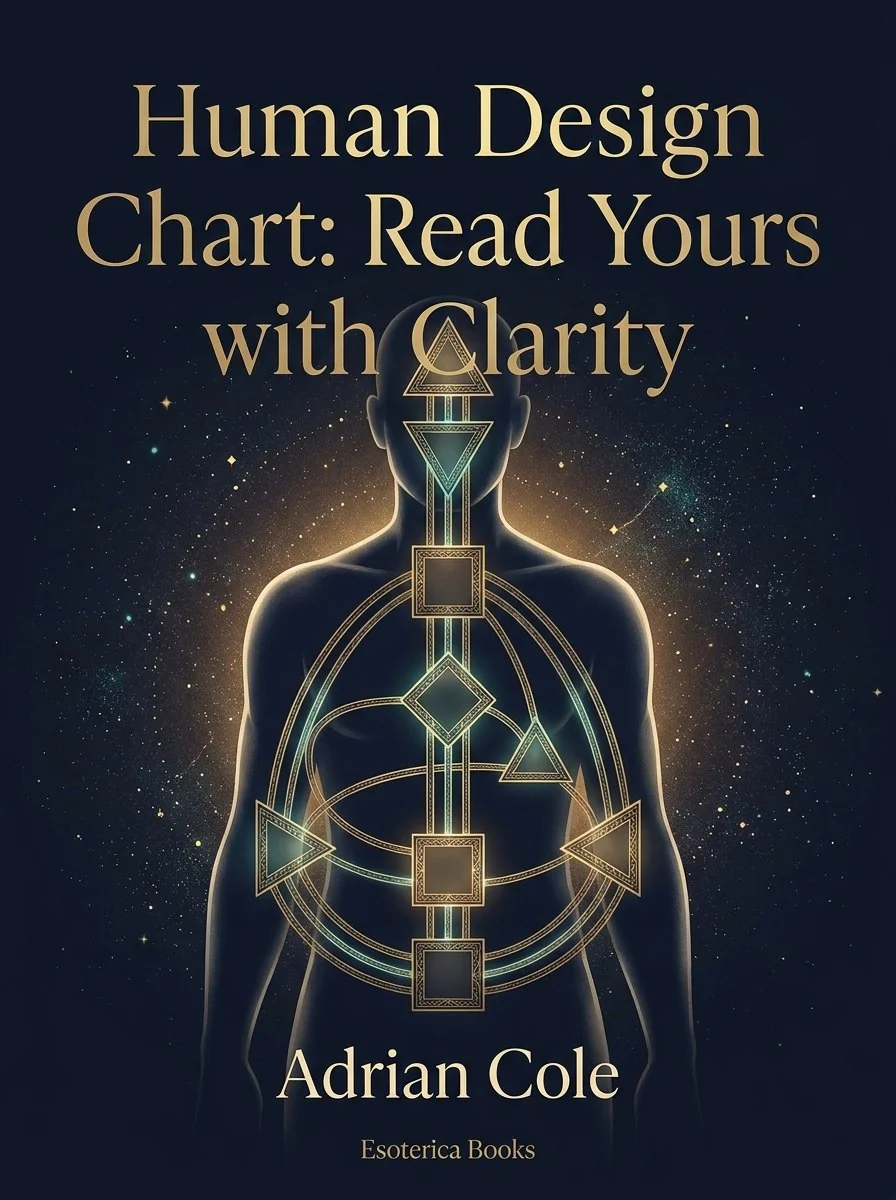


Human Design Chart: Read Yours with Clarity
Contents
- Your Chart Has a Message. Let's Find the First Clue
Start with a quick, practical exercise: locate your Type, Strategy, and Authority on your own bodygraph and use them to explore one ordinary decision. Readers get an immediate introduction to the C.L.E.A.R. Method and discover that they do not need to understand every symbol before beginning. - A Map of Shapes, Numbers, and Connections
Learn how to find, generate, and navigate a Human Design chart using birth date, birth time, and birthplace. A visual walkthrough explains the bodygraph, its nine Centers, connecting lines, numbers, and basic layout, helping readers understand what they are looking at before interpreting individual details. - Five Ways of Moving Through the World
Explore the five Types within the Human Design system: Manifestor, Generator, Manifesting Generator, Projector, and Reflector. Readers learn the distinctions between these categories, recognize the language associated with their own Type, and examine what each description invites them to reflect on without turning labels into limitations. - The Art of Waiting, Responding, and Initiating
Discover how Strategy is described for each Type and why it is one of the central concepts in interpreting a chart. Guided scenarios help readers compare different approaches to invitations, opportunities, responses, and initiating action while developing their own reflective questions. - The Quiet Voice Behind Your Choices
Understand the different Authorities described in Human Design, including Emotional, Sacral, Splenic, Ego, Self-Projected, Environmental, and Lunar Authority. Practical decision exercises help readers explore how their chart describes a personal decision-making process, with room for reflection rather than promises of correct answers. - Your Profile Is More Than Two Numbers
Decode the two numbers that form a Human Design Profile and explore the twelve possible Profile combinations. Readers learn the language of lines, investigate the themes associated with their combination, and use journal prompts to distinguish a useful interpretation from an overly restrictive self-description. - The Nine Centers and the Space Between Them
Explore the nine Centers and the distinction between defined, undefined, and open areas of a bodygraph. Readers learn the vocabulary used to interpret these features and practice reading the visual differences without assuming that a particular configuration determines personality or destiny. - The Lines That Bring Your Chart Together
Move beyond individual Centers to understand Channels, Gates, and Definition. Readers discover how connections are represented in the bodygraph, learn to locate Gate numbers, and work through an illustrated exercise that brings separate chart elements into a coherent interpretation. - When Your Chart Seems to Tell Two Stories
Learn to interpret combinations of Type, Strategy, Authority, Profile, Centers, and Definition without getting overwhelmed by apparent contradictions. A step-by-step comparison exercise demonstrates how to prioritize the main elements and avoid treating every chart detail as equally important. - Put Your Design to Work in Everyday Decisions
Apply the C.L.E.A.R. Method to everyday situations involving plans, commitments, creative projects, conversations, and changing priorities. Readers work through realistic examples, adapt reflection prompts to their own Authority, and learn to distinguish personal observations from assumptions about what their chart should mean. - Become Your Own Chart Interpreter
Practice reading a complete bodygraph from beginning to end, using a repeatable sequence rather than relying on disconnected descriptions or outside interpretations. Readers learn to check their terminology, organize their observations, compare chart elements, and develop a clear personal explanation of their design. - A Living Relationship With Your Bodygraph
Bring the entire system together in a personal Human Design reference guide, including a chart-reading worksheet, decision journal, vocabulary list, and adaptable C.L.E.A.R. practice. The final chapter encourages readers to revisit their interpretations over time, remain open to changing perspectives, and use Human Design as a tool for reflection rather than an identity they must follow.
Your Human Design chart may be full of shapes, numbers, lines, and unfamiliar terminology, but learning to read it does not have to be complicated. Adrian Cole introduces the C.L.E.A.R. Method—Connect, Locate, Explore, Apply, Review—as a five-step framework for understanding your BodyGraph. Starting with Type, Strategy, and Authority, the book gradually explores Profiles, nine Centers, Channels, Gates, and Definition. Illustrated explanations, everyday scenarios, and guided exercises help you connect the different elements and develop your own thoughtful interpretation without treating the system as a set of rigid rules.


📝 Description: Human Design Chart: Read Yours with Clarity
📖 Why choose it
Why this book is worth reading
A Human Design chart can look more complicated than it needs to be, particularly when explanations introduce several unfamiliar terms at once. This guide offers a sensible reading order, beginning with three essential reference points before introducing the finer details. Its strongest practical feature is the C.L.E.A.R. Method, which connects chart interpretation with everyday observation through repeatable exercises. Rather than telling readers what they must believe or do, it encourages them to develop an interpretation they can examine and revise.
⭐ Reader reviews
Reader rating
The strongest feature of this guide is its decision to teach chart reading as a process rather than a collection of disconnected definitions. The C.L.E.A.R. Method gives beginners a useful sequence: start with Type, Strategy, and Authority, then introduce the more detailed elements of the BodyGraph. The contents also make room for combinations of chart features, an important distinction when individual descriptions seem contradictory. Everyday scenarios and a personal reference worksheet support the practical approach. The book is appropriately cautious about treating interpretations as instructions. One limitation: experienced Human Design readers looking for advanced technical analysis or extensive theoretical debate may find the introductory explanations too basic.
❓ Frequently asked questions
📖 Who should read this
This book is for beginners who want to understand their Human Design chart and for existing enthusiasts who need a clearer, more organized approach to reading its main elements. It is particularly suitable for readers who prefer practical exercises and plain-English explanations over extensive esoteric terminology.
🎯 Key themes and symbolism
BodyGraph Interpretation
Types and Strategy
Personal Authority
Everyday Reflection
📜 Historical context
📚 Glossary
- BodyGraph
- Type
- Strategy
- Authority
- Profile
- Gate
📔 Questions to reflect on
- Which elements of your Human Design chart are easiest to understand, and which ones invite you to slow down and look more closely?
- When considering your Type, Strategy, and Authority, what questions arise about the way you approach everyday decisions?
- How might your interpretation of your BodyGraph change if you treated its descriptions as possibilities for reflection rather than fixed definitions of who you are?
📖 Read on the blog
✍️ More books by this author Adrian Cole





🏛 Books from this publisher Esoterica Books



You might also like
See more →







Have a question about this item?
Ask about the edition, condition, delivery or anything else — we reply by email or phone, usually within a day.
