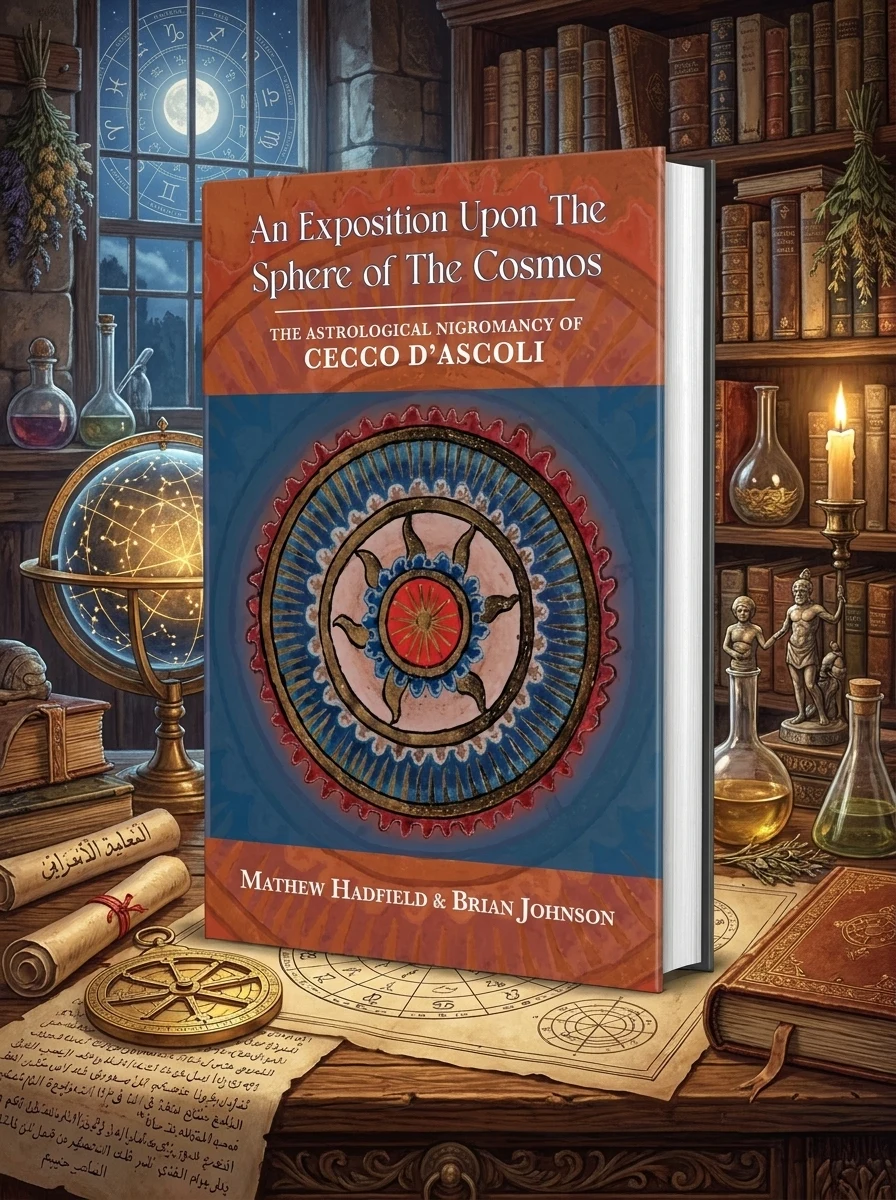
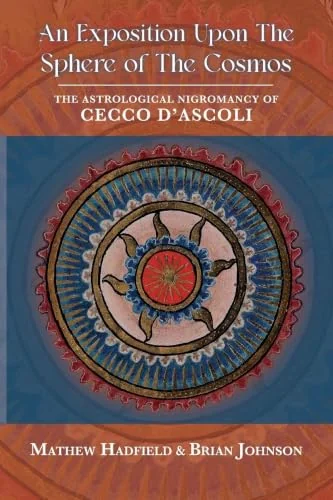
An Exposition upon The Sphere of the Cosmos: The Astrological Nigromancy of Cecco d'Ascoli
This seminal work by Mathew Hadfield and Brian Johnson meticulously unpacks Cecco d'Ascoli's pivotal *Commentary on the Sphaera of Sacrobosco*. It masterfully demonstrates how sophisticated Arabic and Byzantine philosophical and astrological knowledge permeated late medieval Europe, profoundly shaping illicit religious practices and the very fabric of European magical cosmology. Through D'Ascoli's lectures, we witness the formal establishment of Astral Nigromancy, infused with refined Aristotelian and Ptolemaic rationale, laying the essential groundwork for what would become the enduring Grimoire Tradition.


📝 Description: An Exposition upon The Sphere of the Cosmos: The Astrological Nigromancy of Cecco d'Ascoli
💎 Expert review
📖 Why choose it
Why this book is worth reading
Readers deeply invested in the origins of Western occultism will find this book indispensable. It offers a meticulous unpacking of Cecco d'Ascoli’s pivotal commentary, revealing how sophisticated Arabic and Byzantine knowledge shaped late medieval Europe. Those seeking to understand the formal establishment of Astral Nigromancy and its refined Aristotelian rationale will gain profound insight into the foundational layers of the Grimoire Tradition. This text is essential for anyone wishing to trace the dark cosmic roots of medieval magic and witness how philosophical frameworks influenced illicit religious practices, providing a crucial link between classical thought and later esoteric developments.
⭐ Reader reviews
Reader rating
This editorial assessment highlights the book’s rigorous academic approach to Cecco d'Ascoli’s *Commentary on the Sphaera*. It is a vital resource for scholars tracing the lineage of European magical cosmology through Arabic and Byzantine influences. However, it does not suit casual readers seeking accessible narratives or those uninterested in dense philosophical analysis. The text assumes familiarity with Aristotelian and Ptolemaic concepts, making it inaccessible to those looking for simple historical overviews rather than a technical dissection of how these ideas established the groundwork for enduring grimoire traditions and astral nigromancy.
❓ Frequently asked questions
📖 Who should read this
If you're drawn to the intricate origins of Western esotericism, the profound interplay of philosophy and magic, or the historical lineage of grimoire traditions, this deep dive into Cecco d'Ascoli's influence is essential reading. Prepare for a scholarly journey into the mind of a pivotal medieval magus.
🎯 Key themes and symbolism
Cross-Cultural Esotericism
This book illuminates the vital conduits through which advanced Arabic and Byzantine astrological and philosophical concepts flowed into medieval Europe. It reveals how these intellectual exchanges profoundly shaped Western occult thought, demonstrating a complex, interconnected history of spiritual and magical practices across cultures.
Birth of Astral Nigromancy
Delve into how D'Ascoli's lectures on Sacrobosco's *Sphaera Mundi* fundamentally integrated sophisticated Aristotelian and Ptolemaic cosmology with spiritual practices. This synthesis created the foundational framework for astral nigromancy, a highly conceptualized form of magic that quietly propagated through centuries and influenced later occultists.
Grimoire Tradition Genesis
Explore the crucial role this intricate intellectual synthesis played in forging the very bedrock of the European Grimoire Tradition. The text highlights its complex cosmological framework and details early, significant attributions, such as linking the four cardinal kings—Oriens, Amaymon, Paymon, and Egyn—to the cardinal signs of the zodiac.
📜 Historical context
📚 Glossary
- Nigromancy
- Sphaera Mundi
- Grimoire Tradition
📔 Questions to reflect on
- How might a deeper understanding of historical magical cosmologies alter our contemporary perceptions of the universe and our place within it?
- Consider the implications of spiritual practices being built upon sophisticated scientific (for their time) frameworks. How does this challenge modern divisions between science and magic?
- Reflect on the transmission of knowledge across cultures and how foundational Arabic and Byzantine thought shaped European magical traditions. What does this reveal about intellectual exchange?