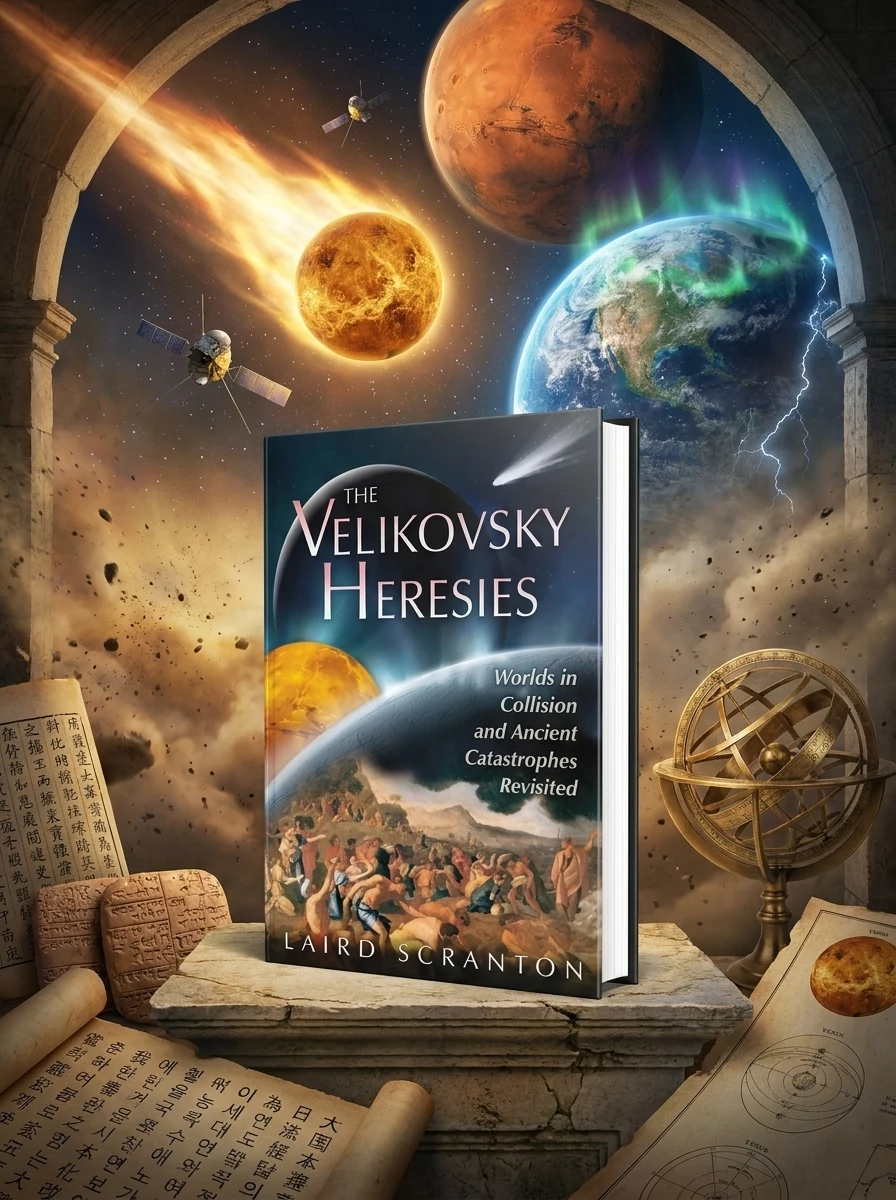
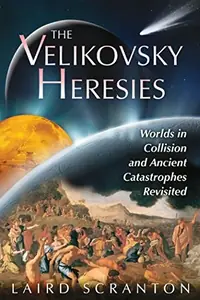
The Velikovsky Heresies: Worlds in Collision and Ancient Catastrophes Revisited
Scranton, Laird

This edition can be ordered. No arrival date is confirmed.
Was Earth's ancient past scarred by a rogue planet, reshaping history as we know it?
Immanuel Velikovsky’s audacious hypothesis, that Venus once traversed our solar system as a comet causing global cataclysms before settling into its orbit, ignited fierce debate decades ago. Laird Scranton meticulously resurrects this controversial narrative, presenting a compelling re-examination. Drawing upon recent astronomical discoveries from space probes and newly translated ancient records from diverse cultures, Scranton endeavors to provide scientific and historical substantiation for Velikovsky's radical claims, challenging conventional planetary science and our understanding of antiquity.
This work resides within the tradition of esoteric history and alternative planetary science, engaging with the controversial legacy of Immanuel Velikovsky’s radical hypotheses on ancient catastrophes. It bridges occult philosophy with interdisciplinary research into astronomical anomalies and historical records.


📝 Description: The Velikovsky Heresies: Worlds in Collision and Ancient Catastrophes Revisited
💎 Expert review
📖 Why choose it
Why this book is worth reading
Readers fascinated by the intersection of mythology, astronomy, and ancient history will find this book a compelling invitation to reconsider established narratives. If you have ever wondered whether Earth’s past was shaped by cosmic upheavals rather than gradual geological processes, Laird Scranton offers a meticulous resurrection of Velikovsky’s controversial ideas. By synthesizing recent astronomical data from space probes with newly translated ancient records, the text provides a robust framework for those seeking scientific and historical substantiation for radical claims. It is ideal for open-minded scholars and enthusiasts who enjoy challenging conventional wisdom and exploring how global cataclysms might have reshaped human civilization and planetary orbits in ways standard science often overlooks.
⭐ Reader reviews
Reader rating
Scranton’s work is a dense, scholarly resurrection of Velikovsky’s once-scorned theories, backed by modern astronomical findings and diverse ancient texts. It serves as a rigorous defense for those willing to engage with complex interdisciplinary arguments that defy mainstream consensus. However, this book is not suitable for readers who prefer straightforward, conventional historical accounts or those deeply committed to standard planetary science models without room for speculative revisionism. The tone is academic and earnest, lacking the accessible flair of popular fringe history. Readers seeking quick answers or entertaining speculation may find the meticulous detail tedious. It demands patience and an open mind regarding controversial scientific intersections.
❓ Frequently asked questions
📖 Who should read this
If you question established scientific dogma and are drawn to the intersections of ancient mysteries, planetary science, and alternative historical narratives, this book is for you. It offers a rigorous, albeit controversial, intellectual journey for those unafraid to challenge conventional wisdom.
🎯 Key themes and symbolism
Revisiting Venus's Genesis
Scranton thoroughly scrutinizes modern astronomical data, including findings from recent space missions. He presents novel interpretations suggesting that these discoveries lend credence to Velikovsky's assertion that Venus experienced a tumultuous, comet-like phase before assuming its current planetary status, offering explanations for its unique characteristics.
Echoes in Ancient Lore
The book delves into a rich tapestry of newly deciphered historical documents, particularly those from East Asian civilizations like China, Korea, and Japan. Scranton argues that these ancient narratives often describe Venus with comet-like attributes, aligning remarkably with the disruptive celestial events proposed by Velikovsky in his original work.
Planetary Cataclysms Unveiled
This volume explores geological and archaeological evidence pointing to significant geomagnetic disturbances around 1500 BCE and 750 BCE. These periods of planetary upheaval are posited as direct correlations to close encounters between the "comet Venus," Earth, and Mars, providing a mechanism for the widespread destruction Velikovsky described.
💬 Quotes from the book
“The emerging data from recent probes to Venus presents a compelling argument for a past far more dynamic and chaotic than conventional models allow, echoing Velikovsky's once-heretical insights.”
“Across disparate cultures, from the Far East to the Near East, ancient chronicles consistently portray Venus not as a tranquil planet, but as a fiery, erratic celestial body, a 'comet of destruction'.”
📜 Historical context
📚 Glossary
- Velikovsky Heresies
- Worlds in Collision
- Geomagnetic Events
📔 Questions to reflect on
- If Velikovsky's theories, as re-examined by Scranton, were proven true, how might our understanding of human history and the development of early civilizations drastically change?
- Consider the implications of a scientific establishment initially dismissing, then potentially re-evaluating, such a radical theory. What does this tell us about scientific progress and open-mindedness?
- How does the integration of ancient mythological accounts with modern astronomical data reshape your perspective on the boundaries between science, history, and legend?
✍️ More books by this author Scranton, Laird
All books by this author →
🏛 Books from this publisher Bear & Company
All books from this publisher →

You might also like
See more →