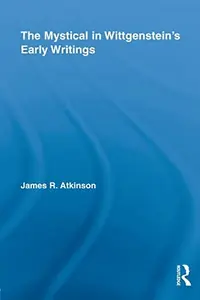
The Mystical in Wittgenstein's Early Writings Atkinson, James R
Stock reported in the catalog; fulfillment is confirmed with your request.
Uncover the hidden spiritual depths within Wittgenstein's foundational logical work.
James R. Atkinson presents a compelling re-evaluation of Ludwig Wittgenstein's *Tractatus Logico-Philosophicus*, proposing that its early writings can be fruitfully understood through a mystical lens. This insightful volume delves into how Wittgenstein's philosophical inquiries into language and logic subtly touch upon profound mystical concepts. Atkinson explores themes such as the nature of God, the ultimate meaning of life, the essence of reality, the concept of the eternal, and the enigma of the solipsistic self, revealing an unexpected spiritual undercurrent in a text often considered purely analytical. It challenges readers to perceive philosophy's mystical dimensions.
This work sits at the intersection of analytic philosophy and Western esotericism, bridging the gap between logical positivism and mystical theology. It challenges the mid-20th-century reception of Wittgenstein by reintroducing spiritual dimensions often suppressed in strict linguistic analysis.


📝 Description: The Mystical in Wittgenstein's Early Writings Atkinson, James R
💎 Expert review
📖 Why choose it
Why this book is worth reading
Readers fascinated by the hidden spiritual undercurrents in seemingly dry philosophical texts will find this volume deeply rewarding. James R. Atkinson invites those who sense a mystical dimension in logic to explore how concepts like God, life's meaning, and the eternal self emerge within the Tractatus. It is ideal for scholars and enthusiasts willing to look beyond analytical surfaces to uncover profound metaphysical questions. If you appreciate re-evaluating foundational works through unconventional lenses, this book offers a compelling path to understanding philosophy’s mystical dimensions.
⭐ Reader reviews
Reader rating
Atkinson provides a stimulating re-evaluation of the Tractatus, successfully arguing for a mystical interpretation that challenges purely linguistic readings. However, readers seeking straightforward logical analysis or historical biography will likely find this approach abstract and unsatisfying. Those who prefer Wittgenstein’s later, ordinary language philosophy may feel disconnected from this early focus. The book is not for purists who view mysticism as antithetical to rigor; it requires an openness to ambiguity. It succeeds in revealing spiritual depths but demands a willingness to embrace interpretive flexibility over strict textual literalism.
❓ Frequently asked questions
📖 Who should read this
If you've pondered the boundaries of logic and spirit, or seek a fresh perspective on seminal philosophical texts, this book offers a profound journey. Ideal for those who enjoy challenging conventional wisdom and exploring the esoteric dimensions of thought, bridging analytical rigor with spiritual contemplation.
🎯 Key themes and symbolism
Mystical Interpretations
This book boldly re-examines Wittgenstein's *Tractatus*, arguing for a mystical reading that transcends conventional analytical interpretations. It posits that the work's logical structures implicitly point towards profound, ineffable truths, inviting a new understanding of its core arguments as more than just linguistic propositions but as veiled spiritual insights.
God and Meaning
Atkinson explores how Wittgenstein's early philosophical reflections on existence and ethics inadvertently pave the way for a mystical understanding of God and the ultimate meaning of life. The book suggests that even within the confines of logical expression, the *Tractatus* gestures towards a transcendent realm that shapes our comprehension of purpose and divinity.
The Solipsistic Self
The author meticulously unpacks Wittgenstein's concept of the 'solipsistic self,' presenting it not as mere isolation but as a gateway to mystical experience. This perspective highlights the unique, enclosed nature of individual consciousness as a profound, self-contained universe, offering a spiritual dimension to the perceived boundaries of personal reality.
💬 Quotes from the book
“The limits of my language mean the limits of my world, yet beyond these boundaries, the ineffable beckons, a silent testament to truths unspoken.”
“To confront the solipsistic core of existence is not merely an intellectual exercise, but an encounter with the profound isolation and unique perspective of the individual soul.”
📜 Historical context
📚 Glossary
- Tractatus Logico-Philosophicus
- Mystical
- Solipsistic Self
📔 Questions to reflect on
- How does the idea that language limits our world, yet hints at the ineffable, resonate with your own spiritual or philosophical understanding?
- Consider your 'solipsistic self.' What does it mean to experience existence from a uniquely individual perspective, and can this lead to mystical insight?
- If fundamental logical texts contain hidden mystical dimensions, what other areas of conventional thought might also harbor unspoken spiritual truths?
🏛 Books from this publisher Routledge
All books from this publisher →
 89
89
You might also like
See more → 89
89
 89
89

 84
84


 80
80