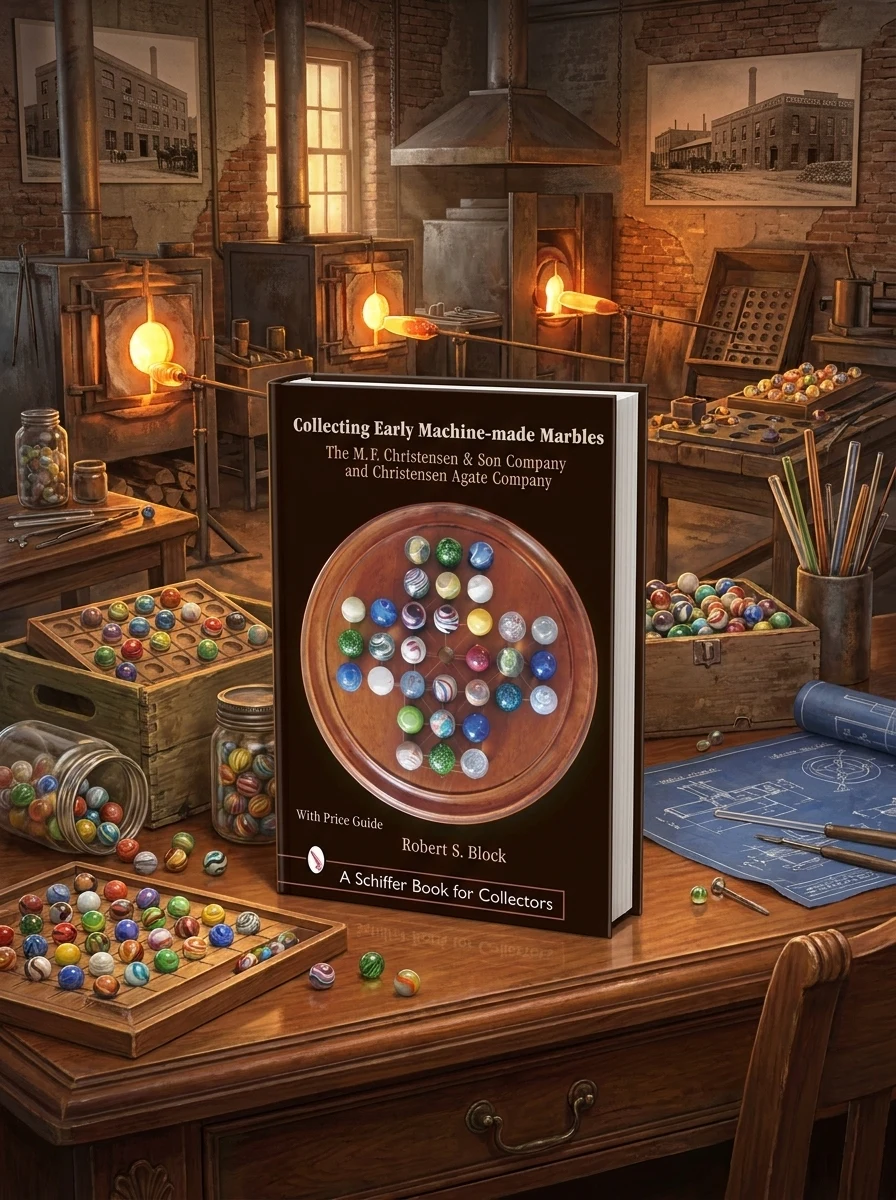

Collecting Early Machine Made Marbles from the M.F. Christensen & Son Company and Christensen Agate Company
This edition can be ordered. No arrival date is confirmed.
A photographic tour through the industrial glass revolution of early twentieth-century Ohio.
Robert Block guides collectors through the golden age of mechanical marble production, focusing on the output of M.F. Christensen & Son and the Christensen Agate Company. This volume features over seven hundred vibrant color images documenting the shift from artisanal to industrial glassmaking. It meticulously catalogs diverse forms including bricks, cobras, guineas, and various slag varieties. Beyond visual appreciation, the text provides essential historical context, manufacturing techniques, and current market valuations for each piece. It serves as a definitive reference for enthusiasts seeking to understand the technical evolution of the industry.
This volume sits at the intersection of industrial history and specialized hobbyist collecting, documenting the transition from artisanal craft to mechanized mass production in early twentieth-century Ohio. It serves as a niche reference within the broader tradition of material culture studies and collector's guides for tangible historical artifacts.


📝 Description: Collecting Early Machine Made Marbles from the M.F. Christensen & Son Company and Christensen Agate Company
💎 Expert review
📖 Why choose it
Why this book is worth reading
This book is an essential resource for serious collectors of early machine-made marbles who wish to deepen their understanding of the Christensen legacy. Readers will appreciate the meticulous documentation of diverse forms like bricks and cobras, supported by historical context and market valuations. It appeals to those fascinated by the technical evolution of glassmaking and the industrial revolution in Ohio. By combining vibrant imagery with practical collecting advice, it bridges the gap between aesthetic appreciation and scholarly research. Enthusiasts seeking a definitive reference for identifying and valuing pieces from the M.F. Christensen era will find this guide indispensable for building a knowledgeable and informed collection.
⭐ Reader reviews
Reader rating
Took a chance on this and glad I did. Some sections stopped me cold in the best way. The symbolism is layered and generous to patient readers. Solid, if not essential.
Bought this as a gift for my sister and ended up ordering a second copy for myself. Every rereading turns up something I missed.
This edition finally does the material justice. Challenging in places, but never needlessly obscure. The font runs small in the appendices.
My book club chose this last month. The historical context alone makes it worth the price. It reads better in small doses — a chapter at a time with notes. Still worth having on the shelf.
Added this to my reference shelf. It connects ideas I'd only seen treated separately elsewhere. I'd have loved an index, but that's on the original text. Recommended with reservations.
My third book from this store and this one might be the best. The typesetting is comfortable for study, with good margins for notes. The ideas are old but land with surprising force today.
While visually striking with its seven hundred color images, this text is strictly a technical manual for a specific niche. It offers little narrative flair or general historical breadth, making it unsuitable for casual readers interested in broader industrial history or those seeking a traditional narrative about the glass industry. The focus on market valuations and precise categorization of slag varieties may bore anyone not already invested in the minutiae of marble collecting. It is purely a reference work, lacking the engaging prose found in general non-fiction. Only those dedicated to the specific hobby of Christensen marble acquisition will find sufficient value in its dense, specialized content.
❓ Frequently asked questions
📖 Who should read this
Dedicated marble collectors, historians of industrial design, and those fascinated by the material culture of early American manufacturing. This volume is essential for anyone seeking to catalog or appraise Christensen-era pieces with authority.
🎯 Key themes and symbolism
Industrial Glass Evolution
The book traces the critical transition from hand-blown to machine-made marbles, highlighting how Ohio factories standardized production. It examines the technological innovations that allowed for mass production while maintaining aesthetic complexity, reshaping the global market for playthings and collectibles during the early twentieth century.
Marble Typology and Classification
Block offers a rigorous taxonomy of Christensen outputs, distinguishing between opaques, swirls, and the rare transitional slabs. Each category is analyzed for its visual characteristics and manufacturing process, providing collectors with the precise vocabulary needed to identify specific types, such as single pontil slags or hand-gathered swirls, with confidence.
Valuation and Market History
Integrating historical narrative with practical collecting advice, the text assigns values to the pictured specimens. It contextualizes the economic significance of these companies, helping readers understand not just the physical attributes of the marbles, but their place in the broader history of American industrial commerce and hobbyist culture.
💬 Quotes from the book
“The mechanical precision of the Christensen factories created a new aesthetic of controlled chaos, where industrial standardization met artistic variation.”
“To collect these marbles is to hold a fragment of Ohio's industrial soul, frozen in glass.”
📜 Historical context
📚 Glossary
- Transitional Slabs
- Pontil Slags
- Hand-Gathered Swirls
📔 Questions to reflect on
- How does the standardization of glass production alter your appreciation for the individual beauty of each marble?
- Which specific visual flaw or feature in the Christensen marbles do you find most intriguing, and why?
- In what ways do these industrial artifacts reflect the broader cultural shift from craftsmanship to efficiency in the early twentieth century?
🏛 Books from this publisher Schiffer Publishing
All books from this publisher →
 89
89







You might also like
See more → 91
91


 91
91


 91
91