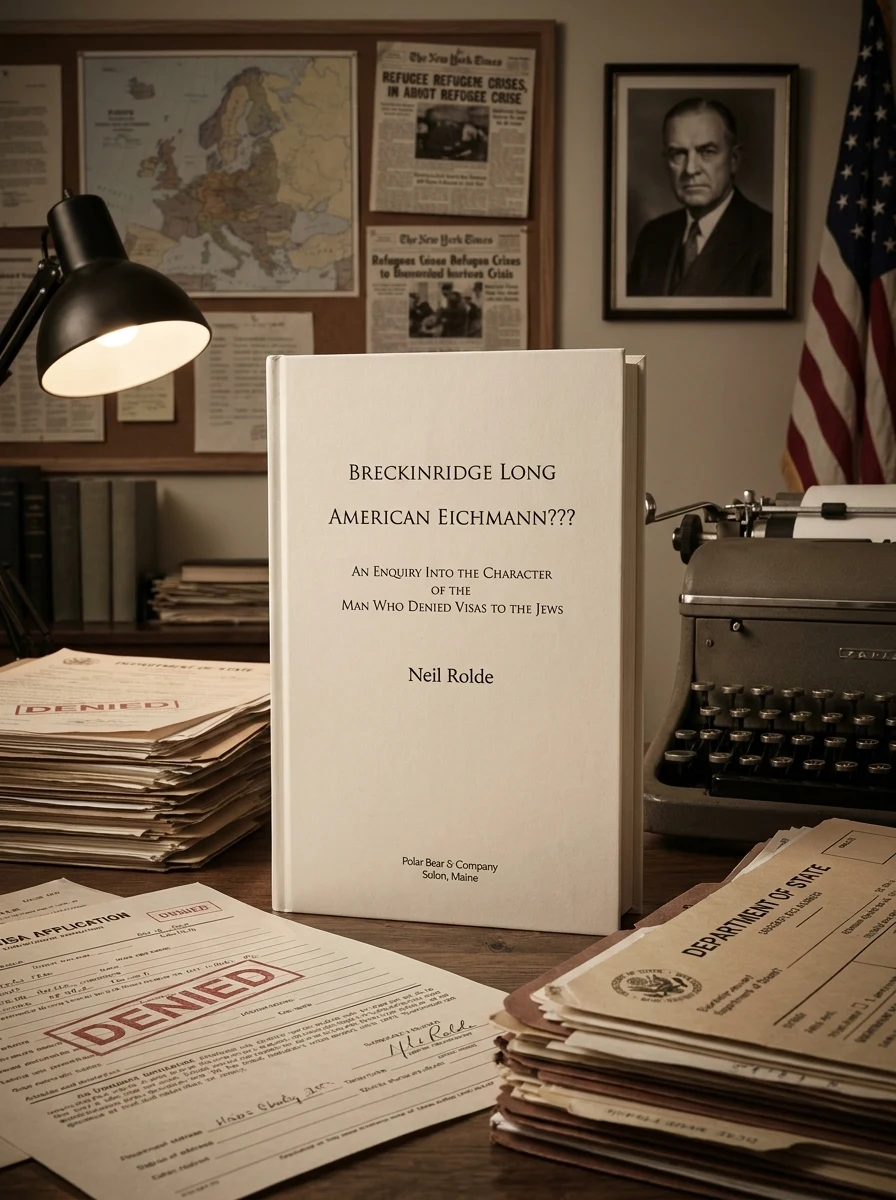

Breckinridge Long, American Eichmann: An Enquiry into the Character of the Man Who Denied Visas to the Jews
Rolde, NeilStock reported in the catalog; fulfillment is confirmed with your request.
A searing examination of the bureaucrat who weaponized state policy to block Jewish refugees from American shores.
Neil Rolde dismantles the reductive caricatures of Breckinridge Long, the State Department official whose obstructionism defined America’s Holocaust response. By excavating archives, Rolde reveals a man driven by complex fears of communist infiltration and deep-seated xenophobia, rather than simple malice. This biography challenges the myth of passive bureaucracy, showing how ideological rigidity and institutional inertia actively conspired to deny visas. It is a crucial corrective to sanitized diplomatic histories, offering a nuanced look at how ordinary administrative decisions can facilitate extraordinary evil during times of global crisis.
This work sits at the intersection of rigorous diplomatic history and moral philosophy, challenging sanitized narratives of American neutrality during the Holocaust. It serves as a critical corrective within the tradition of historical inquiry into state-sponsored obstructionism.


📝 Description: Breckinridge Long, American Eichmann: An Enquiry into the Character of the Man Who Denied Visas to the Jews
💎 Expert review
📖 Why choose it
Why this book is worth reading
This book is essential for readers who wish to understand how ordinary administrative decisions can facilitate extraordinary evil during global crises. It offers a nuanced look at the complex fears, xenophobia, and ideological rigidity that drove a bureaucrat to weaponize state policy against Jewish refugees. By dismantling reductive caricatures, Neil Rolde provides a crucial corrective to sanitized diplomatic histories, revealing how institutional inertia actively conspired to deny visas. Readers seeking to grasp the depth of America’s Holocaust response and the mechanisms of passive bureaucracy will find this examination searing and indispensable.
⭐ Reader reviews
Reader rating
Finally got around to ordering this. It pairs well with more modern commentaries on the same tradition. The historical context alone makes it worth the price. Highly recommend to serious students.
Grabbed this during a weekend order. The material is presented clearly and the structure makes it easy to revisit key passages. Challenging in places, but never needlessly obscure. A few pages arrived with light corner wear, though nothing serious. Solid, if not essential.
Rolde delivers a searing, archival-driven examination that dismantles myths of passive bureaucracy. While intellectually robust, this book is not for those seeking a quick historical overview or readers who prefer narratives centered on heroic resistance rather than institutional complicity. It demands patience with dense political analysis and offers no easy villains, only complex human failures driven by fear and xenophobia. Those expecting a sensationalist thriller may find the focus on ideological rigidity and administrative obstruction dry. However, for those committed to understanding the subtle mechanics of state-sponsored denial, this corrective is vital.
❓ Frequently asked questions
📖 Who should read this
Readers interested in the moral failures of the Roosevelt administration, scholars of diplomatic history, and anyone grappling with the mechanisms of modern state-sponsored exclusion and the ethics of bureaucratic duty.
🎯 Key themes and symbolism
Bureaucratic complicity
Immigration restrictionism
Moral ambiguity
💬 Quotes from the book
“The complexity of his life and motivations are lost when reduced to single dimensions.”
“A wealth of information about this critical and troubled chapter in modern American political history.”
📜 Historical context
📚 Glossary
- Visa Restrictionism
- State Department
- Xenophobia
📔 Questions to reflect on
- How does the language of bureaucracy serve to distance officials from the human consequences of their decisions?
- In what ways do modern immigration policies still reflect the fears and prejudices of the mid-twentieth century?
- Can a person be considered morally complicit in atrocities if they were merely following institutional protocols?
✍️ More books by this author Rolde, Neil
All books by this author →
🏛 Books from this publisher Polar Bear & Company
All books from this publisher →

 82
82


You might also like
See more →




 89
89

 82
82