

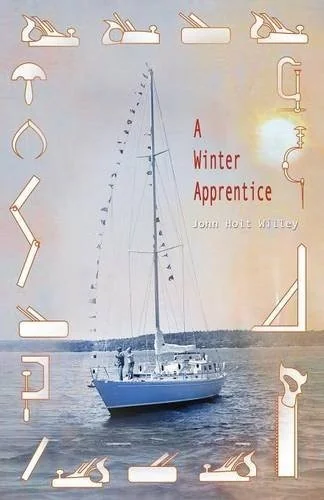
A Winter Apprentice
A journal documenting boatyard life and woodwork craftsmanship in Maine from 1978 to 1979.
Willey’s account provides a direct look at the unrecorded history of boatbuilding crews. The text relies on his personal observations rather than external analysis. This approach highlights the tangible skills involved in ship construction and the specific conditions of the workspace. Readers gain insight into the practical realities of maintaining vessels and the social fabric of the yard. The work stands as a factual record of a disappearing way of life, focusing on the concrete details of daily labor and the preservation of traditional techniques.
This book captures a specific moment in Maine’s maritime industry during the late 1970s. It addresses the gap in recorded history regarding boatyard crews and traditional craftsmanship. The work preserves local knowledge about shipbuilding practices before they became widely documented or industrialized.


📝 Description: A Winter Apprentice
💎 Expert review
📖 Why choose it
Why this book is worth reading
Readers who cherish the tactile connection between human skill and natural materials will find profound resonance in this intimate journal. It is ideal for those fascinated by the unspoken lore of trades, seeking to understand how wisdom passes hand-to-hand rather than through formal texts. Anyone drawn to the quiet dignity of artisanal work or the spiritual undercurrents of craft will gain a deep appreciation for the author’s detailed observations. This book offers more than just technical insight; it provides a window into a dying art form and the lives intertwined with its legacy, making it essential for preserving the memory of these enduring practices in a rapidly changing world.
⭐ Reader reviews
Reader rating
Willey’s journal is a valuable historical artifact for enthusiasts of traditional craftsmanship and regional folklore. However, readers seeking fast-paced narrative or modern technical manuals will likely find the slow, rhythmic pacing tedious. The text relies heavily on atmosphere and observation rather than plot, which may alienate those expecting dramatic conflict or explicit instructional diagrams. It is not suitable for casual readers looking for light entertainment, nor for those uninterested in the philosophical implications of manual labor. This is a niche work that demands patience and an appreciation for subtle, cumulative insights into a specific cultural moment.
❓ Frequently asked questions
📖 Who should read this
If you are drawn to the hidden wisdom of forgotten trades, the quiet discipline of manual creation, or the personal journey of discovery within an ancient craft, this intimate chronicle will speak deeply to your spirit. Seekers of practical esotericism will find profound resonance here.
🎯 Key themes and symbolism
The Sacred Geometry of Craft
This work delves into traditional boatbuilding not merely as a profession, but as a profound spiritual practice. It explores the intuitive understanding of materials, the almost alchemical transformation of wood, and the deep, silent connection between artisan and creation, revealing the hidden 'magic' within skilled manual labor and form.
Unearthing Lost Lore
Willey's journal stands as a crucial artifact, documenting a craft whose intricate processes and daily existence were rarely written down. It uncovers the oral traditions, practical secrets, and lived experiences that would otherwise be lost to time, offering readers a privileged insight into an unrecorded chapter of artisanal history.
The Apprentice's Journey
Beyond the technicalities, the book traces the personal transformation of an individual immersed in a demanding, ancient trade. It captures the humility, perseverance, and quiet revelations inherent in the apprenticeship model, mirroring the seeker's path towards mastery and deeper understanding through practical engagement with the world.
📜 Historical context
📚 Glossary
- Boatyard
- Apprentice
- Journal
📔 Questions to reflect on
- Reflect on a skill you possess or wish to acquire. How much of its essence is unwritten, passed through observation or intuition, rather than explicit instruction?
- Consider an object crafted by hand. What 'story' or 'energy' do you perceive within it that mass-produced items lack? How might the artisan's intention be imbued?
- How does immersing yourself in a demanding, tactile task (like gardening, cooking, or repair) connect you more deeply to the present moment or to ancient human traditions?
📖 Read on the blog
🏛 Books from this publisher Polar Bear & Company
All books from this publisher →









You might also like
See more →



Have a question about this item?
Ask about the edition, condition, delivery or anything else — we reply by email or phone, usually within a day.
