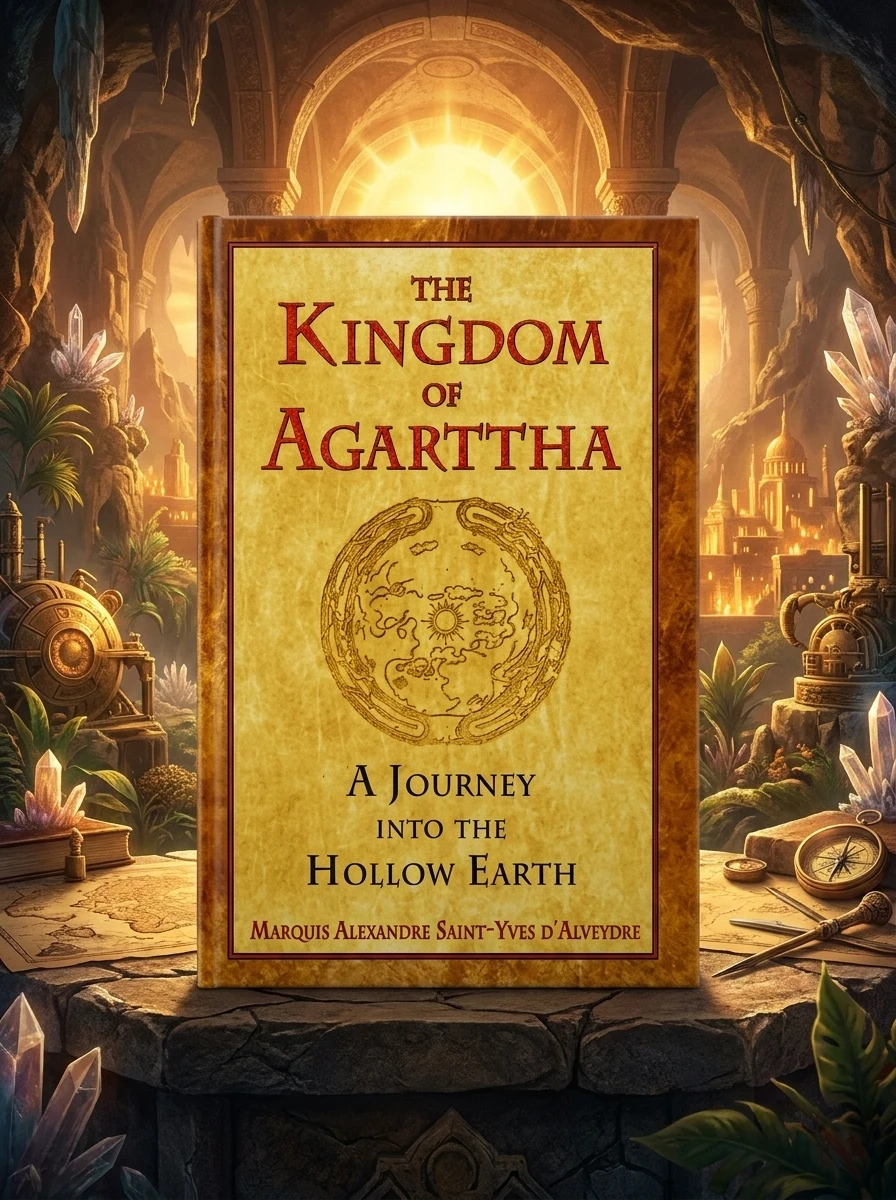
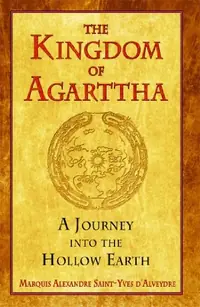
The Kingdom of Agarttha: A Journey Into the Hollow Earth


This edition can be ordered. No arrival date is confirmed.
Unearth the secrets of a hidden, advanced civilization beneath the Himalayas.
Dive into the enigmatic world of Agarttha, an extraordinary subterranean kingdom first unveiled to the West by French esotericist Alexandre Saint-Yves d'Alveydre. This foundational text, now available in English, posits a realm of immense spiritual and technological advancement, far surpassing our own surface world. Ruled by the mystical Brahâtma, Agarttha is presented not merely as a legend but as a potent reality, influencing a lineage of prominent occult thinkers and offering a profound vision of humanity's hidden potential and history.
This text stands as a foundational work in Western esotericism, bridging French occult philosophy with the broader Hollow Earth mythos. It represents a pivotal moment where mystical geography was presented not as mere fable but as a spiritual reality influencing subsequent occult thought.


📝 Description: The Kingdom of Agarttha: A Journey Into the Hollow Earth
💎 Expert review
📖 Why choose it
Why this book is worth reading
This book is an essential read for those deeply invested in the history of esoteric ideas and the concept of subterranean civilizations. Readers fascinated by the intersection of spiritual advancement and hidden technology will find profound value in Saint-Yves d'Alveydre’s vision. It offers a unique window into how 19th-century occultists conceptualized humanity's latent potential and ancient history. If you are drawn to narratives that challenge conventional geography with mystical alternatives, this text provides the intellectual framework for such explorations. It is particularly rewarding for those who appreciate the lineage of thought connecting French esotericism to broader Western occult traditions, offering a potent reality rather than just legend.
⭐ Reader reviews
Reader rating
Saint-Yves d'Alveydre’s work is a dense, philosophical treatise that demands patience and an open mind toward unconventional cosmologies. While it offers a compelling vision of a spiritually advanced subterranean kingdom, it is not suitable for readers seeking straightforward historical accounts or scientific geology. Those expecting narrative-driven adventure or empirical evidence will likely find the text abstract and metaphorical. It appeals strictly to those already versed in Theosophical concepts or Hollow Earth lore. Casual readers looking for light entertainment may struggle with its esoteric density, but dedicated occultists will appreciate its role as a seminal influence on later thinkers in the field.
❓ Frequently asked questions
📖 Who should read this
If you are drawn to ancient mysteries, hidden civilizations, or the foundational texts of Western esotericism, this book is essential. It's for seekers who question conventional history and are curious about the spiritual and philosophical underpinnings of modern occult movements.
🎯 Key themes and symbolism
The Hollow Earth Doctrine
This work introduces the concept of Agarttha, an elaborate system of underground cities said to exist deep beneath the Himalayas. It details a civilization that retreated from the surface at the dawn of the Kali-Yuga, preserving ancient wisdom and evolving spiritually and technologically in seclusion, offering a comprehensive vision of a hidden world.
Esoteric Lineage & Influence
Explore how D'Alveydre's unique vision of Agarttha profoundly shaped subsequent esoteric thought. This book served as a direct inspiration for figures like Papus, René Guénon, and Rudolf Steiner, establishing a crucial link in the chain of 19th and 20th-century occult philosophy and influencing the very concept of 'unknown superiors'.
Spiritual & Technological Progress
Discover a society that embodies an advanced state of being, both spiritually and scientifically. Agarttha, also known as Shambhala, represents a civilization governed by the highest principles, demonstrating a level of human development far beyond contemporary understanding, offering a blueprint for humanity's potential evolution.
💬 Quotes from the book
“Beneath the surface of our tumultuous world, a silent, enlightened dominion preserves the ancient wisdom, awaiting its destined moment.”
“The emissaries of this profound realm have often guided humanity from the shadows, their influence woven into the fabric of our secret societies.”
📜 Historical context
📚 Glossary
- Agarttha
- Brahâtma
- Kali-Yuga
📔 Questions to reflect on
- How does the concept of a hidden, advanced civilization like Agarttha challenge your understanding of human history and potential?
- If such a kingdom existed, what responsibilities do you believe its inhabitants would have towards the surface world, and vice-versa?
- Reflect on how the idea of a 'Kali-Yuga' or an 'Iron Age' resonates with your perception of our current societal state. What might a retreat to an 'Agarttha' signify today?
🏛 Books from this publisher Inner Traditions International
All books from this publisher →



You might also like
See more →