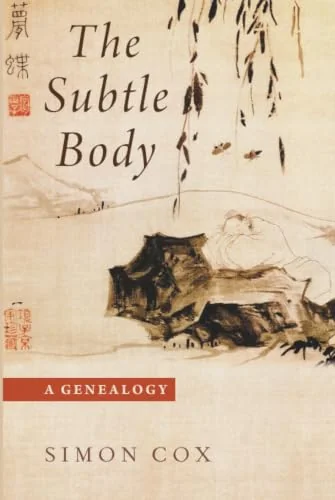
Subtle Body: A Genealogy Cox, Simon
✍️ Cox, SimonA two-thousand-year intellectual history tracing the subtle body concept from Neoplatonism to modern counterculture.
This academic study investigates how the idea of a intermediate entity between soul and body evolved through diverse cultural exchanges. Beginning with late Roman Neoplatonic philosophy, the narrative moves to seventeenth-century English thinkers who developed early terminology. It details how British Orientalist scholars used this lexicon to translate Indian philosophical texts, bringing Eastern thought into Western discourse. The historical account continues through nineteenth-century Theosophy and occultism, concluding with twentieth-century psychology and Western counterculture.
The historical scope spans from the late Roman Empire through the English Renaissance to the Euro-American counterculture of the 1960s and 1970s. It encompasses intellectual traditions across Europe, England, India, and China.


Praise for this book
“How do we imagine, experience, and discuss the phenomenology of embodied being? Is there an essential subtle body? And if so, what is it? In this book, we join Simon Cox on his comparative journey from late antiquity to modernity, from East to West and back again, to track and catch the sparrow.”
“Finally--a book that tracks the idea of a subtle body within Western history. Cox starts from early Greek formulations of a subtle body through its renaissance renditions up through the especially fruitful period of modernity, with the West's extensive borrowing from Indian traditions, to offer a history of how we acquired that ubiquitous phantasm of the new-age subtle body. With his own story interspersed, Cox's delightful history captivates throughout.”
📝 Description: Subtle Body: A Genealogy Cox, Simon
📑 What's inside
- Introduction: Restoring the Body of Light
- 1. Resurrecting an Old Idea
- 2. Morphologies of the Subtle Body
- Chapter One: Vehicles of the Soul from Plato to Philoponus
- 1. Porphyry's Compounded Vehicle
- 2. The Divine Iamblichus
- 3. Platonism in Theory and Practice
- 4. Proclus: The Great Systematizer
- 5. Damascius: The Last Scholarch
- 6. John Philoponus and the Incredible Myth
- Chapter Two: The Body of Light in Renaissance England
- 1. Subtle Bodies, Descartes, and Hobbes
- 2. Ralph Cudworth's Vehicles of the Soul
- 3. Plastick Nature as Ontological Mediator
- 4. Henry More's Cosmology
- 5. The Philosophical Romance of Joseph Glanvill
- 6. Anne Conway's Spiritual Monism
- 7. Cambridge Kabbalah
- 8. Arguing with Machines
- Chapter Three: Oriental Origins
- 1. Chevalier de Ramsay and Chinese Orientalism
- 2. Henry Thomas Colebrooke
- 3. The Sheaths of Vedanta
- 4. Beyond Colebrooke
- 5. Max Müller's Six Systems
- Kuden: Day of the Samurai
- Chapter Four: The Wisdom of the Mahatmas
- 1. Tibetological Foundations
- 2. Helena Blavatsky and the Tibetan Mahatmas
- 3. Subtle Embodiment in
- Isis Unveiled
- 4. Subtle Bodies in
- The Secret Doctrine
- 5. The Creolization of the Subtle Body
- 6. Tibet Beyond Blavatsky
- Kuden: The Secret Body of the Ninja
- Chapter Five: Theosophical Gnosis and Astral Hermeneutics
- 1. Blavatsky's Astral Bodies
- 2. Annie Besant's Esoteric Christianity
- 3. Leadbeater's Christian Gnosis
- 4. G.R.S. Mead, the Subtle Body, and the Esoteric Tradition
- 5. Gnostic Bodies Unleashed
- Chapter Six: Crowley, Orient, and Occult
- 1. From Theosophy to Crowleyanity
- 2. The Magus and the Orient
- 3. Crowley's Ontology?
- 4. The Subtle Body in Practice
- 5. From Creole to Hybrid
- Kuden: The Daoist Alchemical Body
- Chapter Seven: The Alchemical Body of Carl Jung
- 1. From Mead to Jung
- 2. The Secret of the Golden Flower
- 3. Subtle Bodies Top-Down or Ground-Up?
- 4. The Yogas of India and Tibet
- 5. Nietzsche, Snake, and Eagle
- 6. Subtle Body and Eschaton
- Kuden: The Tibetan Vajra Body
- Chapter Eight: From Eranos to Esalen
- 1. The Religion of No-Religion
- 2. Stanford Counterculture
Showing the first 60 entries.
💎 Expert review
📖 Why choose it
Why this book is worth reading
Readers deeply invested in the hidden architectures of Western esotericism will find this book indispensable. It offers a rigorous yet accessible genealogy of the subtle body, revealing how this concept served as a crucial bridge between spirit and flesh across two millennia. If you have ever wondered how ancient Neoplatonism influenced English Platonists or how Indology reshaped spiritual understanding, this text provides the connective tissue. It is essential for those who appreciate the intellectual depth behind mystical experiences and wish to understand the persistent evolution of these ideas from late antiquity through to 20th-century countercultural movements.
⭐ Reader reviews
Reader rating
Simon Cox delivers a meticulous scholarly account that satisfies academic curiosity but may alienate casual readers seeking quick spiritual advice. The dense exploration of philosophical shifts across Neoplatonism and Renaissance scholarship requires patience and a strong background in intellectual history. It is not suitable for those looking for practical occult techniques or immediate mystical results. However, for historians of ideas and serious students of the esoteric tradition, it stands as a vital resource that clarifies the complex lineage of the subtle body without resorting to oversimplification.
❓ Frequently asked questions
📖 Who should read this
If you're drawn to the historical evolution of esoteric ideas, the intersection of philosophy and spiritualism, or the enduring human quest to understand consciousness beyond the physical, this scholarly work offers profound insights into an often-overlooked concept.
🎯 Key themes and symbolism
Tracing an Esoteric Idea
This volume meticulously chronicles the historical trajectory of the subtle body concept, demonstrating its enduring presence and transformation across various epochs. It reveals how this profound idea adapted to different cultural and intellectual landscapes, from its earliest philosophical stirrings to its later manifestations in spiritual and esoteric thought.
Interdisciplinary Nexus of Spirit
The book excels in its cross-disciplinary approach, illustrating how philosophers, mystics, occultists, and psychologists have each contributed to understanding the subtle body. It weaves together threads from ancient Greek thought, European intellectual movements, and Indian philosophical traditions, showcasing a truly global intellectual discourse.
Bridging Mind and Matter
At its heart, the text investigates humanity's persistent quest to define the interface between the spiritual and the physical. It delves into how the subtle body has been conceptualized as a vital, non-corporeal vehicle for consciousness, mediating between the immortal soul and the mortal flesh, offering a critical perspective.
📜 Historical context
📚 Glossary
- Neoplatonism
- Cambridge Platonists
- Orientalist Fathers of Indology
📔 Questions to reflect on
- How does the idea of a "subtle body" resonate with your personal understanding of consciousness or spirituality, particularly in contrast to purely physical or purely spiritual views?
- Considering the historical evolution presented, how might contemporary scientific or philosophical advancements, such as quantum physics or consciousness studies, further redefine or rediscover the subtle body concept?
- In what ways do you think Western and Eastern perspectives on the subtle body, as discussed in the book, converge or diverge significantly, and what does this reveal about their respective worldviews?