


Mojo Workin': The Old African American Hoodoo System
Hazzard-Donald, KatrinaStock reported in the catalog; fulfillment is confirmed with your request.
Uncover the deep roots of African American spiritual survival through the lens of historical Hoodoo practice.
Katrina Hazzard-Donald challenges established narratives by tracing Hoodoo’s evolution from specific African regional clusters into a unified national tradition. She identifies the 'African Religion Complex'—eight shared cultural traits—as the vehicle for this widespread adoption. The text meticulously examines material culture, focusing on potent symbols like High John the Conquer root, to demonstrate how herbal healing and folk belief systems adapted to the American landscape. This work serves as a vital bridge between anthropology and esoteric history, revealing the structural integrity of a marginalized spiritual lineage.
This text situates African American Hoodoo within the broader framework of esoteric history and anthropology, tracing its development from specific African regional clusters into a unified national tradition.


📝 Description: Mojo Workin': The Old African American Hoodoo System
💎 Expert review
📖 Why choose it
Why this book is worth reading
Scholars and practitioners seeking to understand the structural integrity of marginalized spiritual lineages will find this work indispensable. It offers a vital bridge between anthropology and esoteric history, revealing how herbal healing and folk belief systems adapted to the American landscape. Readers interested in the deep roots of African American spiritual survival through the lens of historical Hoodoo practice will appreciate the meticulous examination of material culture. By identifying the 'African Religion Complex' as the vehicle for widespread adoption, the author provides a nuanced view of cultural traits that persist despite displacement. This book is essential for those who wish to move beyond superficial narratives and engage with the profound resilience embedded in these ancient practices.
⭐ Reader reviews
Reader rating
My third book from this store and this one might be the best. The text itself is dense but rewarding — you get out what you put in. Some sections stopped me cold in the best way. Five stars from me.
Added this to my reference shelf. The typesetting is comfortable for study, with good margins for notes. Glad I finally picked this up.
A friend in my study group recommended this one. Plenty of passages worth underlining; my copy is already full of margin notes. Glad I finally picked this up.
I collect works on this subject and this is a worthy addition. Not a light read, but far more accessible than I feared. The ideas are old but land with surprising force today. Glad I finally picked this up.
My third book from this store and this one might be the best. It reads better in small doses — a chapter at a time with notes. The typesetting is comfortable for study, with good margins for notes. It assumes more background than a beginner might have. Recommended with reservations.
Finally got around to ordering this. The language takes some getting used to, but it becomes part of the charm. Challenging in places, but never needlessly obscure. It assumes more background than a beginner might have. Solid, if not essential.
Hazzard-Donald presents a rigorous academic analysis that may alienate casual readers seeking practical spell-casting instructions or mystical anecdotes. The focus on anthropological theory and the 'African Religion Complex' requires patience and an interest in historical sociology rather than immediate occult application. It is not suitable for those looking for simple, actionable folk magic tips without theoretical context. However, for researchers and serious students of esoteric history, it offers unparalleled insight into the evolution of Hoodoo from regional African roots to a unified national tradition. The dense examination of material culture and shared cultural traits demands intellectual engagement, making it a specialized resource rather than a general interest read.
❓ Frequently asked questions
📖 Who should read this
Scholars of African American history, practitioners of folk magic, and readers interested in the intersection of sociology and esoteric traditions will find this rigorous, interdisciplinary study essential for understanding Hoodoo's structural evolution.
🎯 Key themes and symbolism
Regional to National Shift
The author demonstrates how Hoodoo transitioned from localized practices in distinct geographic clusters to a cohesive national identity post-1800, driven by migration and shared cultural resilience across diverse African ethnic groups.
The African Religion Complex
Hazzard-Donald identifies eight specific cultural characteristics common to all African diasporic groups in the US, arguing these shared traits facilitated the rapid spread and standardization of Hoodoo practices across different regions.
Material Spirituality Analysis
The text provides a scholarly examination of physical tools used in practice, particularly the High John the Conquer root, illustrating how material objects serve as conduits for spiritual power and healing within the tradition.
💬 Quotes from the book
“Hoodoo emerged first in three distinct regions... and after the turn of the nineteenth century, took on a national profile.”
“The spread came about through the mechanism of the 'African Religion Complex.'”
📜 Historical context
📚 Glossary
- Mojo
- High John the Conquer
- African Religion Complex
📔 Questions to reflect on
- How does the concept of a 'complex' explain the resilience of your own spiritual practices?
- In what ways do material objects anchor your connection to ancestral traditions?
- How might regional isolation have shaped the specific tools you currently use in your work?
✍️ More books by this author Hazzard-Donald, Katrina
All books by this author →
🏛 Books from this publisher University of Illinois Press
All books from this publisher →



![Songs for the Spirits: Music and Mediums in Modern Vietnam [With DVD]](/img/songs-for-the-spirits-music-and-mediums-in-modern-vietnam-with-dvd.webp)

You might also like
See more →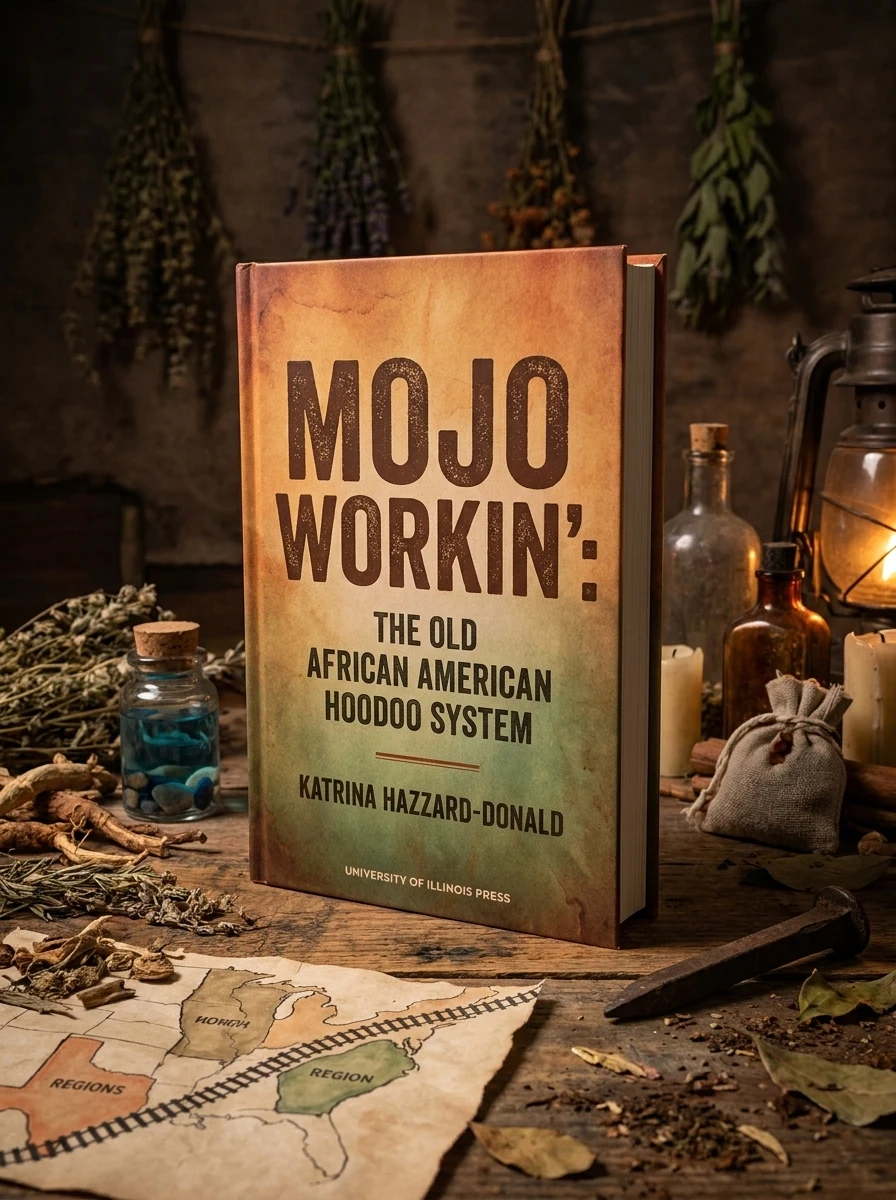

 91
91
 91
91
 91
91