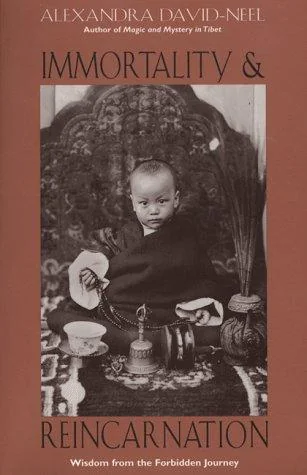
Immortality and Reincarnation: Wisdom from the Forbidden Journey (Original)
✍️ David-Neel, AlexandraAlexandra David-Neel, the intrepid Western pioneer who ventured into Tibet's forbidden city, presents a compelling exploration of Eastern afterlife beliefs. Drawing from her unique firsthand experiences at the dawn of the 20th century, this classic text delves into Taoist, Tibetan, and Hindu philosophies concerning what happens after death. David-Neel meticulously contrasts these traditions with Western thought, revealing a fascinating spectrum of perspectives where immortality often extends beyond the soul to encompass the physical self, offering a rare glimpse into a world profoundly shaped by these enduring spiritual insights.


Praise for this book
“Everything she had to say about Tibet in general and Buddhism in particular was stamped with poetry and insight.”
📝 Description: Immortality and Reincarnation: Wisdom from the Forbidden Journey (Original)
📑 What's inside
- Preface
- China
- Tibet
- The Bardo Thodal
- India
- Conclusion Index
💎 Expert review
📖 Why choose it
Why this book is worth reading
Readers drawn to the intersection of rigorous scholarship and mystical experience will find profound value in this text. Those interested in the historical transmission of Eastern wisdom to the West, particularly through the lens of a dedicated female pioneer, will appreciate David-Neel’s unique perspective. It offers those seeking to understand non-Western conceptions of the soul and physical immortality a rare, grounded insight. The book is ideal for individuals tired of abstract theory who desire concrete philosophical comparisons between Taoist, Tibetan, and Hindu views on death, providing a rich tapestry of spiritual alternatives that challenge conventional Western narratives about eternity.
⭐ Reader reviews
Reader rating
This title serves as a vital historical document for students of comparative religion and esoteric history. However, it does not suit readers seeking practical meditation guides or those who prefer modern scientific critiques of spirituality over early 20th-century philosophical speculation. It may also disappoint those looking for sensationalist adventure tales, as the focus remains firmly on doctrinal analysis rather than narrative excitement. Readers expecting a straightforward religious text will find its comparative approach dense, requiring patience to navigate the intricate contrasts between Eastern and Western metaphysical frameworks presented by this legendary explorer.
❓ Frequently asked questions
📖 Who should read this
If you're a seeker drawn to the profound mysteries of life beyond death, or curious about how Eastern philosophies diverge from Western eschatology, this book is for you. Dive into a meticulously researched and personally experienced account of ancient wisdom.
🎯 Key themes and symbolism
Eastern Afterlife Concepts
David-Neel meticulously unpacks how Taoist, Tibetan, and Hindu traditions perceive existence beyond the grave. She highlights the fundamental divergence from Western thought, particularly the intriguing Eastern notion of immortality potentially extending to both body and soul, offering a rich tapestry of spiritual perspectives on the eternal journey.
Comparative Religious Thought
The book serves as a bridge between East and West, critically examining the differing frameworks for understanding post-mortem existence. David-Neel's analysis provides a unique lens through which to compare and contrast the philosophical underpinnings of various spiritual paths, enriching the reader's appreciation for global religious diversity.
Firsthand Mystical Exploration
As a trailblazing Western woman in early 20th-century Tibet, David-Neel's insights are not academic theory but lived experience. Her unique access to secluded spiritual communities allows her to convey the practical applications and deeply held convictions of these afterlife beliefs, offering an intimate perspective rarely achieved by scholars.
📜 Historical context
📚 Glossary
- Reincarnation
- Lhasa
- Taoist
📔 Questions to reflect on
- How do your personal beliefs about the afterlife compare with the Eastern concepts of immortality and reincarnation discussed in this book?
- Consider the idea of the body also being immortal, as explored by some Eastern traditions. How does this perspective alter your understanding of self and existence?
- If you were to embark on a 'forbidden journey' to seek spiritual wisdom, where would you go, and what fundamental questions would you hope to answer?