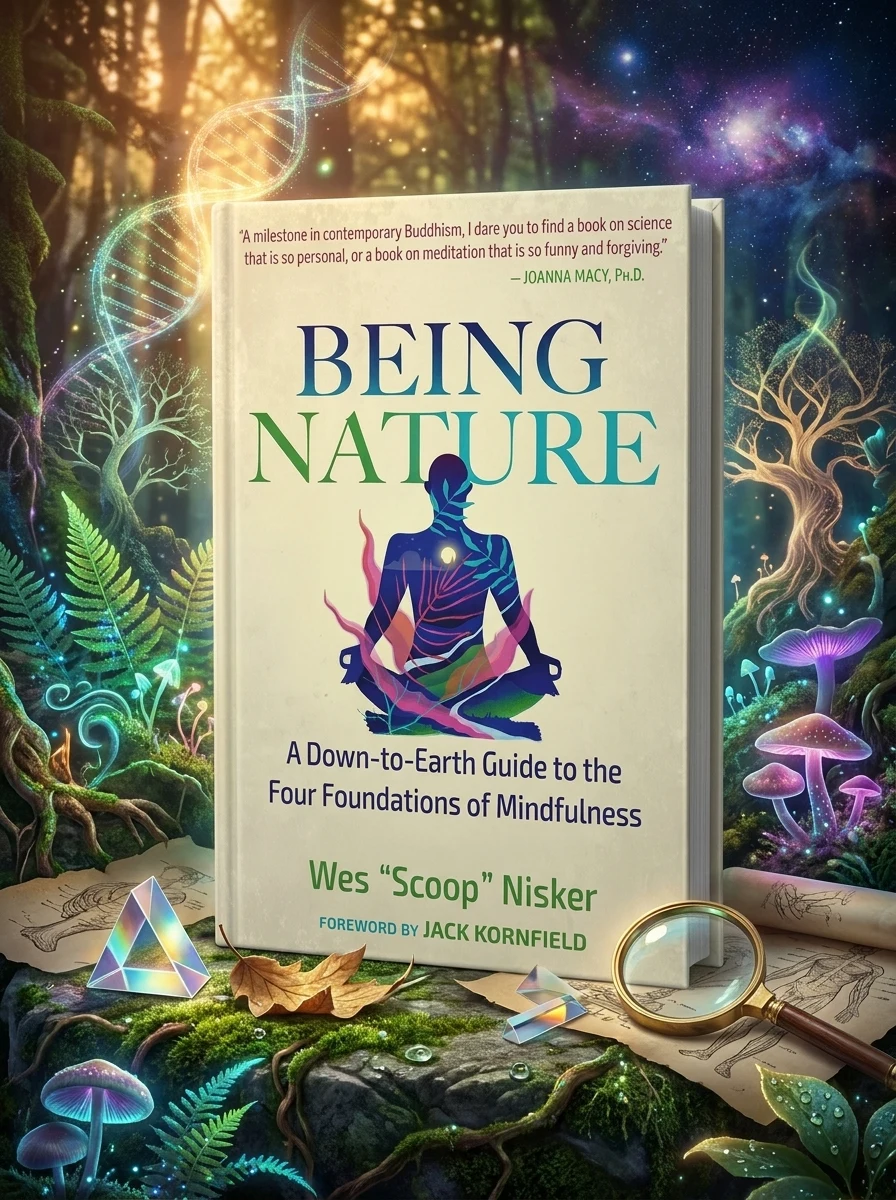
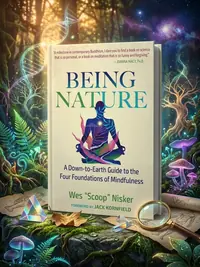
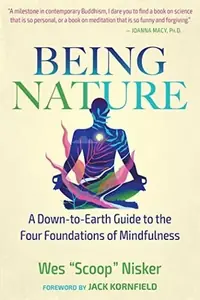
Being Nature: A Down-To-Earth Guide to the Four Foundations of Mindfulness (Edition, New of Buddha's Nature)


This edition can be ordered. No arrival date is confirmed.
Where ancient Buddhist insight meets cutting-edge science to reveal the biological roots of awakening.
Wes Nisker bridges the gap between millennia-old spiritual wisdom and modern empirical science in this provocative guide. By examining the Four Foundations of Mindfulness through the lens of evolutionary biology and physics, he demonstrates how our physical biology dictates our mental patterns. This is not merely theoretical; it offers a playful, practical program for tuning into your own body to dismantle painful conditioning. Readers will discover how recent scientific discoveries validate the Buddha’s insights, providing a tangible path to greater self-awareness, wisdom, and lasting happiness by understanding the physiological origins of emotion and desire.
This work sits at the intersection of contemporary secular Buddhism and integrative science, reflecting a modern trend to validate ancient esoteric practices through empirical biological frameworks. It aligns with the publisher's tradition of bridging spiritual heritage with intellectual rigor.


📝 Description: Being Nature: A Down-To-Earth Guide to the Four Foundations of Mindfulness (Edition, New of Buddha's Nature)
💎 Expert review
📖 Why choose it
Why this book is worth reading
Readers seeking a tangible, grounded approach to mindfulness will find profound value in this text. It is ideal for those who feel disconnected from traditional religious dogma but remain curious about the mechanics of consciousness. By explicitly linking evolutionary biology and physics to the Four Foundations of Mindfulness, Nisker offers a logical pathway for skeptics and scientists alike. The book empowers individuals to understand the physiological roots of their emotional conditioning, transforming abstract spiritual concepts into actionable bodily awareness. It is particularly beneficial for those tired of purely theoretical meditation guides, offering instead a playful, practical program that promises lasting happiness through self-awareness and biological understanding.
⭐ Reader reviews
Reader rating
Nisker’s provocative synthesis of Buddha’s nature and cutting-edge science provides a unique entry point for the intellectually inclined spiritual seeker. The strength lies in its validation of ancient insights through modern empirical data, making the practice feel relevant and biologically plausible. However, readers expecting pure poetic mysticism or traditional scriptural exegesis may find the tone too clinical or overly analytical. Those seeking immediate emotional comfort without rigorous intellectual engagement might struggle with the emphasis on dismantling conditioning through scientific explanation. It is a demanding read for those unwilling to engage with the physiological underpinnings of their own mental patterns.
❓ Frequently asked questions
📖 Who should read this
Readers skeptical of purely metaphysical spirituality who crave empirical grounding. Ideal for those seeking to understand the biological mechanics behind meditation and emotional regulation.
🎯 Key themes and symbolism
Somatic mindfulness
Evolutionary psychology
Scientific Buddhism
💬 Quotes from the book
“How to tune in to our own biology in pursuit of spiritual awakening.”
“Recent discoveries in physics, evolutionary biology, and psychology express in scientific terms the same insights the Buddha discovered more than 2,500 years ago.”
📜 Historical context
📚 Glossary
- Four Foundations of Mindfulness
- Somatic Awareness
- Contemplative Neuroscience
📔 Questions to reflect on
- When you feel a strong emotion, where exactly do you locate it in your body?
- How might your evolutionary biology be influencing your current attachment to a specific outcome?
- What physical sensation arises when you attempt to observe your thoughts without judgment?
🏛 Books from this publisher Inner Traditions International
All books from this publisher →





You might also like
See more →