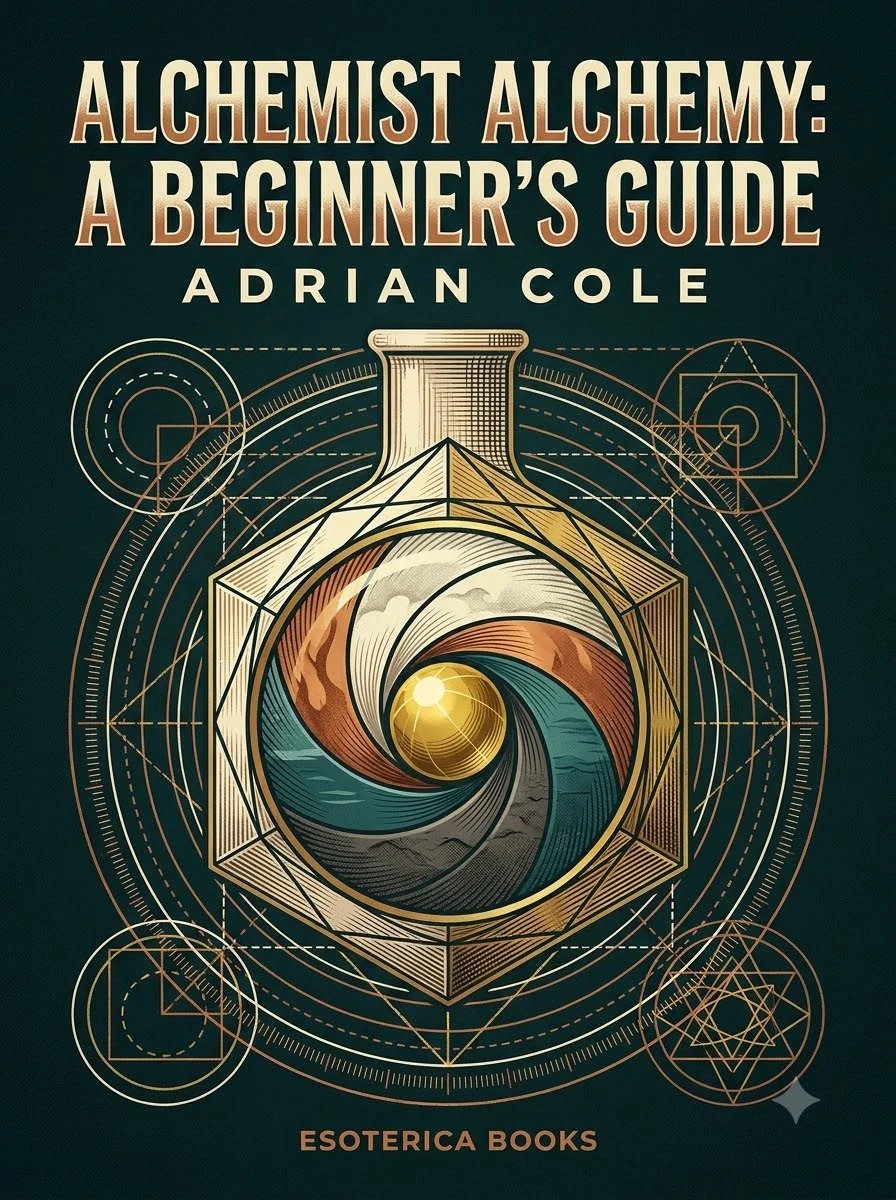
Alchemist Alchemy: A Beginner's Guide
Discover alchemy’s symbols, four elements, and Great Work through a practical method for personal transformation.
What is alchemy, and what did historical alchemists really seek? This beginner-friendly guide explores alchemy as a family of practical, philosophical, and spiritual traditions concerned with materials, symbols, and transformation. Learn to recognize essential alchemy symbols, understand the Four Elements and Three Principles, explore the philosopher’s stone, and discover the historical relationship between metals and planets. With the original G.O.L.D. Method—Ground, Observe, Loosen, Distill—you will also learn to create symbolic exercises, keep an alchemical journal, and develop a personal practice rooted in observation and reflection.
Alchemy belongs to a diverse family of historical traditions that brought together material experimentation, philosophical questions, and spiritual symbolism. Its imagery developed across several cultural settings, including Hellenistic Egypt, the medieval Islamic world, and medieval and early modern Europe.


📝 Description: Alchemist Alchemy: A Beginner's Guide
📖 Why choose it
Why this book is worth reading
Alchemy becomes much easier to approach when its symbols are connected to recognizable objects, clear definitions, and practical exercises. This book offers that starting point. Instead of presenting a confusing collection of mysterious correspondences, it gives readers a repeatable four-stage method for exploring materials and ideas. Its combination of historical background, elemental symbolism, planetary metals, botanical associations, and guided journaling makes it useful both as an introduction and as a workbook to revisit when developing original symbolic compositions.
⭐ Reader reviews
Reader rating
This is a clearly organized introduction to alchemy that understands the importance of distinguishing historical practice from modern spiritual interpretation. Its strongest feature is the G.O.L.D. Method, which gives beginners a practical structure for moving from observation to symbolic expression. The preview also provides a useful first exercise with four ordinary objects, making the abstract language of the elements immediately approachable. The chapter plan covers historical traditions, geometric imagery, botanical associations, planetary metals, and the Great Work without assuming prior knowledge. One limitation is that readers seeking advanced historical scholarship, specialist laboratory techniques, or detailed manuscript analysis will need a more specialized reference.
❓ Frequently asked questions
📖 Who should read this
This book is for curious beginners who want to understand what alchemy really means, recognize its traditional imagery, and explore its spiritual and philosophical dimensions. It also suits readers interested in symbolic journaling, herbal correspondences, and developing a personal alchemical practice.
🎯 Key themes and symbolism
Alchemy Symbols
Four Elements
Great Work
Personal Transformation
📜 Historical context
📚 Glossary
- Alchemy
- Great Work (Magnum Opus)
- Philosopher's Stone
- Transmutation
- Three Principles
- G.O.L.D. Method
📔 Questions to reflect on
- Which of the Four Elements—Earth, Water, Air, or Fire—best represents the theme or creative project you want to explore, and what qualities led you to that choice?
- What might the distinction between Mercury, Sulfur, and Salt reveal about the different qualities or opposing forces within a subject you are examining?
- If you mapped a personal creative project onto the stages of the Great Work, what would separation, purification, recombination, and completion look like in your own process?
📖 Read on the blog
✍️ More books by this author Adrian Cole



🏛 Books from this publisher Esoterica Books



You might also like
See more →



Have a question about this item?
Ask about the edition, condition, delivery or anything else — we reply by email or phone, usually within a day.
