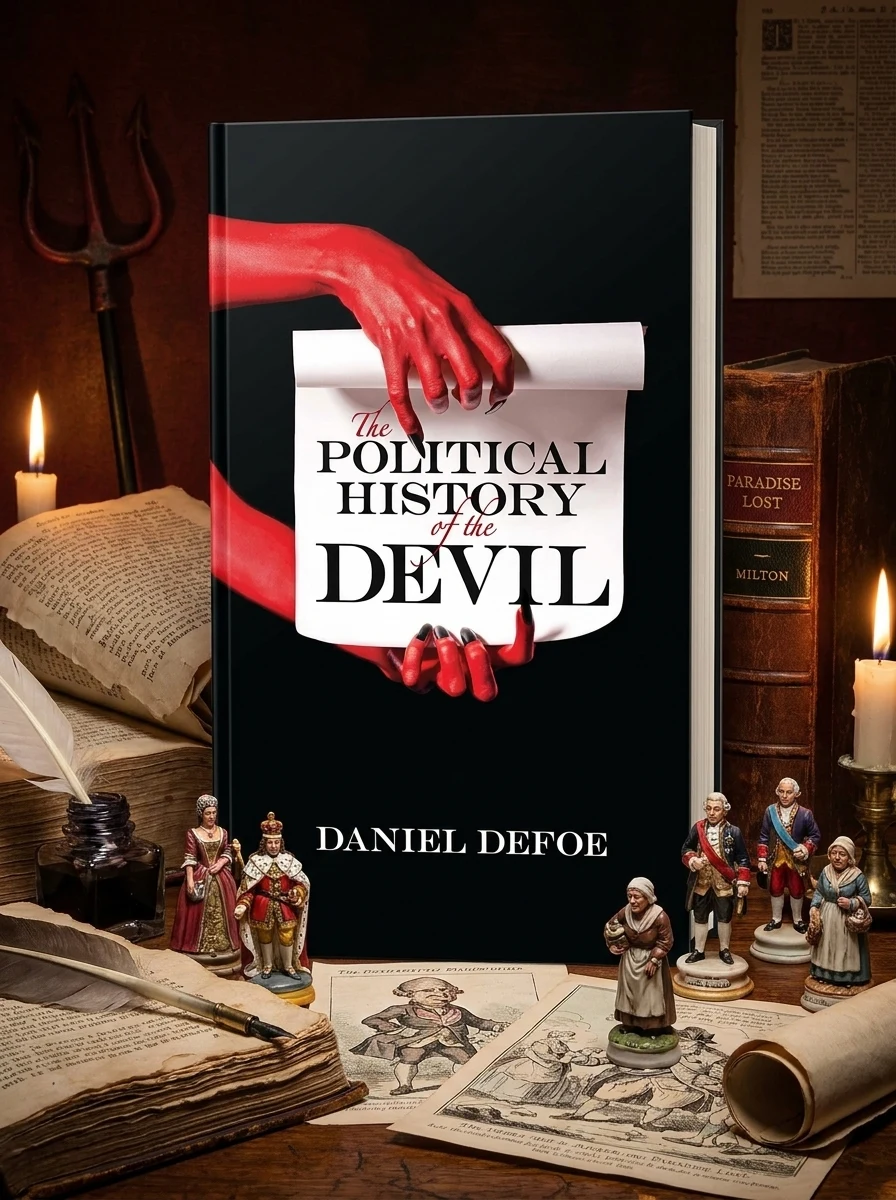
The Political History of the Devil
✍️ Defoe, DanielDaniel Defoe, renowned for his satirical wit, presents not a sermon but a meticulous "history" of the Devil. This intriguing treatise chronicles the infernal adversary's pervasive influence throughout human civilization, from ancient times to Defoe's own era. He dissects the strategies and machinations of this "tyrant of the air," examining the Devil as a formidable cultural and political force shaping human events and beliefs. It's a provocative exploration of evil's enduring role in the world, delivered with Defoe's characteristic keen observation and a journalistic eye for detail.


📝 Description: The Political History of the Devil
💎 Expert review
📖 Why choose it
Why this book is worth reading
Readers fascinated by the intersection of theology, politics, and history will find this treatise exceptionally rewarding. It appeals to those who appreciate Defoe’s satirical wit applied to grand metaphysical concepts rather than mere fiction. If you enjoy uncovering how cultural narratives shape our understanding of evil, this book offers a unique perspective on the Devil as a political agent. It is ideal for scholars and enthusiasts of esoteric history who seek to understand the enduring influence of infernal adversaries in human civilization. By viewing the Devil through a journalistic eye, Defoe provides a provocative exploration that challenges conventional religious interpretations, making it essential for anyone interested in the historical construction of evil.
⭐ Reader reviews
Reader rating
This title offers a distinctive, albeit niche, perspective on the figure of the Devil, framed as a political history rather than a theological sermon. It suits readers who enjoy Defoe’s characteristic keen observation and satirical edge applied to serious subjects. However, it does NOT suit those seeking straightforward religious instruction or traditional demonology texts. Readers expecting a fictional narrative or simple moralizing will likely find its analytical approach dry. It is best for those willing to engage with complex historical inquiries into cultural forces. While intellectually stimulating for the right audience, its specific focus may alienate general readers looking for lighter entertainment or direct spiritual guidance.
❓ Frequently asked questions
📖 Who should read this
If you're drawn to the intersection of history, theology, and political satire, or seek to understand the enduring cultural impact of the Devil figure beyond traditional religious doctrine, Defoe's unique perspective offers a compelling journey into the heart of infernal influence.
🎯 Key themes and symbolism
The Devil's Biography
Defoe undertakes the ambitious task of chronicling the Devil's existence as if he were a verifiable historical figure. He traces the adversary's supposed origins, evolution, and shifting manifestations across various epochs, attempting to construct a coherent narrative of this ubiquitous entity's life and deeds, often divorced from strictly theological dogma.
Infernal Geopolitics
The author meticulously details how the Devil, in his view, has strategically influenced human affairs, from inciting conflicts to corrupting leaders. This isn't merely a spiritual battle, but a worldly one, where the Devil acts as a master manipulator, pulling political strings and shaping the course of nations through subtle and overt means.
Enlightenment Critique
Beneath the seemingly straightforward historical account lies a subtle critique of human folly and societal structures. Defoe uses the figure of the Devil as a lens to examine human vices, political corruption, and the pervasive nature of evil, challenging his contemporaries to recognize infernal influences in their own world.
📜 Historical context
📚 Glossary
- Tyrant of the Air
- God of the World
- Antiquarian
📔 Questions to reflect on
- How might Defoe's "political" Devil manifest in contemporary global events or societal structures?
- Consider a historical event you know well. How might Defoe interpret the Devil's influence within it?
- If the Devil is a "tyrant of the air," what does that imply about the unseen forces shaping our reality?