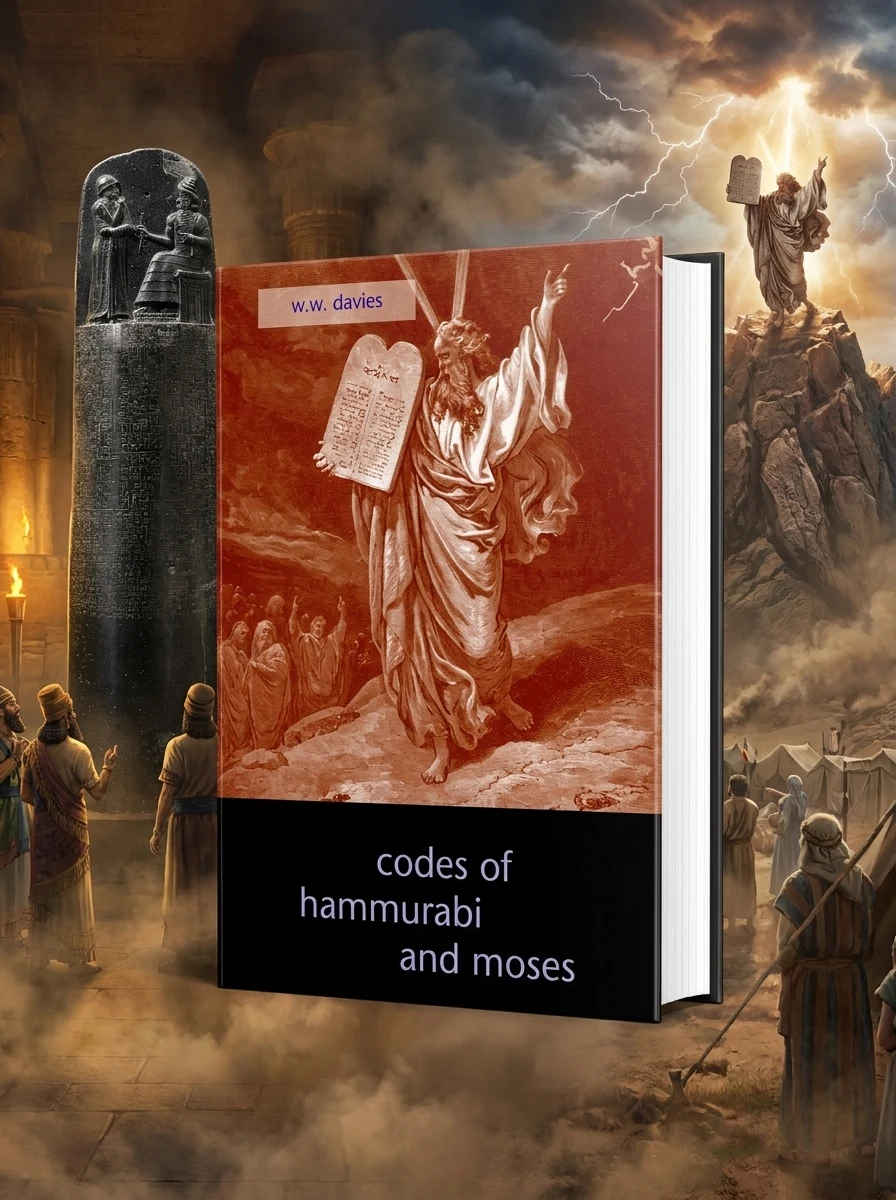

The Codes of Hammurabi and Moses
Stock reported in the catalog; fulfillment is confirmed with your request.
Bridge the chasm of millennia, exploring the ancient roots of justice and faith.
This volume presents W.W. Davies' seminal translation of the Code of Hammurabi, a monumental legal text that profoundly predates Mosaic law. It offers a direct gateway to the legal and social structures of ancient Mesopotamia, revealing startling parallels and divergences with later Western legal and religious traditions. Essential for anyone seeking to understand the deep historical currents that shaped our foundational concepts of justice, governance, and spiritual order, this book provides a crucial lens through which to view the evolution of human civilization.
This volume anchors itself in the deep history of ancient Mesopotamia, serving as a critical bridge between early legal frameworks and subsequent Western religious traditions. It situates the Code of Hammurabi within the esoteric study of how foundational concepts of justice and spiritual order evolved across millennia.


📝 Description: The Codes of Hammurabi and Moses
💎 Expert review
📖 Why choose it
Why this book is worth reading
Readers deeply interested in the ancestral roots of justice and faith will find immense value in this seminal translation. It offers a direct gateway into the social structures of ancient Mesopotamia, allowing you to witness the startling parallels between early codes and later Mosaic law. If you seek to understand the deep historical currents that shaped our foundational concepts of governance and spiritual order, this book provides an essential lens. It is not merely for legal scholars but for anyone curious about the evolution of human civilization and the enduring legacy of ancient wisdom on modern thought.
⭐ Reader reviews
Reader rating
This work serves as a crucial academic resource for those tracing the lineage of Western legal and religious traditions. Davies’ translation provides vital insights into Mesopotamian social structures, making it indispensable for serious students of esoteric history and comparative jurisprudence. However, casual readers seeking narrative drama or modern self-help applications will find little appeal here. It is a dense, scholarly examination rather than an accessible popular history. Those expecting a light read or speculative fiction will be disappointed by its rigorous focus on historical analysis and textual translation. It demands patience and intellectual commitment from its audience.
❓ Frequently asked questions
📖 Who should read this
If you're drawn to the origins of law, the deep past of human civilization, or the historical context of sacred texts, this book is an indispensable guide. It will enrich your understanding of how justice, faith, and society first intertwined.
🎯 Key themes and symbolism
Ancient Legal Foundations
Delve into the intricate statutes of Hammurabi, a legal framework established nearly a millennium before Mosaic law. This theme explores the earliest codified justice system, offering insights into Mesopotamian societal norms, economic regulations, and punitive measures, providing a foundational understanding of ancient jurisprudence.
Historical Religious Parallels
Examine the compelling historical connections and distinctions between the Hammurabic Code and the laws attributed to Moses. This book invites readers to ponder the shared human impulse for order and divine decree, shedding light on how ancient legal traditions influenced, or ran parallel to, the development of early Abrahamic religious thought.
Unveiling Prehistoric Civilizations
Journey back to "gray antiquity," a period once considered beyond detailed historical record. The discovery and translation of Hammurabi's Code opened a window into a sophisticated society, challenging prior notions of prehistoric existence and offering a tangible link to foundational human governance and social organization.
💬 Quotes from the book
“To establish justice in the land, to destroy the wicked and the evil, to prevent the strong from oppressing the weak.”
“That the diligent student may perceive the ancient principles of equity, and trace the very roots of jurisprudence.”
📜 Historical context
📚 Glossary
- Hammurabi
- Diorite
- Promulgation
📔 Questions to reflect on
- How do the values reflected in Hammurabi's Code resonate or conflict with your own modern understanding of justice and fairness?
- Consider the impact of a written, publicly displayed legal code on ancient society. How might it have shaped daily life and power structures?
- In what ways might the discovery of such ancient texts influence our contemporary interpretations of religious or historical narratives?
You might also like
See more →

 91
91