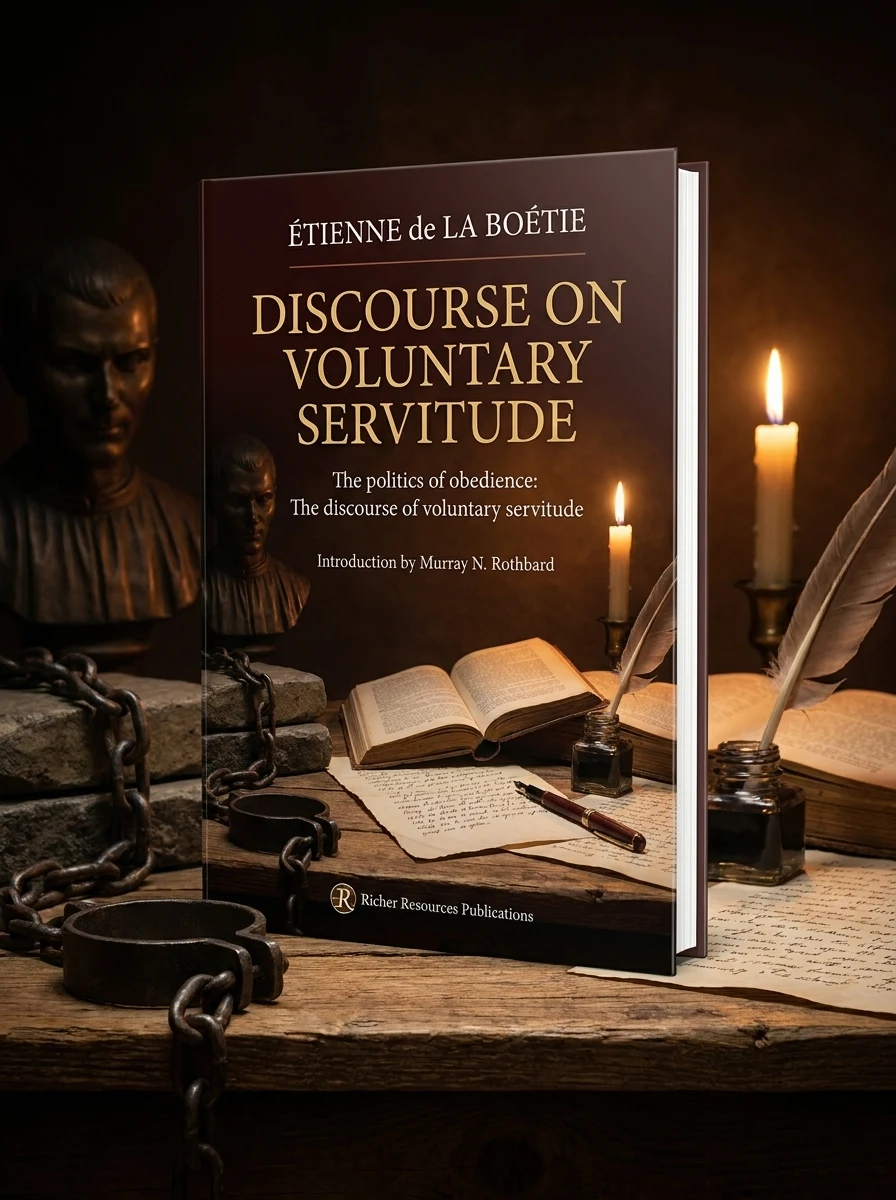

Discourse on Voluntary Servitude: Why People Enslave Themselves to Authority
Stock reported in the catalog; fulfillment is confirmed with your request.
Why do we surrender our freedom to those who wield power?
Étienne de La Boétie's profound essay probes the perplexing question of why populations so readily relinquish their inherent freedom, often to a single ruler. Far from a guide to tyranny, this seminal work explores the psychological and social mechanisms that lead individuals to accept subjugation, even when the power of the oppressor is derived solely from the consent of the governed. It presents a radical counterpoint to contemporary political thought, suggesting that true liberation begins not with revolution, but with a collective refusal to serve. A timeless meditation on the nature of liberty and obedience.
This seminal essay emerges from the tradition of early modern political philosophy, challenging contemporary notions of sovereignty and power structures. It stands as a radical counterpoint to established authority, exploring the psychological underpinnings of obedience rather than mere governance.


📝 Description: Discourse on Voluntary Servitude: Why People Enslave Themselves to Authority
💎 Expert review
📖 Why choose it
Why this book is worth reading
This book is essential for anyone seeking to understand the invisible chains of social compliance and the mechanics of authoritarianism. Readers who question why populations consent to their own subjugation will find profound insight here. It offers a liberating perspective, suggesting that freedom is reclaimed not through violent revolution, but through the collective refusal to serve. Those interested in the intersection of psychology and politics, or who wish to dismantle internalized obedience, will gain a powerful tool for critical thinking. It serves as a timeless meditation on liberty, urging individuals to recognize their inherent power and reject the psychological mechanisms that sustain tyranny.
⭐ Reader reviews
Reader rating
De La Boétie’s work is a piercing examination of voluntary servitude, yet it may not suit readers seeking practical political strategies or historical narratives. Those looking for actionable policy reforms might find its philosophical abstraction too detached from immediate reality. However, for intellectual explorers fascinated by the paradox of consent and the psychology of power, it is indispensable. The text does not offer easy answers but rather provokes deep reflection on the nature of authority. It challenges the reader to confront uncomfortable truths about societal compliance. While dense in its meditation on liberty, it remains a crucial touchstone for understanding how power derives from obedience rather than force alone.
❓ Frequently asked questions
📖 Who should read this
If you've ever pondered the foundations of power or felt the chains of societal norms, this incisive work is for you. It's an essential read for anyone passionate about individual liberty, critical thought, and the profound responsibilities that come with true freedom.
🎯 Key themes and symbolism
The Paradox of Submission
This core concept investigates the strange phenomenon where people willingly cede their autonomy to rulers, even when the rulers' power is inherently fragile. La Boétie argues that the strength of any tyrant rests entirely on the populace's tacit agreement to be governed, highlighting the psychological roots of obedience.
Inherent Human Freedom
La Boétie champions an intrinsic human desire for freedom, positing it as a natural state. He explores how this innate liberty becomes suppressed or forgotten through habit, propaganda, and the fear of the unknown, urging readers to rediscover and reclaim their birthright of self-governance.
Unmasking Despotic Power
While not a manual for revolution, the essay meticulously dissects the mechanisms by which despots maintain control, largely through the people's own complicity. It serves as a philosophical mirror to Machiavelli's The Prince, revealing how power is acquired and sustained, but from the perspective of the governed.
💬 Quotes from the book
“Resolve to serve no more, and you are at once freed.”
“He who so domineers over you has only two eyes, has only two hands, has only one body, no more than the least man from the great number of your cities.”
📜 Historical context
📚 Glossary
- Voluntary Servitude
- Tyranny
- Consent of the Governed
📔 Questions to reflect on
- In what ways might you unknowingly contribute to systems of authority that limit your own freedom today?
- How would society transform if individuals universally chose to withdraw their consent from unjust power structures?
- Reflect on a time you felt compelled to obey an authority figure. Was that obedience truly voluntary, or was it influenced by fear or habit?
You might also like
See more →

 91
91