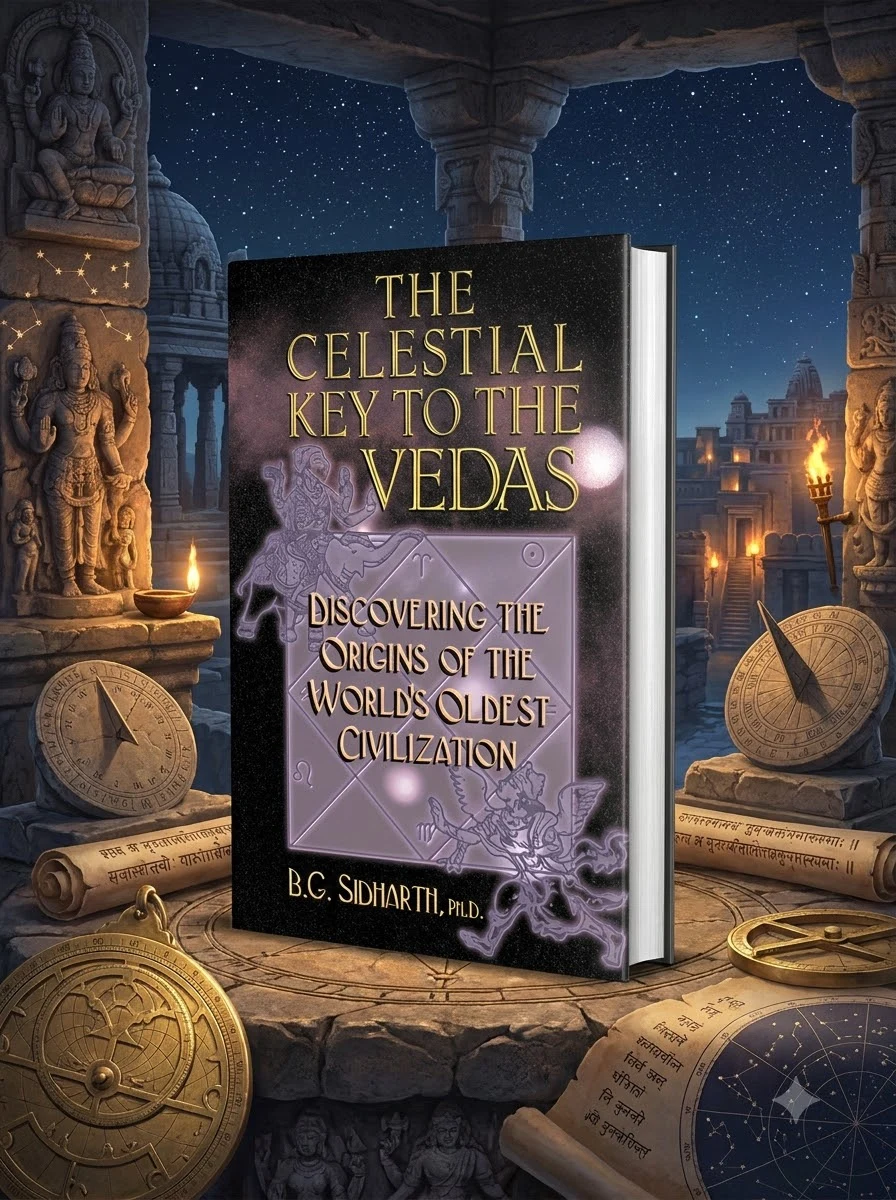
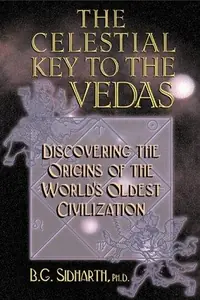
The Celestial Key to the Vedas: Discovering the Origins of the World's Oldest Civilization (Original)


This edition can be ordered. No arrival date is confirmed.
Unearth ancient India's astronomical secrets that rewrite civilization's dawn.
Astronomer B. G. Sidharth presents a compelling re-evaluation of ancient Indian history, positing that the Rig Veda, often considered the oldest Indo-European text, is vastly more ancient than commonly accepted. Through a meticulous analysis of astronomical events and alignments encoded within these sacred scriptures, Sidharth provides robust evidence suggesting its origins date back as far as 10,000 B.C., challenging the prevailing academic timeline of 1500 B.C. This groundbreaking research not only redefines the antiquity of the Vedas but also implies a highly sophisticated civilization in India long before Greece or Egypt.
This work sits at the intersection of esoteric history and alternative archaeology, challenging mainstream academic timelines through the lens of Vedic astronomy. It contributes to the ongoing discourse on the antiquity of Indian civilization within occult and philosophical circles.


📝 Description: The Celestial Key to the Vedas: Discovering the Origins of the World's Oldest Civilization (Original)
💎 Expert review
📖 Why choose it
Why this book is worth reading
Readers fascinated by the origins of human civilization and those skeptical of conventional historical timelines will find this book profoundly stimulating. It appeals to individuals seeking evidence that ancient India possessed sophisticated astronomical knowledge far earlier than traditionally believed. If you are drawn to mysteries that suggest a lost, advanced era predating Greece or Egypt, this text offers a rigorous, data-driven perspective. It is ideal for enthusiasts of esoteric history who appreciate detailed technical analysis over mere speculation. By decoding the Rig Veda through celestial alignments, it provides a compelling narrative for those eager to rewrite the dawn of civilization and understand the deep roots of Vedic wisdom.
⭐ Reader reviews
Reader rating
B. G. Sidharth offers a meticulously researched argument that redefines the Vedic timeline, using astronomical data to support claims of extreme antiquity. The work is intellectually robust for those interested in alternative historical frameworks and scientific approaches to ancient texts. However, it does not suit readers seeking mainstream academic consensus or those uninterested in dense astronomical calculations. Skeptics of fringe theories may find the conclusions overstated without broader archaeological corroboration. It is best appreciated by open-minded scholars willing to engage with unconventional evidence rather than casual readers looking for light mythology.
❓ Frequently asked questions
📖 Who should read this
If you're fascinated by ancient civilizations, the intersection of science and spirituality, or eager to challenge mainstream historical narratives, this book is for you. Readers interested in the true origins of Hinduism and the sophisticated knowledge of early cultures will find it profoundly stimulating.
🎯 Key themes and symbolism
Astronomical Dating of Texts
Sidharth employs an innovative method of deciphering astronomical references embedded within ancient Vedic hymns and myths. By identifying precise celestial configurations, planetary positions, and lunar asterisms described in the Rig Veda, he correlates these observations with specific historical periods, thereby establishing a scientific basis for dating the texts far earlier than traditional linguistic or archaeological approaches.
Revising Ancient Indian History
This book fundamentally questions the established timeline for ancient Indian civilization and the Indo-European migrations. By pushing the Rig Veda's antiquity to 10,000 B.C., it suggests a highly advanced, astronomically aware culture thriving on the subcontinent millennia before previously thought. This challenges the historical narrative that often credits other civilizations with earlier complex developments.
Cosmology in Vedic Mythology
The author explores the profound connection between ancient Hindu deities, myths, and astronomical phenomena. He reveals how seemingly symbolic narratives and the system of lunar mansions (nakshatras) are in fact sophisticated records of celestial observations. This perspective uncovers a deeper, scientific layer beneath the mythological tapestry of the Vedas and Hindu epics.
💬 Quotes from the book
“The precise celestial configurations described within the Rig Veda are not mere metaphor, but a detailed astronomical record, anchoring its verses to a specific epoch long before conventional historical frameworks allow.”
“By meticulously charting the lunar asterisms and planetary positions, we unveil a sophisticated observational tradition in ancient India, predating civilizations often credited with the earliest advancements in scientific thought.”
📜 Historical context
📚 Glossary
- Rig Veda
- Lunar Asterisms (Nakshatras)
- Indo-European Prehistory
📔 Questions to reflect on
- If the Rig Veda is indeed 12,000 years old, how might this fundamentally alter our understanding of human civilization's development and its origins?
- Consider how astronomical observation, rather than archaeology or linguistics, offers a unique lens through which to interpret and date ancient cultural artifacts and texts.
- Reflect on the idea that ancient myths and religious narratives might contain hidden scientific or historical data. How does this change your perception of 'myth'?
🏛 Books from this publisher Inner Traditions International
All books from this publisher →



You might also like
See more →