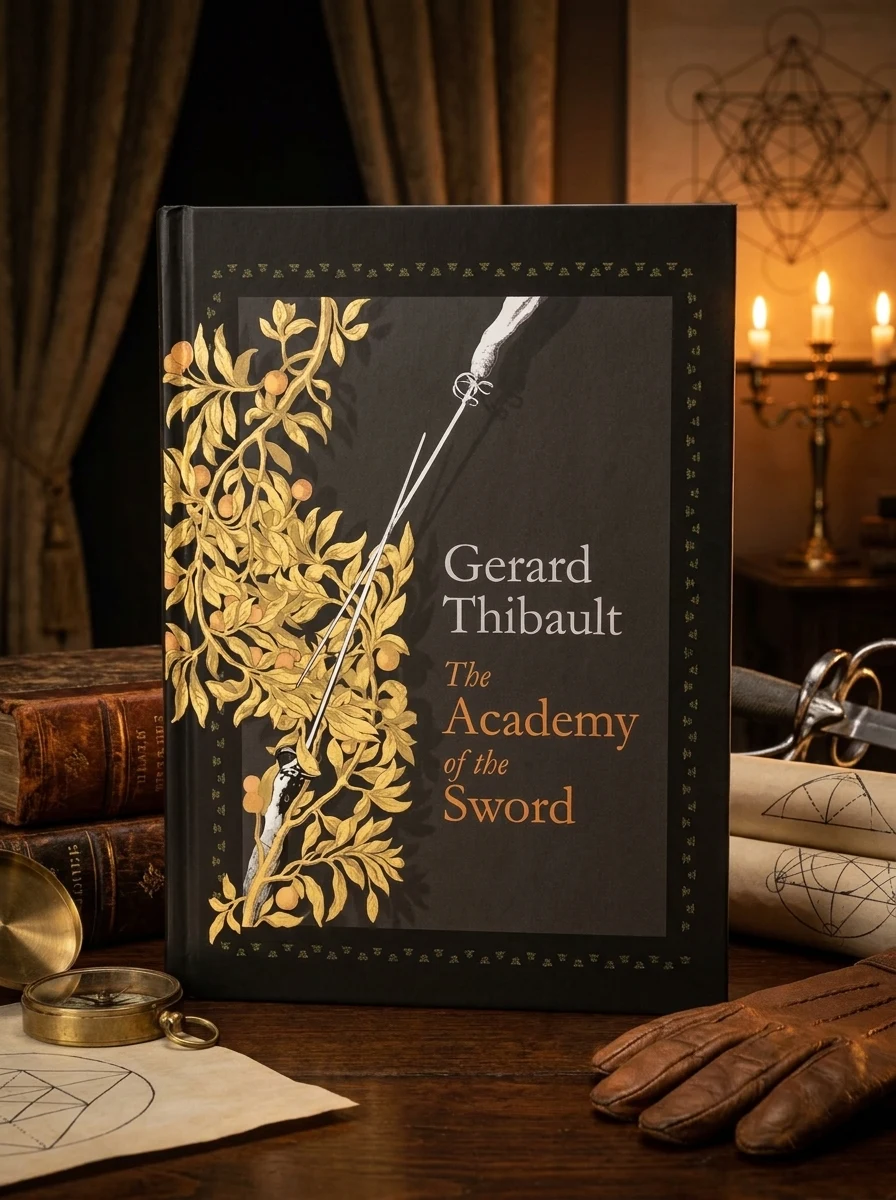
The Academy of the Sword
Gerard Thibault's "The Academy of the Sword" is an unparalleled exploration of Renaissance swordsmanship, transcending mere combat instruction. This masterwork meticulously details the intricacies of rapier technique, uniquely interwoven with Pythagorean sacred geometry, transforming martial practice into an esoteric discipline. Translated by John Michael Greer, it offers a window into a philosophical approach to combat, showcasing a thoroughly documented Western esoteric martial art. Beyond its historical significance, this lavishly illustrated volume provides practical insights for contemporary study and application.


📝 Description: The Academy of the Sword
💎 Expert review
📖 Why choose it
Why this book is worth reading
Readers fascinated by the hidden dimensions of historical combat will find this volume indispensable. It appeals to those who seek to understand swordsmanship not merely as a physical skill but as a spiritual and geometric practice. Enthusiasts of Western esoteric traditions will appreciate how Thibault interweaves Pythagorean principles with lethal technique, offering a rare glimpse into an esoteric martial art. Contemporary practitioners seeking practical insights grounded in deep philosophical context will also benefit from this lavishly illustrated guide. It serves as a bridge between historical documentation and modern application, allowing the reader to explore a forgotten art that transforms martial practice into a profound discipline.
⭐ Reader reviews
Reader rating
This text is a dense, scholarly exploration best suited for serious students of esoteric history or advanced fencers interested in theoretical underpinnings. It demands patience due to its complex integration of sacred geometry and historical technique. Casual readers seeking straightforward combat manuals or light historical fiction will likely find the philosophical depth tedious and inaccessible. The work does not cater to those looking for quick, actionable tips without contextual framework. However, for those willing to engage with its rigorous documentation and esoteric focus, it offers a unique and invaluable perspective on Renaissance martial philosophy that is rarely found in contemporary literature.
❓ Frequently asked questions
📖 Who should read this
For the discerning martial artist, the occult scholar, or the Renaissance history enthusiast, "The Academy of the Sword" offers an unparalleled journey. If you seek to understand the profound connections between philosophy, geometry, and lethal combat, this volume is an essential addition to your collection.
🎯 Key themes and symbolism
Renaissance Worldview
The work serves as a vibrant artifact of Renaissance intellectual life, reflecting an era where science, art, and mysticism were not disparate fields but integrated facets of understanding. It illuminates how the period's philosophical currents, including classical geometry, permeated even the most practical and lethal of arts.
Sacred Geometry in Combat
At its core, the book demonstrates how Pythagorean sacred geometry informs every aspect of rapier combat. It presents a system where angles, distances, and movements are not arbitrary but dictated by universal mathematical truths, offering a profound, almost spiritual, dimension to the art of the sword.
📜 Historical context
📚 Glossary
- Rapier
- Pythagorean Geometry
- Treatise
📔 Questions to reflect on
- How might integrating principles like sacred geometry or other esoteric knowledge change one's approach to a physical discipline or skill you currently practice?
- In what ways does Thibault's work challenge or expand your understanding of what constitutes a "martial art" or "combat system"?
- Reflect on the Renaissance worldview that allowed for such a seamless blend of science, philosophy, and practical application. What can modern thought learn from this integration?