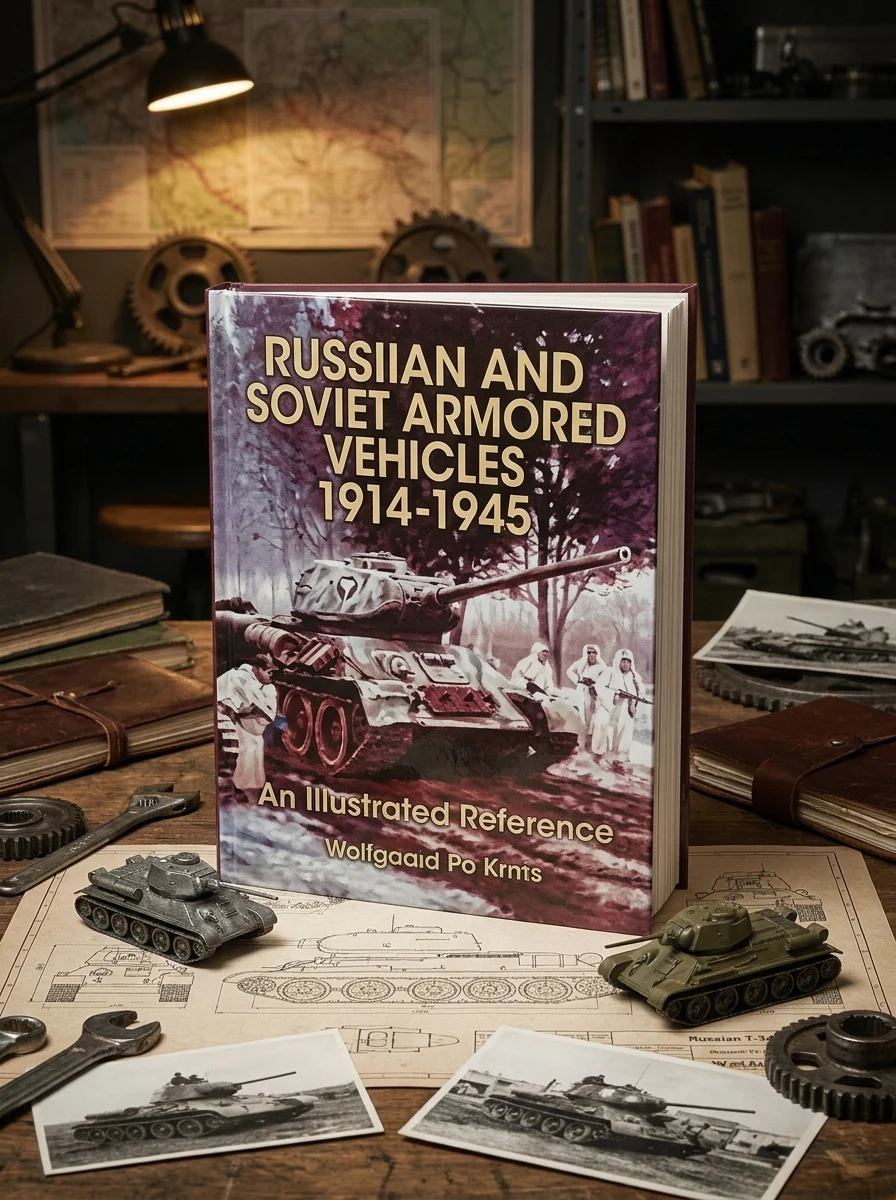
Russian Tanks and Armored Vehicles 1917-1945: An Illustrated Reference
This edition can be ordered. No arrival date is confirmed.
Steel leviathans of the East: a visual chronicle of Soviet armor from the Great War to the Eastern Front.
This volume serves as a comprehensive visual archive of Russian armored warfare, spanning the chaotic years of 1917 through the end of World War II. Fleischer meticulously documents the evolution of these mechanical beasts, utilizing striking photography, much of it previously unseen, to reveal the gritty reality of their construction and deployment. The text explores not only the mass-produced icons but also the experimental prototypes and foreign designs that influenced Soviet engineering. It is an essential resource for understanding the industrial might and tactical desperation that defined the Eastern Front's mechanized warfare.
This work sits within the niche tradition of illustrated military history, specifically focusing on the industrial and engineering evolution of Soviet armored warfare during the mid-20th century. It serves as a visual archive for enthusiasts of mechanized combat history rather than philosophical or esoteric texts.


📝 Description: Russian Tanks and Armored Vehicles 1917-1945: An Illustrated Reference
💎 Expert review
📖 Why choose it
Why this book is worth reading
This book is an essential resource for the dedicated historian, model builder, or military enthusiast who seeks a comprehensive visual chronicle of Soviet armored vehicles. Readers will appreciate Fleischer’s meticulous documentation of mechanical beasts, utilizing striking photography to reveal the gritty reality of their construction and deployment. It offers deep insight into the industrial might and tactical desperation that defined the Eastern Front's mechanized warfare. By exploring not only mass-produced icons but also experimental prototypes and foreign designs, it provides a unique perspective on Soviet engineering ingenuity during the chaotic years of 1917 through World War II. The previously unseen images make this volume particularly valuable for those studying the physical evolution of these steel leviathans.
⭐ Reader reviews
Reader rating
As someone who reads a lot in this field, I can be picky. I found myself reading passages aloud just to sit with them. The font runs small in the appendices.
Was skeptical at first. The typesetting is comfortable for study, with good margins for notes. I'd have loved an index, but that's on the original text. Good, with the caveats above.
As someone who reads a lot in this field, I can be picky. It pairs well with more modern commentaries on the same tradition. The material is presented clearly and the structure makes it easy to revisit key passages. Definitely recommend.
Exactly what I was looking for. I appreciated how the argument builds steadily from first principles. The font runs small in the appendices. Recommended with reservations.
While this volume excels as a visual archive, it is strictly a technical reference rather than a narrative history. It does not suit readers seeking political analysis, personal soldier accounts, or broad strategic overviews of the Eastern Front. Those looking for philosophical depth or literary prose will find the focus on engineering and industrial production dry and unengaging. However, for those interested in the gritty reality of construction and deployment, the striking photography and documentation of experimental prototypes offer significant value. It is a specialized tool for understanding the mechanical evolution of Soviet armor, best appreciated by those with a specific interest in military hardware rather than general wartime history.
❓ Frequently asked questions
📖 Who should read this
Dedicated to modelers seeking accurate visual references, military historians analyzing Eastern Front logistics, and enthusiasts fascinated by the brutal engineering of early 20th-century mechanized warfare.
🎯 Key themes and symbolism
Experimental Prototypes
The author highlights the often-overlooked history of failed and experimental designs, providing insight into the trial-and-error process that shaped final production models. These pages reveal the technical risks and innovations that never reached the front lines.
Foreign Design Influence
Fleischer traces the lineage of Soviet tanks back to their foreign inspirations, showing how captured or purchased Western technology was reverse-engineered and adapted to meet the harsh demands of the Russian theater and industrial capacity.
Industrial Expansion
The book details the massive logistical and industrial effort required to amass such a vast fleet, emphasizing the sheer scale of production and the rapid technological adaptation that allowed Russia to dominate the armored warfare landscape of the era.
💬 Quotes from the book
“The steel husks of the East were born not in pristine laboratories, but in the smoke-choked chaos of rapid industrialization.”
“Every rivet tells a story of compromise, necessity, and the relentless push for dominance on the frozen steppes.”
📜 Historical context
📚 Glossary
- Eastern Front
- Prototypes
- Reverse Engineering
📔 Questions to reflect on
- How did the geography of the Eastern Front influence the design priorities of Soviet armor compared to Western tanks?
- What ethical implications arise from studying the industrial efficiency of warfare tools used in brutal conflicts?
- In what ways did foreign technology shape the identity of Russian military engineering during this period?
🏛 Books from this publisher Schiffer Publishing
All books from this publisher →
 89
89






You might also like
See more →
 91
91
 91
91
 91
91


 91
91
 91
91