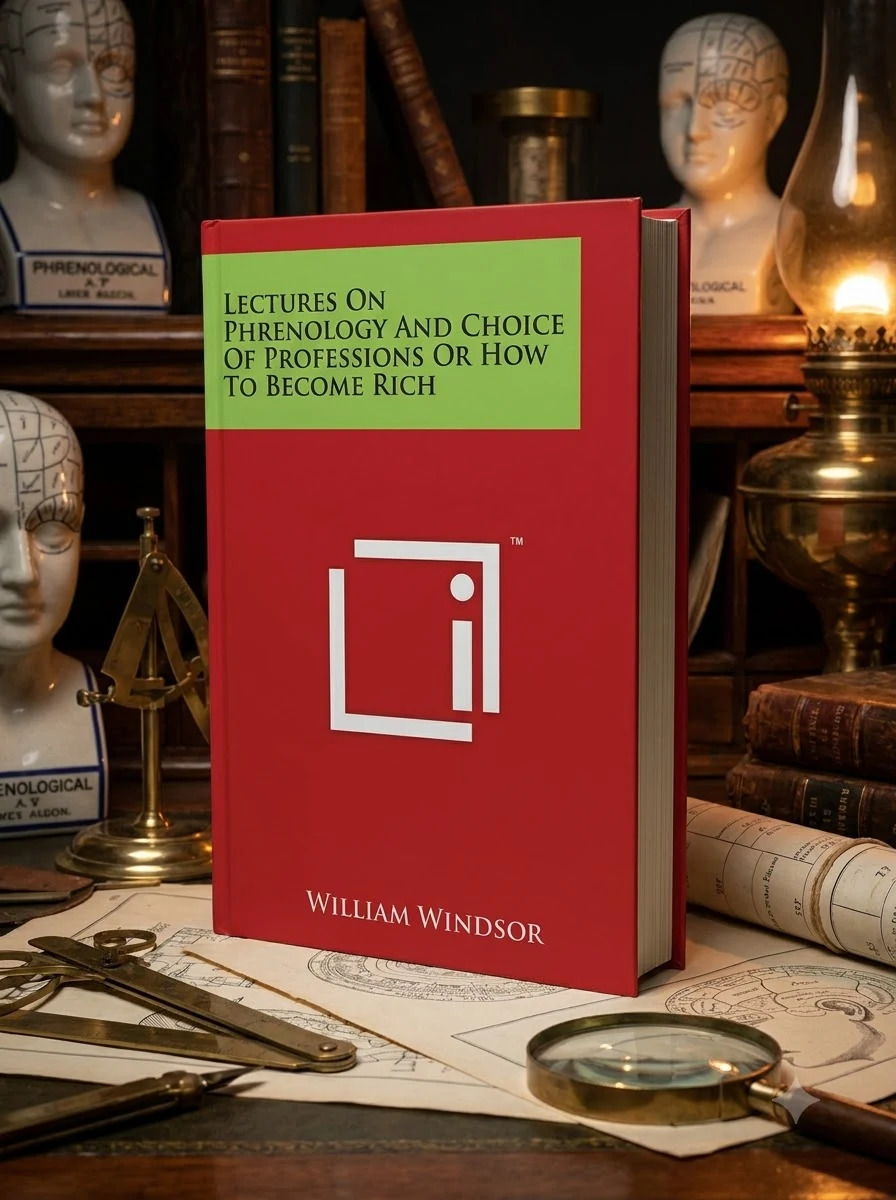


Lectures on Phrenology and Choice of Professions or How to Become Rich
A 1889 series of lectures detailing phrenological character analysis for professional success.
This Paperback edition, reissued by Literary Licensing, LLC on March 30, 2014, captures late nineteenth-century ideas surrounding physical analysis and wealth creation. William Windsor outlines how evaluating head shape and character traits helps individuals find suitable professions. Measuring 22.91 centimeters long by 15.19 centimeters wide, this 158-page paperback reprint serves collectors interested in historical speeches and early self-help literature centered on Mind, Body, Spirit concepts.
First released in 1889, this material originates from late nineteenth-century American interest in phrenology, public lectures, and self-improvement techniques.


📝 Description: Lectures on Phrenology and Choice of Professions or How to Become Rich
💎 Expert review
📖 Why choose it
Why this book is worth reading
Readers fascinated by the historical intersection of pseudoscience and self-help will find this book a delightful artifact. It offers a unique window into how past generations attempted to decode human potential through physical observation. Those interested in the evolution of career counseling or the cultural history of fortune-telling will appreciate its candid approach to linking skull contours with professional success. It serves as both an educational resource on obsolete scientific theories and an entertaining look at the timeless desire for material prosperity and self-discovery through unconventional means.
⭐ Reader reviews
Reader rating
This text is a fascinating historical curiosity rather than a practical guide, appealing primarily to collectors of occult ephemera or historians of science. Readers seeking rigorous academic analysis or modern psychological insights will likely find its assertions outdated and lacking in empirical validity. The book’s value lies entirely in its representation of 19th-century beliefs, making it suitable for those who enjoy the aesthetic and philosophical context of phrenology. However, it may disappoint anyone expecting actionable advice grounded in contemporary understanding, as its core premise is firmly rooted in discredited theories of cranial bumps.
❓ Frequently asked questions
📖 Who should read this
Are you fascinated by historical occult practices, the evolution of self-help, or the intriguing intersection of science and esotericism? If you seek to understand past beliefs about human potential and prosperity, this unique historical artifact awaits your discovery.
🎯 Key themes and symbolism
Phrenological Self-Discovery
This work meticulously details phrenology's principles, presenting it as a method for understanding individual aptitudes. Readers explore supposed connections between cranial formations and personality traits, offering a historical lens on self-assessment and the pursuit of potential as understood in the late 19th century.
Career & Wealth Attraction
Beyond character analysis, Windsor posits phrenology as a practical tool for material success. The lectures guide readers on leveraging cranially-revealed strengths to choose prosperous professions. This highlights a historical approach to vocational guidance, suggesting that aligning one's 'brain-bumps' with suitable work could lead directly to wealth.
19th-Century Esotericism
This volume offers a compelling glimpse into the pseudo-sciences and self-improvement movements prevalent in the late 1800s. It showcases how phrenology, despite its later debunking, was embraced as a legitimate scientific and spiritual discipline. The book reflects a broader cultural fascination with understanding human nature through novel, often unconventional, means during a period of rapid intellectual change.
📜 Historical context
📚 Glossary
- Phrenology
- Pseudoscience
- Cranioscopy
📔 Questions to reflect on
- How do historical pseudo-sciences like phrenology reflect the enduring human desire for self-understanding and predictability?
- In what ways do modern self-help or personality assessment tools echo the aspirations, if not the methods, of 19th-century phrenology?
- If your career path or financial success were determined by a physical attribute, what might that imply about free will and societal expectations?