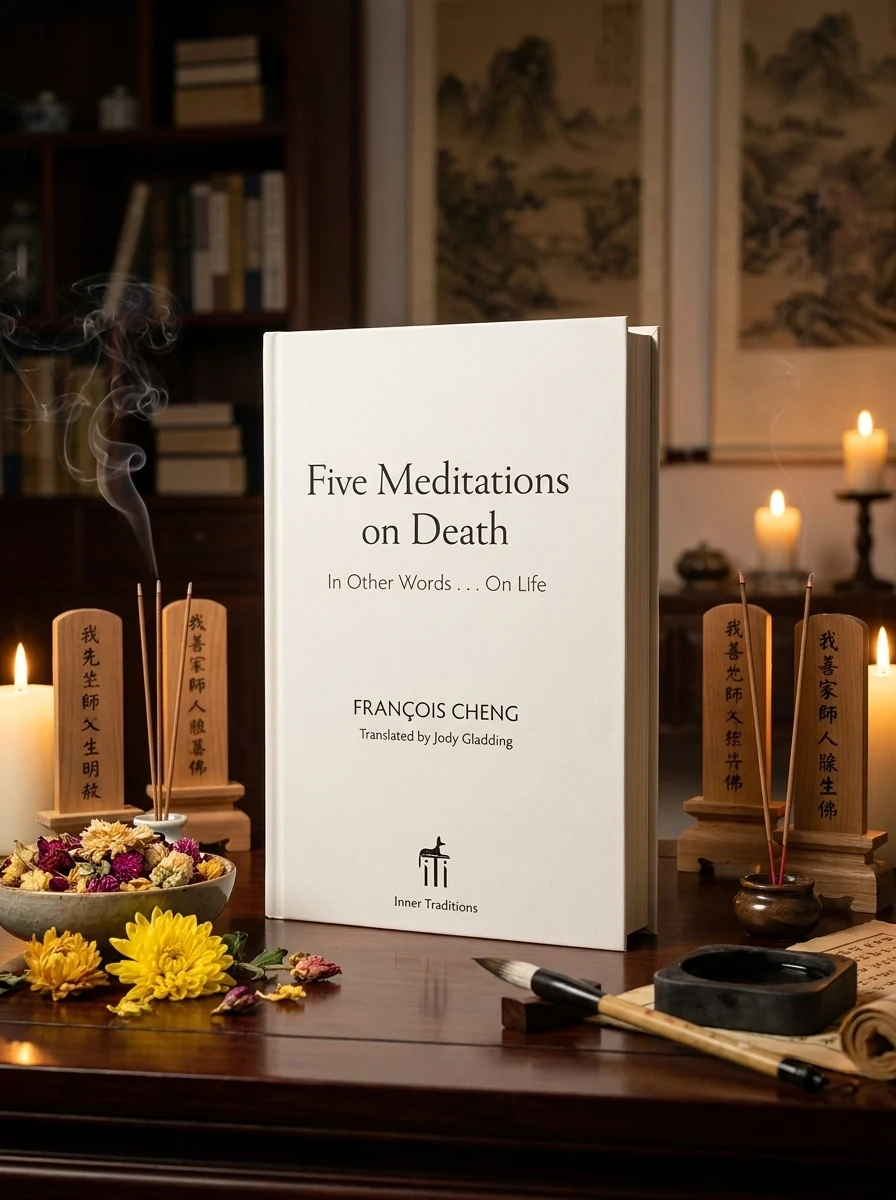
Five Meditations on Death: In Other Words . . . on Life


This edition can be ordered. No arrival date is confirmed.
Death is not an end, but the very crucible in which life finds its most sacred meaning.
From the insightful mind of poet-philosopher François Cheng, these five profound meditations, born from intimate conversations, explore how the awareness of mortality profoundly shapes and enriches our existence. Penned in his 84th year, Cheng offers a unique perspective, bridging his native Chinese traditions of ancestor reverence with a broader philosophical inquiry. He posits that death is not a stark, final cessation but a vital transition within a continuous, living process, challenging conventional Western binaries and inviting a deeper contemplation of life's inherent sacredness.
This work sits at the intersection of contemporary Western esotericism and traditional Chinese philosophical thought, specifically drawing on ancestor reverence and non-dualistic metaphysics. It represents a modern bridge between Eastern contemplative traditions and Western inquiries into mortality and sacredness.


📝 Description: Five Meditations on Death: In Other Words . . . on Life
💎 Expert review
📖 Why choose it
Why this book is worth reading
This book is for those who feel that conventional Western views of death are too stark or final, seeking a more holistic understanding of existence. It is ideal for readers drawn to mysticism and esoteric philosophy who wish to explore how mortality shapes life’s sacred meaning. Cheng’s unique perspective, rooted in Chinese tradition yet accessible to a global audience, offers comfort and intellectual depth. Readers who appreciate poetic philosophy and the idea that death is a vital transition rather than an end will find profound resonance here. It invites a deeper contemplation of life’s inherent value through the lens of continuous process.
⭐ Reader reviews
Reader rating
François Cheng’s meditation on mortality is a beautiful but dense philosophical exercise. While his synthesis of Chinese ancestor reverence with broader metaphysical inquiry is elegant, it demands patience from the reader. The text is not for those seeking quick self-help fixes or linear logical arguments; it requires immersion in abstract concepts. Readers who prefer empirical science or rigid theological dogma may find its fluid approach to life and death unsatisfying. However, for those willing to engage with its poetic density, it offers a transformative view of existence that challenges binary thinking. It is a niche gem rather than a mass-market appeal.
❓ Frequently asked questions
📖 Who should read this
If you seek a profound, contemplative journey into the nature of existence, and are open to Eastern philosophical insights woven with poetic sensibility, this book is for you. It offers solace and deep reflection without offering simple answers.
🎯 Key themes and symbolism
Mortality's Sacred Purpose
Cheng argues compellingly that confronting our finite nature is not morbid but essential for true living. He explores how the prospect of death imbues our experiences, relationships, and decisions with profound significance, transforming the mundane into the sacred and giving life its ultimate, meaningful dimensions.
Ancestral Bonds & Legacy
Drawing upon his Chinese heritage, Cheng illuminates the enduring power of ancestor worship. He reveals how this ancient practice fosters a deep connection to those who came before us, illustrating how the lives of the departed continue to resonate within the living, shaping cultural identity and personal purpose across generations.
Death as Continuum
This work challenges the stark 'black and white' view of life and death prevalent in modern thought. Cheng presents death not as an abrupt termination but as a fluid, integral phase within a larger, ongoing process of existence, inviting readers to perceive a more interconnected and dynamic reality beyond conventional boundaries.
💬 Quotes from the book
“It is in facing the ultimate horizon of our being that life's true colors, its fragile beauty and profound depth, are finally revealed.”
“The boundary we perceive between here and gone is but a veil, thinly drawn over a continuous stream of existence that encompasses both past and future.”
📜 Historical context
📚 Glossary
- Ancestor Worship
- Humanism
- Existential Contemplation
📔 Questions to reflect on
- How does the awareness of your own mortality reshape your daily choices and long-term aspirations?
- In what ways do you feel connected to those who came before you, and how do their legacies influence your present?
- If death is a transition rather than an end, what implications does this hold for your understanding of time and existence?
🏛 Books from this publisher Inner Traditions International
All books from this publisher →

You might also like
See more →