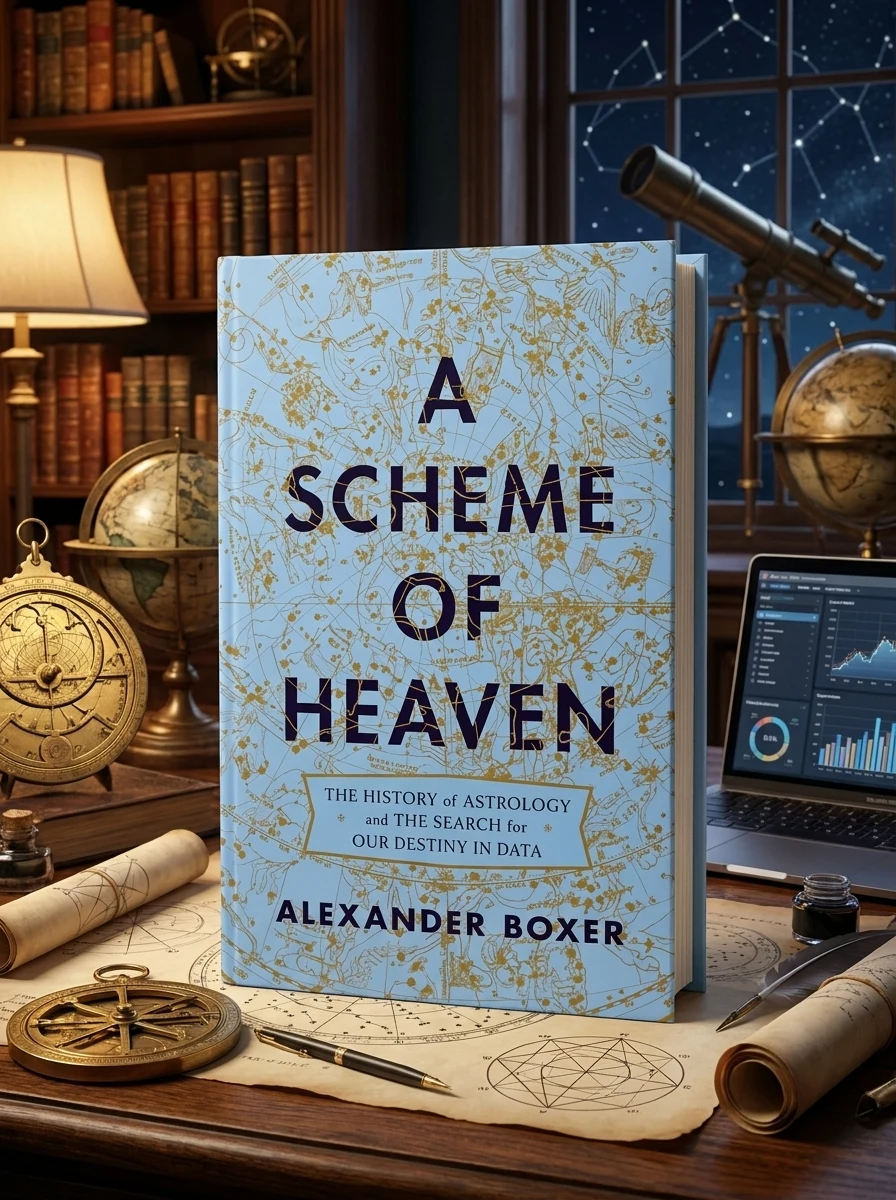


A Scheme of Heaven: The History of Astrology and the Search for Our Destiny in Data
This edition can be ordered. No arrival date is confirmed.
Unravel the cosmic algorithms that shaped destiny, from ancient skies to modern minds.
This refreshing work redefines astrology not as mere superstition, but as a sophisticated historical endeavor in data science. Data scientist Alexander Boxer meticulously explores the mathematical and astronomical frameworks that allowed ancient scholars to decode celestial patterns and their earthly correlations. From Ptolemy to Kepler, the book highlights how brilliant minds engaged with these complex systems, viewing horoscopes as intricate early forms of data visualization. It's a compelling journey through humanity's initial quest to find meaning within the vast datasets of the cosmos.
This work bridges the historical tradition of astrology with modern data science, reframing ancient celestial mapping as an early form of complex data visualization and analytical inquiry.


📝 Description: A Scheme of Heaven: The History of Astrology and the Search for Our Destiny in Data
💎 Expert review
📖 Why choose it
Why this book is worth reading
Readers fascinated by the intersection of history, mathematics, and human psychology will find this book profoundly rewarding. It appeals to those who view astrology not through a lens of superstition, but as a sophisticated historical endeavor rooted in data analysis. If you are intrigued by how ancient scholars decoded celestial patterns to understand earthly correlations, this text offers a fresh perspective on their intellectual legacy. It is ideal for data scientists and historians alike who wish to explore humanity's initial quest to find meaning within vast cosmic datasets. By tracing the journey from Ptolemy to Kepler, it validates the rigorous mental frameworks used in early horoscope creation, making it essential for anyone seeking to understand the analytical roots of our destiny-seeking behaviors.
⭐ Reader reviews
Reader rating
Alexander Boxer offers a refreshing redefinition of astrology as a historical data science rather than mere superstition. The book meticulously explores the mathematical and astronomical frameworks employed by ancient scholars, highlighting how brilliant minds viewed horoscopes as intricate early data visualizations. However, this rigorous academic approach may not suit readers seeking spiritual guidance or traditional astrological interpretations. Those expecting practical advice on natal charts will find little value here. Instead, it is a compelling intellectual journey for those interested in the evolution of thought and the human desire to decode cosmic patterns. It is best suited for audiences with an appreciation for historical analysis and the history of science.
❓ Frequently asked questions
📖 Who should read this
For those curious about the intellectual history of science, the mathematical foundations of ancient thought, or the surprising connections between celestial mechanics and human inquiry. If you've ever wondered about the serious intellectual work behind astrology, this illuminating study is for you.
🎯 Key themes and symbolism
Ancient Data Analysis
This work recontextualizes astrology as humanity's foundational attempt at large-scale data interpretation. It illustrates how early astrologers, through meticulous observation and calculation, developed complex systems to correlate celestial mechanics with terrestrial events, effectively creating the first predictive models from cosmic data.
A Scientific History
The book traces astrology's evolution through the eyes of history's great thinkers, from classical antiquity to the early modern period. It showcases how figures like Ptolemy and Kepler, now revered as scientists, dedicated significant intellectual effort to understanding and refining astrological principles, positioning it as a cutting-edge field of its time.
Decoding Celestial Charts
Boxer demystifies the structure and calculation behind horoscopes, the "schemes of heaven." Readers gain insight into the intricate astronomical computations required to map planetary positions at specific moments, revealing the sophisticated mathematical framework that underpins these ancient and often misunderstood predictive tools.
💬 Quotes from the book
“Before the age of big data, there was the cosmos, and ancient astrologers were its first, most ambitious data analysts.”
“To read a horoscope is not merely to interpret symbols, but to reconstruct an intricate astronomical snapshot, a testament to ancient mathematical prowess.”
📜 Historical context
📚 Glossary
- Horoscope
- Ptolemy
- Al-Kindi
📔 Questions to reflect on
- How does understanding astrology as an ancient data science alter your perception of its historical significance?
- What parallels can you draw between the "pattern-matching" efforts of ancient astrologers and modern predictive analytics?
- In what ways might the historical pursuit of celestial understanding have shaped broader scientific methodologies, even those we consider strictly empirical today?
🏛 Books from this publisher W. W. Norton & Company
All books from this publisher →
 87
87




You might also like
See more →