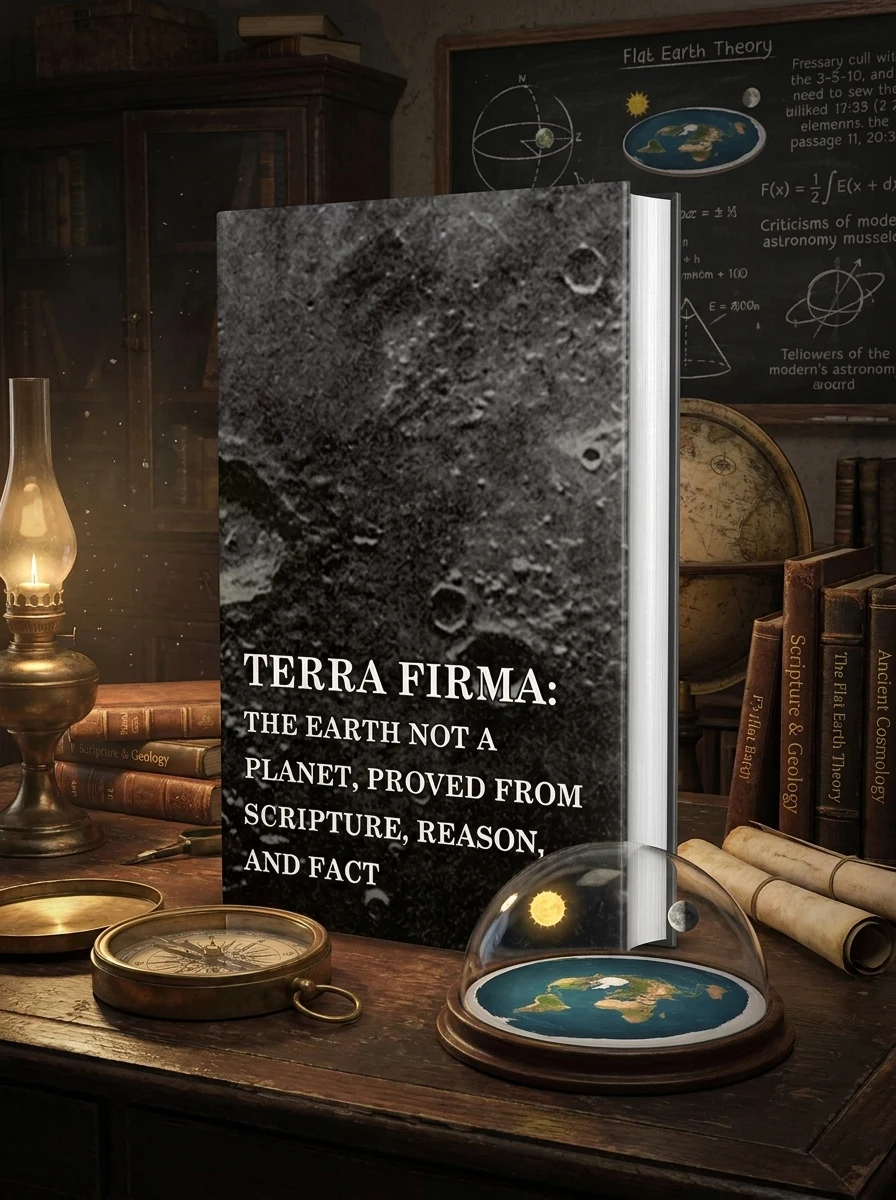
Terra Firma: the Earth Not a Planet, Proved from Scripture, Reason, and Fact


Stock reported in the catalog; fulfillment is confirmed with your request.
Challenge accepted science with Scott's unwavering defense of a flat, unmoving Earth.
David Wardlaw Scott's 1901 treatise, "Terra Firma," meticulously builds a case against the prevailing spherical Earth model. Drawing heavily on scriptural interpretations, rational arguments, and selective observations, Scott posits a stationary, level world, challenging the tenets of modern astronomy. This seminal text offers a fascinating glimpse into early 20th-century alternative cosmologies, establishing itself as a foundational work for Flat Earth theory enthusiasts and historical curiosities alike, showcasing a unique blend of faith and skepticism.
This work emerges from the early twentieth century as a pivotal text in the history of geocentric and flat Earth cosmologies, representing a period where scriptural literalism often clashed with emerging astronomical consensus. It stands as a foundational artifact for understanding the intersection of faith-based skepticism and alternative scientific theories during that era.


📝 Description: Terra Firma: the Earth Not a Planet, Proved from Scripture, Reason, and Fact
💎 Expert review
📖 Why choose it
Why this book is worth reading
Readers with a deep interest in the history of scientific dissent or the evolution of esoteric cosmological models will find this treatise invaluable. It serves as a primary source for understanding how early twentieth-century thinkers utilized scripture and selective observation to construct arguments against mainstream astronomy. Those studying the cultural resistance to heliocentrism or the development of flat Earth theory will appreciate Scott's meticulous, albeit controversial, methodology. It offers a unique window into a worldview where faith and perceived fact were seamlessly intertwined to challenge established scientific norms.
⭐ Reader reviews
Reader rating
While historically significant for its detailed construction of an alternative cosmology, this book is not suitable for readers seeking modern astronomical accuracy or those with a strong background in contemporary physics. It will likely frustrate anyone expecting rigorous scientific validation rather than scriptural interpretation. However, historians of science and enthusiasts of esoteric history will find it a fascinating, if flawed, artifact. The text is earnest in its defense of a stationary Earth but requires a specific interest in historical fringe theories to remain engaging.
❓ Frequently asked questions
📖 Who should read this
For those fascinated by historical curiosities, alternative cosmologies, or the interplay between faith and scientific inquiry, this volume offers a provocative and unique perspective. Delve into a foundational text that challenges conventional wisdom with earnest conviction.
🎯 Key themes and symbolism
Biblical Cosmology Reimagined
Scott rigorously interprets scripture, particularly accounts like the Adamic Creation and the Deluge, to assert a literal, flat Earth. He argues these sacred texts provide irrefutable evidence against any planetary model, forming the bedrock of his cosmological understanding and demonstrating how faith can inform a worldview.
Critique of Modern Astronomy
The author critically examines and dismantles theories prevalent in "modern astronomy" of his era, such as the Nebular Hypothesis. He challenges the supposed proofs offered for Earth's globularity, presenting counter-arguments rooted in his unique perspective and inviting readers to question scientific dogma.
Empirical Observation First
Scott emphasizes direct sensory experience and common-sense observations, like the apparent horizontality of land and water, as superior to complex astronomical calculations. He synthesizes traveler testimonies and physical proofs to reinforce his vision of a non-globular world, prioritizing lived experience over theoretical models.
💬 Quotes from the book
“The sacred texts speak clearly of an Earth fixed and level, not a spinning orb among the stars.”
“To assert globularity requires a suspension of both reason and observable fact, yielding to speculative astronomical dogma.”
📜 Historical context
📚 Glossary
- Nebular Hypothesis
- Globularity
- Adamic Creation
📔 Questions to reflect on
- How do you personally reconcile scientific consensus with deeply held spiritual or philosophical beliefs?
- What role do you think direct observation should play in shaping our understanding of the universe, compared to theoretical models?
- Consider how a book like "Terra Firma" might have been received in its original time, versus how it is perceived today. What does this tell us about changing intellectual landscapes?
You might also like
See more →