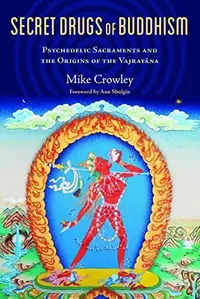
Secret Drugs of Buddhism: Psychedelic Sacraments and the Origins of the Vajrayana
This edition can be ordered. No arrival date is confirmed.
Uncover the hidden psychoactive roots of Vajrayana Buddhism, challenging conventional spiritual narratives.
Michael Crowley's seminal work meticulously investigates the compelling, often concealed, history of entheogenic substances within Buddhist traditions. This groundbreaking study synthesizes scriptural insights, botanical knowledge, pharmacological data, and religious iconography to reveal the profound impact of psychoactive plants on Indian spirituality. From the enigmatic Soma of ancient Hindu texts to the sacramental Amrita of early Vajrayana Buddhism, Crowley posits that potent entheogens were central to these practices. The book delves deep into identifying the specific components of Amrita's original formulations, drawing evidence from across Asia to illuminate a fascinating, forgotten chapter in spiritual history.
This work situates itself within the study of esoteric history and comparative religion, specifically examining the intersection of pharmacology and Vajrayana Buddhist traditions.


📝 Description: Secret Drugs of Buddhism: Psychedelic Sacraments and the Origins of the Vajrayana
💎 Expert review
📖 Why choose it
Why this book is worth reading
Readers with a deep interest in the hidden histories of spiritual practices will find this text indispensable. It appeals to those seeking to understand the biological and botanical foundations of ancient rituals, offering a fresh perspective on how sacred states were achieved through specific plant sacraments. Scholars of comparative religion, historians of ideas, and practitioners interested in the material origins of enlightenment experiences will gain profound insights here. By synthesizing diverse fields like botany and pharmacology with religious iconography, the book provides a comprehensive view of how psychoactive substances shaped Indian spirituality. It is essential for anyone questioning conventional narratives about the development of major spiritual traditions and their reliance on entheogenic tools.
⭐ Reader reviews
Reader rating
Crowley’s study is a meticulous synthesis of scriptural analysis and botanical science, offering a compelling argument for the central role of entheogens in Vajrayana Buddhism. However, readers expecting a devotional guide or a simple historical chronicle may find the dense integration of pharmacological data and iconographic interpretation difficult to navigate. This book does not suit those who prefer established orthodox religious histories without controversial botanical claims. It is best suited for academic researchers and open-minded investigators willing to engage with complex interdisciplinary evidence. The candid approach challenges long-held assumptions, making it a provocative but rigorous addition to the field of esoteric studies.
❓ Frequently asked questions
📖 Who should read this
If you're a seeker of hidden spiritual truths, a student of religious esotericism, or simply fascinated by the intersection of botany and altered states of consciousness, this book offers a profound re-evaluation of Buddhist origins. Prepare to have your understanding of sacred traditions expanded.
🎯 Key themes and symbolism
Entheogenic History of Buddhism
This book provocatively re-examines Buddhist history, suggesting that psychoactive plants, or entheogens, were not merely peripheral but fundamental to the development of Vajrayana practices. It uncovers a hidden lineage where altered states of consciousness, induced by specific botanical compounds, may have profoundly shaped spiritual revelation and ritual.
Identifying Ancient Sacraments
A significant portion of the text is dedicated to a scholarly quest to pinpoint the exact botanical ingredients of ancient "Amrita." Crowley meticulously sifts through diverse evidence—from historical texts and iconography to botanical science—to reconstruct the likely composition of these potent, mind-altering elixirs used by early practitioners.
Challenging Religious Narratives
By presenting substantial evidence for psychedelic use in early Buddhist rites, the book directly confronts contemporary understandings of Vajrayana. It compels readers to reconsider the origins and evolution of revered spiritual practices, questioning whether modern non-psychoactive rituals diverge significantly from their ancient, entheogen-infused predecessors.
💬 Quotes from the book
“The persistent echoes of a potent, mind-altering sacrament reverberate through the earliest Vajrayana scriptures, demanding a re-evaluation of their literal and symbolic interpretations.”
“By cross-referencing ancient botanical records with pharmacological data and iconographic depictions, a compelling composite emerges, suggesting specific fungal and plant compounds as the true 'elixir' of enlightenment.”
📜 Historical context
📚 Glossary
- Entheogen
- Vajrayana
- Amrita
📔 Questions to reflect on
- How might understanding the potential entheogenic origins of some spiritual traditions alter your perception of their current practices and teachings?
- Consider the implications of a hidden, psychoactive element in religious history. What does this suggest about the nature of spiritual experience itself?
- If ancient spiritual leaders utilized specific plants for revelation, how does this challenge or confirm your own beliefs about the path to enlightenment or deeper understanding?
🏛 Books from this publisher Synergetic Press
All books from this publisher →
You might also like
See more →



 91
91